
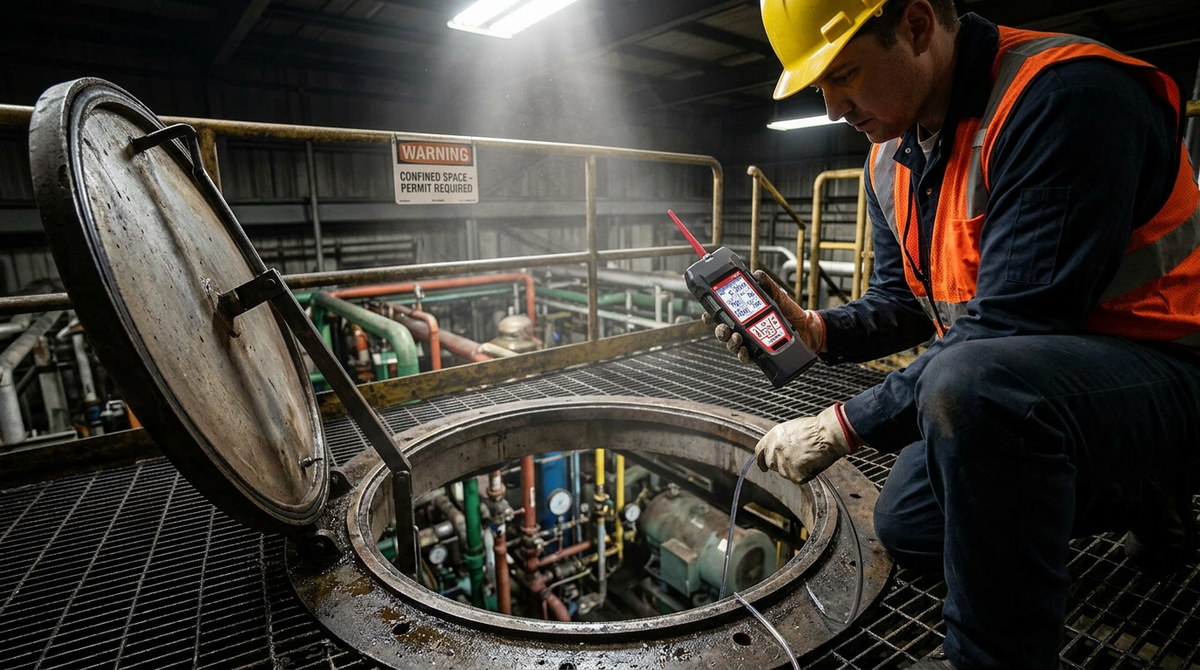
Canadian workers die every year in confined spaces — not from collapses or falls, but from atmospheric hazards they couldn't see or smell. Oxygen-deficient air, hydrogen sulfide, carbon monoxide, and flammable vapours kill within seconds of exposure. A confined space gas monitor is not optional equipment in Canada. Federal and provincial regulations require atmospheric testing before any worker enters, and continuous monitoring for the duration of work. This guide covers the legal requirements, the four gases you must monitor, what equipment meets the standard, and how to build a compliant pre-entry protocol.
What Regulations Apply to Confined Space Gas Monitoring in Canada?
Confined space entry in Canada is governed by a layered regulatory framework. The national baseline is CSA Z1006-16 — the Canadian Standard for confined space entry. All federal workplaces and most provincially regulated workplaces reference or adopt this standard. On top of that, every province with significant industrial activity has its own confined space regulation with atmospheric monitoring requirements.
The key regulatory instruments are:
- CSA Z1006-16 — Management of work in confined spaces. Defines confined space, hazard assessment, atmospheric testing requirements, and equipment specifications. The national baseline that provincial regulators adopt or reference.
- Federal: Canada Occupational Health and Safety Regulations, Part XI — applies to federally regulated workplaces (transportation, banking, telecommunications, crown corporations).
- Ontario: O. Reg. 632/05 — Confined Spaces. Requires a written program, trained entry supervisor, atmospheric testing before and during entry, and rescue planning.
- British Columbia: BC OHS Regulation, Part 9 — requires testing for flammable gas, oxygen content, and toxic substances before entry.
- Alberta: OHS Code, Part 5 — requires pre-entry hazard assessment and atmospheric testing; requires continuous monitoring when conditions may change.
- Quebec: LSST + applicable safety codes — requires hazard identification and atmospheric testing as part of the confined space entry procedure.
If your operation spans multiple provinces or falls under federal jurisdiction, verify which regulatory layer applies. In all cases, the minimum is a documented pre-entry atmospheric test and a confined space gas monitor. "I checked it before we started" is not sufficient if you cannot produce the written record.
Which Gases Must Be Monitored in a Confined Space?
CSA Z1006 identifies four primary atmospheric hazards that must be evaluated in any confined space assessment. Most Canadian regulators follow the same list. A four-gas confined space monitor — measuring O₂, LEL, H2S, and CO simultaneously — covers the baseline requirement for the majority of industrial confined spaces in Canada.
| Gas / Parameter | Safe Range / Action Level | Why It Matters |
|---|---|---|
| Oxygen (O₂) | 19.5% – 23.0% (deficiency below, enrichment above) | Below 19.5%: impairs judgment within minutes, unconsciousness at ~16%, death below 6%. Above 23%: fire/explosion risk increases dramatically. |
| Flammable gas / LEL | <10% LEL before entry; continuous alarm at 25% LEL during work | Methane, propane, solvent vapours, hydrogen. Below 10% LEL = safe to enter. 10–25% = borderline. Above 25% = evacuate immediately. |
| Hydrogen sulfide (H2S) | STEL 15 ppm; TWA 1 ppm (ACGIH/NIOSH) | Sewers, wastewater, pulp processing. Odour threshold is deceptive — nasal fatigue sets in quickly. 100 ppm = rapid unconsciousness. 1,000 ppm = lethal within minutes. |
| Carbon monoxide (CO) | TWA 25–35 ppm; STEL 200 ppm | Any combustion nearby (generators, propane forklifts, torches). Colourless, odourless, accumulates rapidly. Builds to dangerous levels before most workers notice. |
Some confined spaces require additional gas monitoring depending on the specific hazard. Spaces in petroleum facilities may require monitoring for benzene (STEL 0.5 ppm). Spaces in wastewater treatment may require ammonia (STEL 35 ppm). Spaces where fumigants are used may require phosphine. Always complete the site-specific hazard assessment before defaulting to a four-gas reading.
If the confined space involves welding or cutting, CO and O₂ enrichment monitoring are especially critical — oxygen levels can shift rapidly with ongoing work even if the pre-entry reading was clean.
Pre-Entry Gas Monitoring Protocol: Step by Step
A passing gas reading before entry does not clear a confined space permanently. Atmospheric conditions can change as work progresses — disturbed sediment releases H2S, a generator placed near the entry point produces CO, a gas line fitting leaks LEL-active vapour. The pre-entry protocol below reflects CSA Z1006 and standard Canadian practice.
Step 1 — Identify all atmospheric hazards for this space. Review the confined space register and hazard assessment. What processes occurred inside this space? What's above, below, and adjacent? What can enter through drains, vents, or adjacent piping? This step determines which gases you need to monitor and what additional PPE applies.
Step 2 — Bump-test the instrument before entry operations begin. Apply a certified calibration gas mixture to confirm all sensors respond correctly. A bump test must be done each day the instrument is used, or before each entry sequence per the manufacturer. Do not skip this. A monitor that passes bump test but drifts during entry is a liability; one that has never been bump-tested is unknown.
Step 3 — Monitor from outside the confined space first. Use an extension hose or probe to test the atmosphere before any person enters. Lower the probe through the entry point and allow it to stabilize (minimum 60 seconds per metre of depth, or as required by the instrument manufacturer). Test top, middle, and bottom of the space — gases stratify. H2S is heavier than air and pools at the bottom. Methane is lighter and accumulates at the top.
Step 4 — Document the reading. Record the date, time, gas readings, instrument serial number, name of tester, and whether entry was authorized. This record is your regulatory compliance evidence. A verbal attestation is not sufficient in any Canadian jurisdiction.
Step 5 — Authorize entry only when all readings pass. All four parameters must be within acceptable ranges before the first worker enters. If any reading exceeds the action level, ventilate the space and retest. Do not enter to ventilate from inside.
Step 6 — Maintain continuous monitoring during entry. Workers inside must carry a personal multi-gas detector set to alarm before action levels are reached. The entry attendant outside also monitors atmospheric conditions. If the alarm sounds, workers exit immediately. Investigate before re-entering.
Equipment Requirements for a Confined Space Gas Monitor
Not every portable gas detector qualifies for confined space monitoring under Canadian regulations. The instrument must be appropriate for the hazards identified, calibrated, and maintained per the manufacturer's schedule. The following requirements apply across most Canadian jurisdictions and CSA Z1006.
Four-gas simultaneous measurement. A single-gas or two-gas detector does not cover the regulatory baseline for most confined spaces. The standard for industrial confined space entry in Canada is a device that simultaneously reads O₂, LEL (catalytic bead or infrared), H2S, and CO. Devices that require sequential readings introduce delay and user error.
Audible, visual, and vibrating alarms. In loud environments — pumping stations, tank farms, equipment-heavy spaces — audible alarms alone are inadequate. A compliant instrument provides multi-mode alerting so workers with hearing protection detect the alarm.
Intrinsically safe certification. In spaces where LEL-active atmospheres are possible, the monitor must be certified for use in hazardous locations (ATEX, CSA Class I/II rating). A standard instrument is not approved for use in a potentially explosive atmosphere.
Calibration compliance. Sensors must be calibrated at intervals specified by the manufacturer — typically every 6 months for CO and O₂ sensors, more frequently for H2S sensors in heavy-use applications. Calibration requires a certified calibration gas mixture specific to each sensor. Bump testing is not a substitute for calibration.
Datalogging capability. Modern four-gas detectors log readings continuously with timestamps. In a regulatory inspection or incident investigation, this log is primary evidence. Instruments without datalogging create documentation gaps.
ERE Inc. rents and sells four-gas detectors suited to Canadian industrial confined space work, including the GX-6100 portable multi-gas detector — with O₂, LEL, H2S, and CO sensors, datalogging, and intrinsic safety rating. Browse the full line at portable gas detectors.
For help choosing the right instrument for your specific confined space type, see our portable gas detectors buyer's guide for Canada.
Continuous Monitoring During Confined Space Work
Pre-entry testing establishes baseline conditions. Continuous monitoring is what keeps workers safe once they're inside. These are not the same requirement — both are mandatory.
Continuous monitoring serves three functions: it detects atmospheric changes that develop during work (disturbed sludge releasing H2S, a fuel-powered tool consuming O₂), it provides early warning before concentrations reach immediately dangerous levels, and it creates a timestamped record showing atmospheric conditions throughout the entry period.
Each worker who enters a permit-required confined space should carry a personal four-gas detector on their body — not hanging at the entry point. Gas concentrations differ at the floor versus the access hatch. A detector at the hatch will not detect pooled H2S at the worker's breathing zone level.
The entry attendant stationed outside must maintain communication with workers inside and monitor atmospheric conditions at the entry point. If the attendant loses contact with workers inside, the emergency rescue plan is activated immediately — the attendant does not enter to investigate.
Some operations use continuous fixed-gas monitoring systems for enclosed plant areas and utility tunnels that see daily entry. These systems provide early warning and can trigger ventilation automatically. They supplement but do not replace portable monitoring during entry — fixed sensors cover specific points, not every location a worker may occupy.
Confined Space Gas Monitor: Rental or Purchase?
If your team enters confined spaces frequently — daily or weekly — purchasing and maintaining your own fleet of four-gas detectors is the lower long-term cost. Calibration, bump testing, and documentation are managed in-house, instrument availability is guaranteed, and you build institutional familiarity with the equipment.
If confined space entry is occasional — a seasonal tank cleanout, an infrequent infrastructure inspection — renting from a supplier with calibrated, maintained instruments is often the better choice. Renting provides instruments that are already calibrated, eliminates sensor degradation from infrequent use, and shifts maintenance responsibility to the supplier.
ERE Inc. rents calibrated four-gas detectors for short-duration confined space work in Canada. See our instrument rental options or read our guide on what to expect from gas detector rentals in Canada.
A third option is a hybrid approach: own a baseline instrument for supervisory pre-entry testing, and rent additional units when more workers are entering simultaneously. This minimizes capital outlay while ensuring every person in the space has a working personal monitor.
Common Confined Spaces in Canada and Their Typical Gas Hazards
Gas hazards vary by confined space type and the processes that have occurred inside. The table below covers the most common confined space categories in Canadian industrial, municipal, and construction settings.
| Confined Space Type | Typical Gas Hazards | Primary Concern |
|---|---|---|
| Sewer manholes / wet wells | H2S, O₂ deficiency, methane | H2S spiking from disturbed sediment; O₂ displacement by biological activity |
| Underground utility vaults | O₂ deficiency, CO (from above-grade traffic), natural gas ingress | O₂ displacement in sealed vaults; CO accumulation from nearby vehicle exhaust |
| Storage tanks (chemical, petroleum) | LEL (hydrocarbon vapours), O₂ enrichment/deficiency, benzene (carcinogen) | Residual product vapour at explosive concentrations; purge gas displacement of O₂ |
| Grain bins / silos | O₂ deficiency, CO (from grain respiration and fungi) | Biological respiration consumes O₂ rapidly; CO from mould activity |
| Boiler rooms / heat exchangers | CO (from combustion), O₂ deficiency, natural gas (LEL) | Incomplete combustion producing CO; natural gas leaks |
| Pipelines and pipe tunnels | LEL, O₂ deficiency, H2S (sour service lines) | Product residue and purge gas; stratification in long horizontal sections |
| Mine workings and tunnels | O₂ deficiency, CO, diesel exhaust, methane | Multiple simultaneous hazards; diesel CO from vehicles underground |
| Wastewater treatment structures | H2S, O₂ deficiency, CO, methane | High biological activity; H2S spike risk during agitation |
This table is not a substitute for a site-specific hazard assessment. Every confined space entry requires a documented evaluation of the specific space, its history, adjacent processes, and current conditions before selecting the monitoring protocol.
Can ERE Inc. Help With Confined Space Gas Monitoring Equipment?
ERE Inc. has supplied environmental and safety monitoring equipment to Canadian industrial, municipal, and environmental consulting clients since 1994. Our instrument team can help you select, rent, or purchase four-gas detectors suited to your confined space types — and confirm that the instrument you're considering meets the requirements of the applicable provincial regulation.
- Equipment supply: Browse portable gas detectors — including four-gas instruments for confined space entry, single-gas monitors, and pumped-inlet models for remote sampling before entry
- Instrument rentals: Short-term calibrated instrument rental for occasional confined space work — contact ERE for current rental availability in your region
- Technical guidance: ERE's team can review your confined space types and recommend the right sensor configuration — H2S range, LEL sensor type (catalytic vs IR), datalogging options
- Calibration guidance: ERE can advise on calibration gas specification for your instrument and region
Need confined space gas monitoring equipment for your team?
ERE Inc. — Canada's environmental and safety equipment specialist since 1994.
→ Request a Quote | 1-888-287-EREC | Browse Gas Detectors | sales@ereinc.com
Frequently Asked Questions
What four gases are required for confined space monitoring in Canada?
Canadian confined space regulations and CSA Z1006 require testing for four primary atmospheric hazards: oxygen (O₂, acceptable range 19.5%–23.0%), flammable gas expressed as percentage of the lower explosive limit (LEL), hydrogen sulfide (H2S), and carbon monoxide (CO). A four-gas detector measuring all simultaneously is the standard instrument for most confined space entries in Canada. Site-specific hazards may require additional sensors — benzene in petroleum spaces, ammonia in wastewater treatment, phosphine in fumigated spaces.
What is CSA Z1006 and does it apply to my workplace?
CSA Z1006-16 is the Canadian national standard for management of work in confined spaces. It defines confined space, prescribes hazard assessment requirements, atmospheric testing protocols, equipment specifications, entry permits, and rescue planning. Most provincial confined space regulations reference or are harmonized with CSA Z1006. If you operate in a provincially regulated workplace in Ontario, BC, Alberta, Quebec, or other provinces, your provincial regulation governs — but CSA Z1006 is typically accepted as the technical standard for compliance. Federally regulated workplaces follow Canada OHS Regulations Part XI.
Does continuous monitoring replace pre-entry testing?
No. Pre-entry testing and continuous monitoring are separate regulatory requirements that serve different purposes. Pre-entry testing establishes baseline conditions before the first worker enters. Continuous monitoring detects changes that develop during work — stirred sediment releasing H2S, a fuel-powered tool consuming O₂, a gas line seep that wasn't present at the start. Both are required under CSA Z1006 and provincial confined space regulations. A space that tested clean on entry can become hazardous within minutes if conditions change.
Can I use a single-gas H2S detector for a confined space entry?
In most cases, no. A single-gas monitor cannot detect oxygen deficiency, flammable gas buildup, or CO accumulation — all of which can be present simultaneously with an H2S hazard. The regulatory baseline in Canada for most confined space entries is a four-gas instrument covering O₂, LEL, H2S, and CO. A single-gas detector might satisfy the monitoring requirement only if a documented site-specific hazard assessment has conclusively determined that H2S is the sole atmospheric hazard — which is rare in industrial confined spaces.
How often must a confined space gas monitor be calibrated?
Calibration intervals are set by the instrument manufacturer and must be followed. Most four-gas detectors require full calibration every 6 months for CO and O₂ sensors. H2S sensors may require more frequent calibration in high-humidity or high-concentration environments. In addition to scheduled calibration, a bump test must be performed before each day of use or before each entry sequence — whichever is more frequent. A bump test confirms sensor response but does not replace calibration. Records of both must be maintained. See our guide on gas detector calibration requirements in Canada for detail.
Related articles
- Portable Gas Detectors: Buyer's Guide for Canada
- Gas Detector Rental in Canada: What to Know
- Gas Detector Calibration Requirements in Canada
- Browse Portable Gas Detectors
Lire en français : Surveillance des gaz en espaces confinés au Canada