
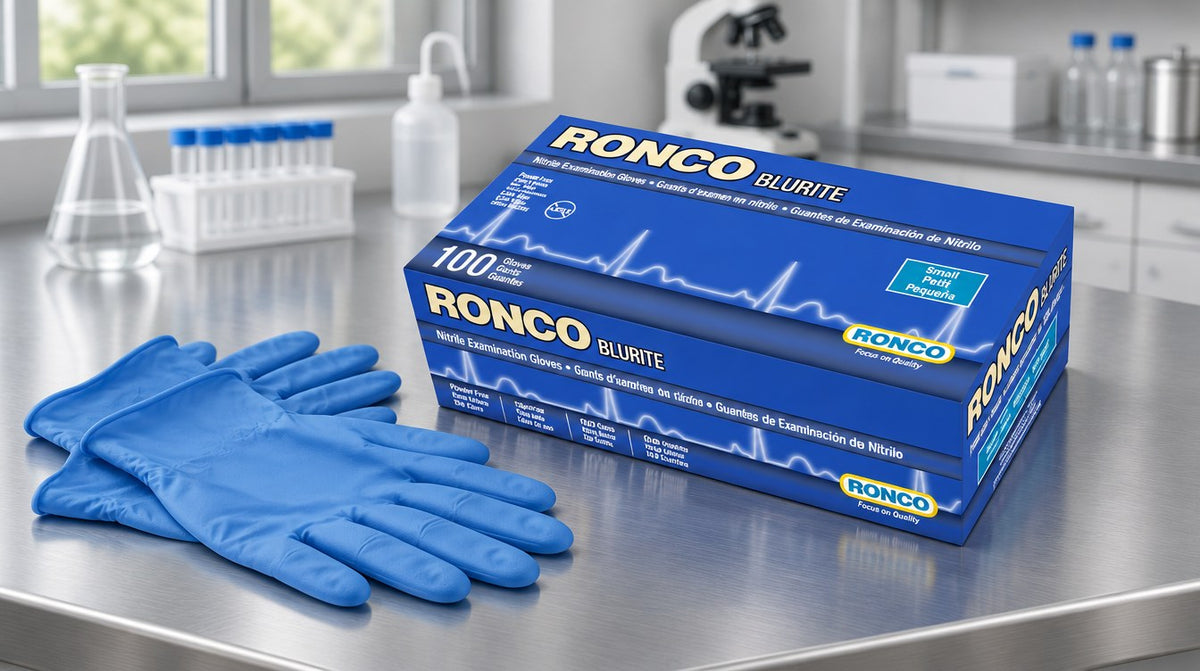
For most Canadian labs, plants and field crews, disposable nitrile is the default: it is latex-free, resists a wider range of chemicals than latex, and tears less than vinyl. Choose latex when touch sensitivity and elasticity matter and no one is allergic. Choose vinyl for short, low-risk tasks. Then match thickness (mil), cuff length and texture to the job.
What is the difference between nitrile, latex and vinyl gloves?
Nitrile is a synthetic rubber, latex is natural rubber and vinyl is PVC. About 8,100 searches a month in Canada are for "nitrile gloves", 4,400 for "latex gloves" and 1,300 for "vinyl gloves". ERE lists all three in its disposable gloves collection, from RONCO.
| Material | ERE examples (RONCO) | Choose it for |
|---|---|---|
| Nitrile | NE (3 mil), NE2 (4 mil), BluRite Plus (4 mil) | Laboratory, automotive, food processing and chemical handling; latex-free |
| Latex | LE2 (4 mil), Silktex | Food processing, dental, laboratory and pharmaceutical work where feel and elasticity matter |
| Vinyl | VE1B (3 mil), VE2 (4 mil) | Short, low-risk tasks: beauty, food service, general use |
| Polyethylene | POLY (0.5 mil) | Frequent glove changes in food service, janitorial and painting |
Are nitrile gloves better than latex?
For most industrial work, yes, because nitrile is latex-free and resists a wider range of chemicals. RONCO describes its NE5 nitrile glove as resistant to a wider range of chemicals than latex. The RONCO LE2 latex glove is a 4 mil powder-free exam glove for extended wear in food processing, dental, laboratory and pharmaceutical settings, with CFIA acceptance and a Medical Device Licence.
The deciding factor is allergy. If any worker or customer has a latex sensitivity, specify nitrile. The BluRite Plus is manufactured without chemical accelerators, which makes it suitable for users with latex or accelerant sensitivities.
How thick should a disposable glove be?
Pick the thinnest glove that survives the task: 3 to 4 mil for sample handling and bench work, 5 to 6 mil for general industrial use, 8 mil for rough, oily or abrasive work. Thickness is quoted in mil (thousandths of an inch); more mil means more puncture resistance and less touch sensitivity.
| Thickness | RONCO example | Typical use |
|---|---|---|
| 3 mil | NE blue nitrile, 100 per box | Bare-hand feel for lab, medical, food service and electronics |
| 4 mil | NE2 blue nitrile, Riva 4 (AQL 0.65) | General laboratory and industrial use |
| 5 mil | BluRite Nitrile | All-purpose; high tensile strength, moderate chemical and solvent resistance |
| 6 to 8 mil | Octopus Grip, diamond-textured, 50 per box | Automotive, janitorial and industrial work needing grip |
When do you need an extended cuff?
Use an extended cuff when liquid can run down the forearm: sampling from drums, decanting, cleaning and decontamination. The BluRite 6 EC is a 6 mil nitrile exam glove with a 12" extended cuff, tested against chemotherapy drugs and fentanyl.
Are disposable gloves enough for chemical work?
No. Disposable gloves protect against incidental splashes; change them as soon as they are contaminated. For solvents, immersion or long contact, check the manufacturer's permeation data and choose a reusable chemical-resistant glove. Our guide to chemical resistant gloves and EN 374 codes explains how, and the cut resistant gloves guide covers mechanical hazards. CCOHS also publishes general guidance on selecting protective gloves.
Which certifications should a Canadian buyer check?
Check for a Health Canada Medical Device Licence on exam-grade gloves, and CFIA acceptance if the gloves touch food. Several RONCO gloves, including the NE, N2, LE2 and BluRite Plus, list a Medical Device Licence on the product page, and the licence can be verified in Health Canada's MDALL database. The specification sheets, user information sheets and licences are on each product page.
How do you choose disposable gloves?
- Define the hazard. Biological, light chemical splash, oil or abrasion.
- Check allergies. Any latex sensitivity means nitrile.
- Pick the material. Nitrile by default; latex for feel; vinyl for short, low-risk tasks.
- Pick the thickness and cuff. 3 to 4 mil for bench work, 6 to 8 mil for industrial, 12" cuff for forearm exposure.
- Check certifications. Medical Device Licence for exam use, CFIA acceptance for food contact.
- Plan volume. Gloves ship per 50 or 100 per box and by the case; ask us for case quantities.
Browse the full range in the disposable gloves collection.
Frequently asked questions
What are nitrile gloves best used for?
General-purpose laboratory, automotive, food-processing and light chemical work where a latex-free, puncture-resistant disposable glove is needed.
Which is better, latex or nitrile?
Nitrile for most industrial work, because it is latex-free and resists more chemicals. Latex gives the best feel but carries an allergy risk.
What does mil mean on gloves?
One mil is one thousandth of an inch. Higher mil means a thicker, more puncture-resistant glove with less touch sensitivity.
Can I buy gloves by the case?
Yes. Request a quote with the glove, size and case quantity and we will confirm stock and lead time.
Need disposable gloves for your site?
ERE Inc. has supplied environmental, laboratory and safety equipment from Montreal for 30+ years. Tell us the material, thickness, sizes and case quantity and we will match the glove.
→ Request a Quote | 1-888-287-EREC | Browse Disposable Gloves | sales@ereinc.com
Lire en français : Gants jetables : nitrile, latex ou vinyle, types, épaisseur et choix au Canada