
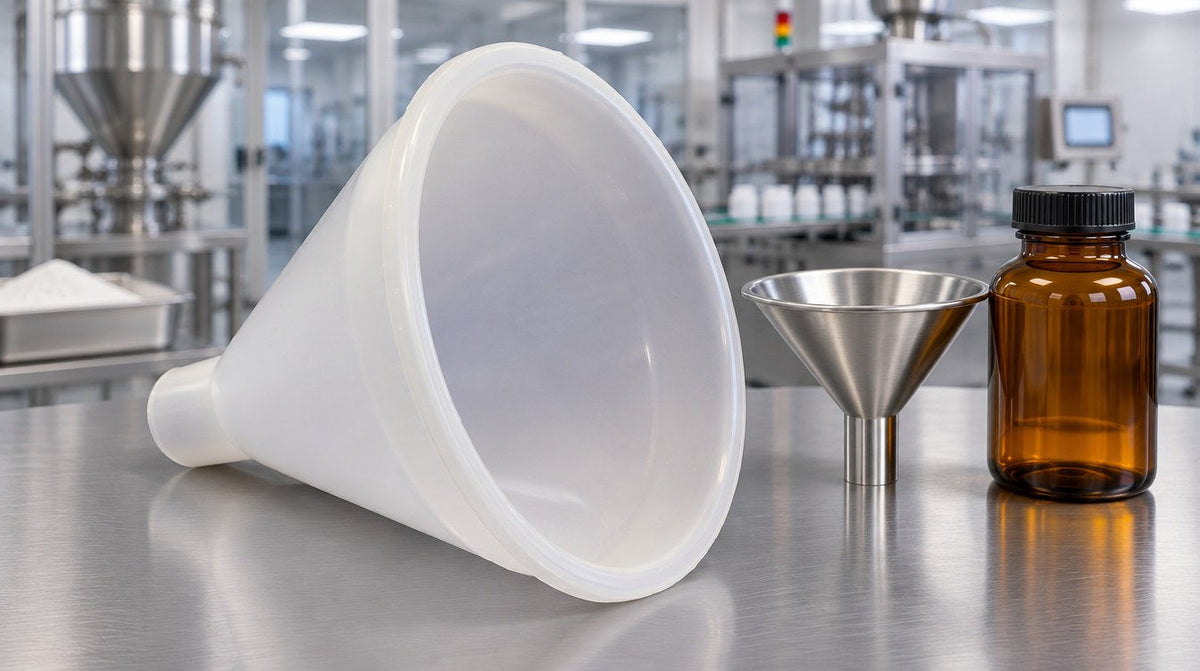
The right funnel depends on what you pour and where you pour it. Powder funnels have a wide spout so material flows without bridging, liquid funnels trade spout width for pouring control, and drum funnels are built to sit in a bung with splash control or flame protection. Material is the second choice: plastic (PP, HDPE, PTFE) resists chemicals, while stainless steel suits heat, GMP cleaning and flammables.
What Is the Difference Between a Powder Funnel and a Liquid Funnel?
A powder funnel has a wide-diameter spout so powder and granules can flow through without forming blockages, while a liquid funnel has a narrower spout that controls the pour. The wide spout also makes a powder funnel a good fit for creams and often for liquids, as the Powder Funnel description notes.
If your material clumps, bridges or is dosed from a scoop, start with a powder funnel. If you are filling narrow-neck bottles with a free-flowing liquid, a liquid funnel avoids spills. Browse both families in our powder funnels and liquid funnels collections.
Which Funnel Material Should You Choose: Plastic, PTFE or Stainless Steel?
Choose plastic for general chemical resistance and low cost of ownership, PTFE when chemical attack is the concern, and stainless steel for heavy-duty, heat or GMP cleaning. The table summarizes the ERE range.
| Funnel | Material | Best for |
|---|---|---|
| Liquid Funnel PP | Chemically resistant polypropylene | Reusable general-purpose factory, laboratory and production work |
| PTFE Funnel | PTFE | General laboratory use with excellent resistance to chemical attack |
| Stainless Steel Liquid Funnel | Stainless steel | A wide range of liquids; fluted spout for smooth pouring |
| 316L Stainless Steel Powder Funnel | 316L stainless steel | Powders and granules |
| Industrial Funnel 304ss Straight Spout | 304 stainless steel, satin polish | Heavy-duty pharmaceutical, chemical and food use; easy to clean in line with GMP guidelines |
Plastic funnels are the usual answer to a search for a plastic funnel in a lab or plant. Confirm the chemical you pour against the material, and read the product's safety data sheet. Workplace labelling and SDS expectations in Canada are set by Health Canada's WHMIS program.
When Do You Need a Pharmaceutical-Grade or Metal-Detectable Funnel?
You need one when the funnel sits inside a regulated production flow: GMP, cleanroom or food manufacturing, where contamination control is audited. The SteriWare range from Sampling Systems Ltd. is built for that use.
- The SteriWare ULTRA Liquid Funnel is made from medical USP Class VI HDPE, comes in 50 mm and 100 mm diameters, and is double bagged with a box liner as a third layer of protection. It targets vaccine manufacture, GMP and cleanroom work.
- The Natural HDPE SteriWare Liquid Funnel and the Blue PP Metal Detectable SteriWare Liquid Funnel cover standard and metal-detectable liquid transfer.
- Powder versions are available, including a double-bagged USP Class VI powder funnel, in the powder funnels collection.
For stainless steel, the 304 stainless steel industrial funnel is finished to a satin polish for cleaning in line with GMP guidelines.
How Do You Remove Lumps or Debris While Pouring?
Use a funnel with a strainer. The Funnel with Strainer is meant for products with large particles: pour the material in and the large particles or contamination collect on the mesh instead of reaching the container.
What Funnel Do You Use for 205 L Drums and Safety Cans?
Use a drum funnel designed for bung openings, not a laboratory funnel. Three options cover most Canadian sites:
- Splash and drip control: the ENPAC Universal Poly Drum Funnel pours liquids without drips or splashes, and the UltraTech Bung Access Ultra-Drum Funnel with Spout has a zig-zag channeled surface to diffuse splashing, level surfaces so cans, buckets and bottles can stand upright while draining, and a lockable lid.
- Flammables: the Justrite Safety Drum Funnel, 2.6 gal. is steel with a 10 3/4 in. mouth, a flame arrestor, and a hinged cover with fusible link to reduce the spread of vapours; it is FM approved.
- Safety cans: the Justrite Replacement Funnel for Steel Type 1 Safety Cans fits cans of 1 gallon (4 L) and above and is FM approved and ULC listed.
Drum funnels sit next to spill control and drum handling. See our guides to spill containment pallets and overpack drums, and the drum handling collection. For sampling liquids out of a drum, see drum and tank liquid sampling.
How Do You Pick the Right Funnel in Four Questions?
- What is the material? Powder or cream: wide-spout powder funnel. Free-flowing liquid: liquid funnel.
- What chemical is it? Match the funnel to the SDS and the container: PP for general use, PTFE for aggressive chemicals, stainless steel for heat and GMP cleaning.
- Is the process regulated? GMP, cleanroom or food: choose USP Class VI HDPE or metal-detectable options, and stainless steel with a satin finish.
- What is the receiving container? Lab bottle: standard funnel. Drum or safety can: drum or safety can funnel; flammables: flame arrestor and FM approval.
Need help choosing a funnel?
ERE Inc. is a Montreal supplier of laboratory, sampling and spill-control equipment, serving environmental consultants since 1994. Tell us what you pour and we will match the funnel, size and material.
→ Request a Quote | 1-888-287-EREC | Browse powder funnels | sales@ereinc.com
Frequently Asked Questions
Can I use a powder funnel for liquids?
Yes. The wide spout of a powder funnel also suits creams and is often used with liquids, but for narrow-neck bottles a liquid funnel gives better pouring control.
Is a plastic or a stainless steel funnel better?
It depends on the application. Plastic (PP, HDPE, PTFE) resists chemical attack and suits general laboratory and factory work. Stainless steel suits heavy-duty use, heat and GMP cleaning.
What is a USP Class VI funnel?
It is a funnel made from medical-grade USP Class VI HDPE, such as the SteriWare ULTRA range, supplied double bagged for GMP, cleanroom and vaccine manufacturing work.
What funnel is used to fill a flammable-liquid drum?
Use a safety drum funnel with a flame arrestor and a hinged cover with fusible link, such as the FM-approved Justrite Safety Drum Funnel.
How do I get a quote for funnels?
Send us the material you pour, the container and the quantity through the quote request page and our team will confirm the model and pack size.
Related articles
- Spill containment pallets: sump capacity, hardcovers and drum handling
- Overpack drum guide: salvage vs overpack drums
- Drum and tank liquid sampling equipment and methods
Lire en français : Entonnoirs à poudre et à liquide : types, matériaux et choix au Canada