
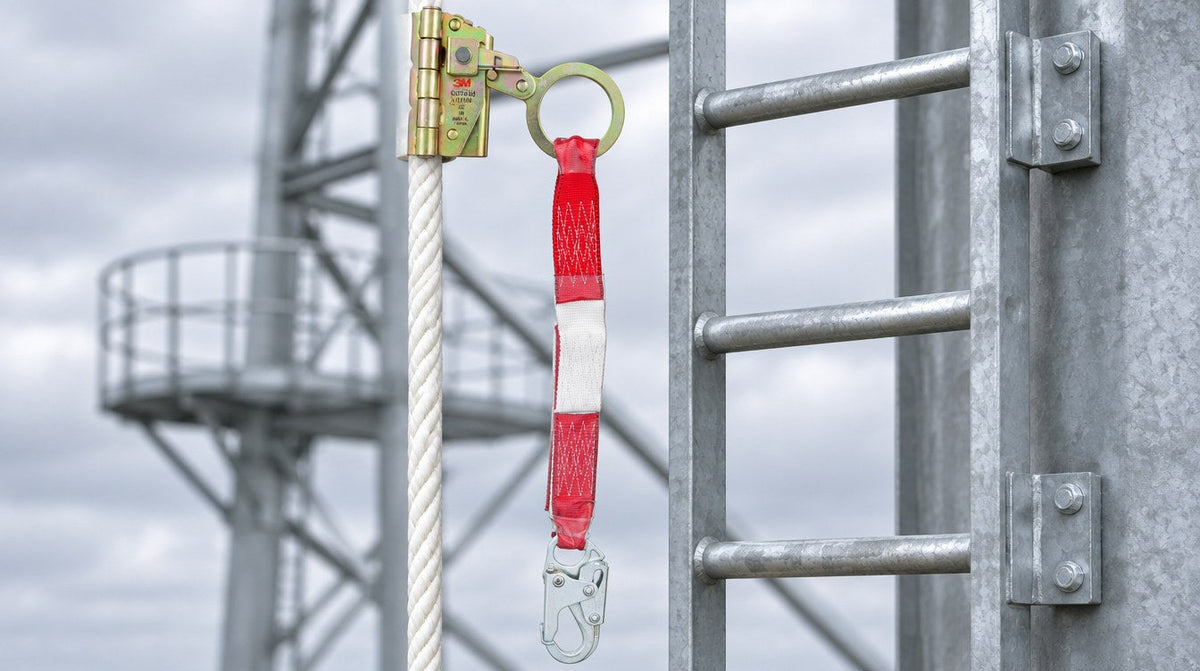
A rope grab is a fall arrester that slides along a vertical lifeline and locks onto the rope when a worker falls. To choose one, match the grab to the exact rope it was tested with, check the integral lanyard length, and confirm the worker's weight range. This guide explains how automatic and manual rope grabs differ, why the rope and the grab are bought as a pair, and which 3M, PIP, Peakworks and Miller rope grabs and lifelines ERE Inc. supplies.
In this guide
- What is a rope grab and how does it work?
- Automatic or manual: which rope grab do you need?
- Can you use any rope with a rope grab?
- What does CSA Z259.2.5 require?
- Which rope grabs and lifelines does ERE supply?
- How to choose a rope grab and lifeline
- Frequently asked questions
What is a rope grab and how does it work?
A rope grab is a device that rides on a vertical lifeline and locks onto it with a cam when a fall starts. It connects to the dorsal D-ring of a full body harness through a short integral lanyard that absorbs energy, and the lifeline is anchored above the work. A researcher's description of the older CSA Z259.2.1 standard puts it plainly: a fall arrester slides along the rope but locks if a fall occurs, with the locking done by a cam.
Rope grabs are used on ladders, towers, roofs and vertical structures where a worker climbs or moves up and down a fixed line. They are one part of a personal fall arrest system, together with a fall arrest harness and an anchor. For overhead anchors on a roof see our guide to roof anchors, and for a retractable alternative see self-retracting lifelines.
Fall hazards and the rules around them vary by province. The CCOHS fall hazards page is a good general starting point, and your provincial regulator sets the standard edition that applies. As one example, the Prince Edward Island guide to fall protection regulations says that under section 3(4) of its regulations all rope grabs must comply with CSA Z259.2.1-98.
Automatic or manual: which rope grab do you need?
Use an automatic (mobile) rope grab for climbing, where the device should follow the worker, and a manual grab where the worker needs to fix the device at a set position. The two work differently:
| Feature | Automatic / mobile grab | Manual grab (rope adjuster) |
|---|---|---|
| Best for | Climbing ladders and towers | Work positioning, and travel restraint near a fall hazard |
| Behaviour | Slides up and down with the worker, locks on a fall | The worker sets and fixes the position on the rope |
| Example | PIP Dynamic Automatic Sliding Rope Grab, with a panic lock and an orientation lock-out so it cannot be installed upside down | 3M DBI-SALA Lad-Saf Static Wire Rope Grab, a manual all-metal design with a cam locking system |
| Both modes | 3M Protecta Cobra rope grab: a mobile design that follows the user, with a manual option to fix it in place | |
For travel restraint on sloped roofs or near leading edges, 3M's guidance on CSA Z259.2.5-17 is to use a manually adjusted rope grab. It advises against automatic grabs there, because a locked-off or parked grab can be jostled loose as the worker moves and then travel toward the hazard.
Can you use any rope with a rope grab?
No. Use only the lifeline the grab was tested and approved with. Under CSA Z259.2.5-17 the rope grab and lifeline are tested together as a system, including rope stretch, and the standard requires a grab approved for more than one rope to pass every test with each combination. A rope that merely has the right diameter is not enough: a different rope may raise the arresting force, slip or break.
The product listings show how tight that pairing is:
- The 3M Protecta Cobra rope grab is for 5/8 in. (16 mm) polyester/polypropylene rope and only for use with 3M Protecta fall protection rope.
- The PIP Dynamic Automatic Sliding Rope Grab is listed for use with FP16EPS and FP16KRN rope, and is designed for workers weighing 60 kg (132 lb) to 160 kg (352 lb).
- The PIP Dynamic Vertical Rope Lifeline with Carabiner is a 5/8 in. 3-strand polyester rope certified by CSA for use with Dynamic rope grabs.
Two other habits to avoid: tying knots in a lifeline to create a stop, and attaching a self-retracting device to a rope grab. 3M's note explains that knots and bends reduce breaking strength and leave hidden damage, and that rope grabs are not for use with self-retracting devices.
What does CSA Z259.2.5 require?
CSA Z259.2.5-17 covers fall arresters and vertical lifelines. According to 3M's summary of the standard, a fall arrester meant for the harness dorsal D-ring must:
- have an integral connection to the rope grab, no longer than 750 mm (30 in.);
- limit the average arresting force to 6 kN and the maximum arresting force to 8 kN in testing;
- arrest the fall within 1 m (39 in.) of travel on the lifeline.
The shorter lanyard matters because a common older practice was to attach a 1.8 m (6 ft) energy-absorbing lanyard, and if the grab slid below the worker a free fall of about 3.6 m (12 ft) could result. Check the standard edition shown on the data sheet and the one your province requires, since older units were certified to Z259.2.1.
Which rope grabs and lifelines does ERE supply?
ERE Inc. is a multi-brand distributor, so you can match the grab, the rope and the rest of the fall arrest system from one supplier. Current ranges include:
- Rope grabs: the 3M Protecta Cobra (integral 2 ft PRO shock absorbing lanyard, detachable anywhere along the lifeline), the PIP Dynamic Automatic Sliding Rope Grab, and the 3M DBI-SALA Lad-Saf Static Wire Rope Grab for 3/8 in. wire rope.
- Rope lifelines: 3M Protecta Rope Lifelines (16 mm polyester sheath over polypropylene core, tensile strength 2540 kg / 5600 lb), the 3M DBI-SALA 50 ft Rope Lifeline with Snap Hook (5-tuck splice, self-locking snap hook), and the Peakworks VL-1125-50 Vertical Lifeline (polysteel copolymer, minimum breaking strength 6,000 lb / 27 kN, back splice at the trailing end).
- Cable and guided systems: the PIP Guided-Type Fall Arrester for 5/16 in. or 3/8 in. cable, and the Miller Vertical Lifelines listing, certified to CSA Z259.2.1 (R2004).
Browse the full fall protection collection for connectors, anchors and harnesses. Product specifications and availability change, so confirm details on the product page or ask us.
How to choose a rope grab and lifeline
- Define the task. Climbing a ladder calls for an automatic grab; positioning or restraint calls for a manual one.
- Pick the lifeline first or as a pair. Decide on rope or cable, then take the grab that the manufacturer lists for that exact line.
- Check the worker weight range on the data sheet, including tools.
- Check the lanyard. It should be the integral connector supplied, within the 750 mm limit, and connect to the dorsal D-ring.
- Confirm the standard (Z259.2.5 or an older edition) against what your regulator requires.
- Plan the anchor and inspection. The lifeline anchor, rope condition and a competent person's inspection are part of the system.
Need a rope grab and lifeline matched?
Tell us the task, the height and the worker weight and we will confirm a compatible grab and rope pair.
Frequently asked questions
What is a rope grab used for?
A rope grab is a fall arrester that moves along a vertical lifeline and locks onto it in a fall. It is used for climbing ladders, towers and other vertical structures, and some manual models are used for work positioning or travel restraint.
What is the difference between a rope grab and a fall arrester?
A rope grab is a type of fall arrester that runs on a rope. Other fall arresters run on cable or rail. In practice, buyers search for both terms for the same family of devices.
Can I use a rope grab on any rope?
No. Use only the lifeline the manufacturer lists for that grab. Under CSA Z259.2.5-17 the grab and rope are tested as a system, so a rope of the right diameter that was not tested with the grab is not an approved combination.
How long can the lanyard on a rope grab be?
The integral connector on a fall arrester for the dorsal D-ring is limited to 750 mm (30 in.) under CSA Z259.2.5-17, and it is permanently attached to the grab.
Can you tie knots in a vertical lifeline?
Not as a stop. Knots reduce the breaking strength of the rope, can leave damage that is not visible, and are not covered by the standard or tested with rope grabs.
Related articles
- Self-retracting lifeline: CSA classes and how to choose
- Fall arrest harness: how to read CSA Z259.10 classes
- Roof anchors: types, strength and how to choose
- Davit arm vs tripod for confined space rescue
Lire en français : Antichute à corde : types, corde compatible et choix au Canada