
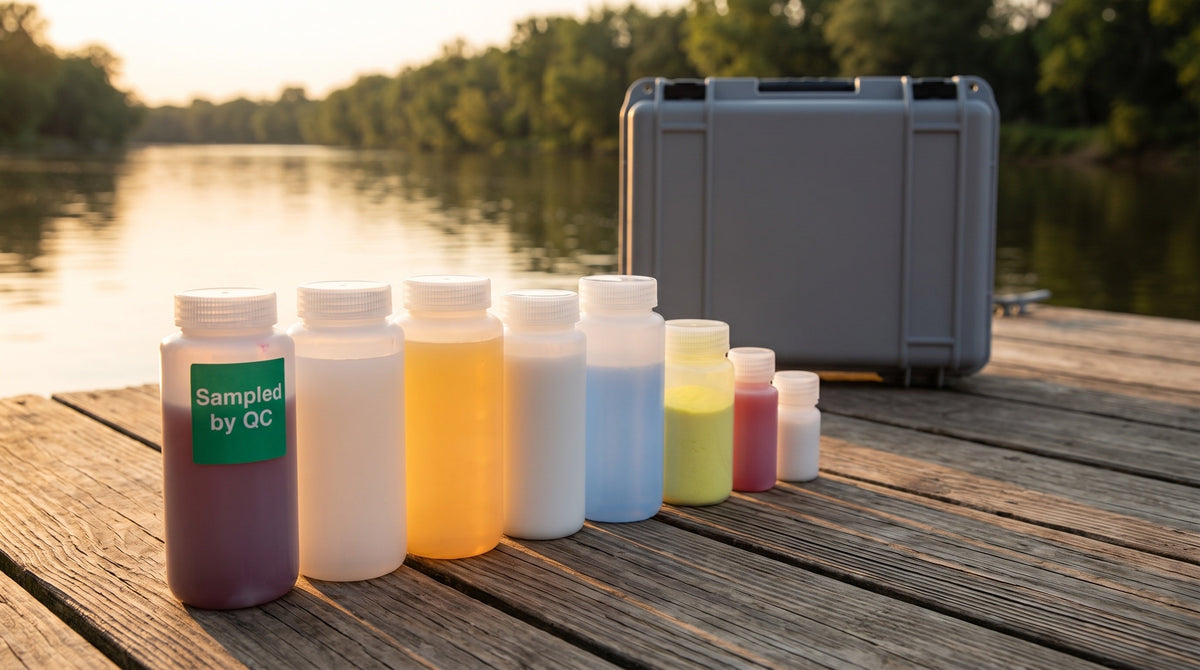
The right sample bottle depends on the analysis your lab will run, not on the bottle's size or price. Metals, nutrients and VOCs normally need the lab's own pre-preserved bottles; unpreserved general chemistry, sediment and sludge, archive samples and transport can go in clean HDPE; semi-volatile organics call for glass or PTFE. ERE lists wide-mouth HDPE bottles in clear and amber, sterile bottles, and virgin-PTFE bottles. This guide shows what each is made of, what it suits, and where to stop and ask the lab.
In this guide
- Which sample bottle do you need: HDPE, amber, sterile or PTFE?
- Which analyses need the lab's own bottles?
- Can you use plastic bottles for organic samples?
- What sizes do the wide-mouth bottles come in?
- When do you need sterile sample bottles?
- When is a PTFE bottle worth it?
- How do you fill bottles from a stream, lake or tank?
- How do you choose a sample bottle, step by step?
- Frequently Asked Questions
Which Sample Bottle Do You Need: HDPE, Amber, Sterile or PTFE?
Match the bottle to the sample and the analysis. ERE lists four families in the bottles collection, all from the same sampling-supply range, and they are not interchangeable.
| Bottle | Made of | Suits | Not the right choice for |
|---|---|---|---|
| Wide Mouth Transparent Bottles | HDPE body, PP lid, watertight; BSE/TSE free | Liquids and powders, transport, sludge and sediment, unpreserved general samples; you can see the contents | Analyses that specify glass or a preservative |
| Wide Mouth Amber Bottles | HDPE body, PP cap; USP Class VI, FDA and EU compliant per the record | Light-sensitive liquids and powders held in plastic | Analyses that call for amber glass |
| Sterile Liquid & Powder Bottle | HDPE body, PP lid; gamma-irradiated, individually bagged | Microbiological and sterile-handling work | Chemistry where the lab supplies a preserved bottle |
| Sampling Systems PTFE Bottles A125 | 100% virgin PTFE, crevice-free interior, heavy wall | Aggressive samples, trace work, high-temperature use up to 280 °C (400 °F) | Routine field sampling where HDPE is accepted |
Which Analyses Need the Lab's Own Bottles?
Any analysis that needs a preservative added at the bottle, which includes metals, mercury, nutrients, cyanide, sulphide and volatile organics. The lab supplies those bottles already dosed, and its bottle and its preservative are part of the method.
The Bureau Veritas sampling bottle chart shows how that looks in practice for Canadian provinces. It names a distinct bottle or vial and preservative for each group:
| Analysis group | Preservative on the Bureau Veritas chart |
|---|---|
| Unpreserved general chemistry | None |
| Nutrients | H2SO4 |
| Metals, total or field-filtered dissolved | HNO3 |
| Mercury, total or field-filtered dissolved | HCl |
| Cyanide | NaOH |
| Sulphide | NaOH / zinc acetate |
| BTEX, F1, VOCs, THMs (vials) | Sodium bisulfate |
| F2-F4, TEH, PAH, C10-C50 | Sodium bisulfate (all provinces except Quebec); H2SO4 (Quebec) |
Two things follow. First, that chart is one laboratory's practice; yours may differ, so get its container list before you order anything. Second, the only row that needs no preservative is general chemistry, which is where a clean HDPE bottle can be accepted. For everything else, keep the lab's bottle in the cooler and use ERE's bottles for the jobs around it: sediment and sludge, product and process samples, retains, and moving samples between sites.
Can You Use Plastic Bottles for Organic Samples?
Not for semi-volatile organics. US EPA SW-846, Chapter Four (Organic Analytes) says containers for SVOC samples are typically glass with PTFE-lined threaded caps, and that plastic containers or plastic lids without PTFE liners should not be used for storage because of potential contamination by phthalate esters. The same chapter's aqueous examples specify 1 L amber glass containers.
That has a direct consequence for the table above, and we would rather say it plainly. The HDPE and PP bottles, clear or amber, are not substitutes for amber glass with a PTFE liner on an organics method. If you need a chemically inert container for aggressive or trace-sensitive samples, the PTFE bottle is the item in our range built for it; for a regulated organics method, use the glass bottle the lab sends or the method names.
What Sizes Do the Wide-Mouth Bottles Come In?
Clear and amber share the same dimensions from 30 mL to 1000 mL, and the clear range adds a 2000 mL size. Bottles ship by the box, so the box quantity sets the minimum order. All figures below are from the product records.
| Volume | Height | Diameter | Neck | Box quantity | Clear part no. | Amber part no. |
|---|---|---|---|---|---|---|
| 30 mL | 63 mm | 37 mm | 21 mm | 72 | SS-8126H-30 | SS-8126H-30A |
| 60 mL | 85 mm | 39 mm | 21 mm | 72 | SS-8126H-60 | SS-8126H-60A |
| 125 mL | 99 mm | 51 mm | 28 mm | 72 | SS-8126H-125 | SS-8126H-125A |
| 250 mL | 131 mm | 62 mm | 32 mm | 72 | SS-8126H-250 | SS-8126H-250A |
| 500 mL | 169 mm | 73 mm | 43 mm | 48 | SS-8126H-500 | SS-8126H-500A |
| 1000 mL | 201 mm | 92 mm | 52 mm | 24 | SS-8126H-1000 | SS-8126H-1000A |
| 2000 mL | 241 mm | 120 mm | 88 mm | 6 | SS-8126H-2000 | Not listed |
The neck diameter is what to check against your field gear. A 43 mm neck takes a scoop or a funnel that a 21 mm neck will not, and that is the reason to choose wide-mouth for sludge, sediment and powders in the first place.
When Do You Need Sterile Sample Bottles?
When the result depends on the bottle not adding organisms, which means microbiological sampling. The sterile bottle is packed in a cleanroom, sterilized by gamma irradiation and supplied in an individual laminate bag; the record lists leak-tight (powder-tight and water-tight) construction and HDPE and PP conforming to FDA, EC 1935/2004 and EU 10/2011. Sizes run from 60 mL to 2000 mL, in boxes of 50, 30 or 10.
How you handle it matters as much as what it is made of. The US EPA quick guide to drinking water sample collection says, for coliform sampling, that sterile 125 or 150 mL plastic bottles must be used, that you should not rinse them, hold the cap by its outside edges without setting it down, and avoid touching the inside of the bottle or cap. Whether your method also needs a dechlorinating agent in the bottle is a question for the lab; our record does not say that these bottles contain one.
When Is a PTFE Bottle Worth It?
When the sample would attack, or be contaminated by, ordinary plastic. The PTFE bottle range (A125) is moulded from virgin PTFE that the record states conforms to FDA and USP Class VI requirements, with a heavy wall, a crevice-free interior, a matching PTFE cap, and a service range from low temperature up to 280 °C (400 °F). Ten sizes run from 1 mL (A125-1) to 2000 mL (A125-2000), sold singly.
That is a specialist item. Reach for it when the sample chemistry or the trace level rules out HDPE, or when you must heat the container; otherwise it is more bottle than a routine job needs.
How Do You Fill Bottles From a Stream, Lake or Tank?
With a bottle holder on a pole, so you are not leaning over the water. The ERE Grab Sample Kit is that setup: a fibreglass telescopic pole (6-12 ft or 8-16 ft), a Purcy clamp, eight 1 L polyethylene Nalgene bottles and a carrying case. The kit's description is for any stream, lake, river or reservoir. Spare poles, clamps and 1 L bottles are listed as replacement parts.
For sediment and sludge, the bottle is the last step rather than the first. Collect with a grab sampler, then transfer to a wide-mouth bottle: see our guides to water and sediment grab samplers and drum and tank liquid sampling, and for wells our groundwater bailer guide.
How Do You Choose a Sample Bottle, Step by Step?
- Get the lab's bottle list. Ask which analyses need its pre-preserved bottles and which accept a clean bottle.
- Set aside the preserved analyses. Metals, mercury, nutrients, cyanide, sulphide and volatiles use the lab's bottles.
- Check the material the method names. If it says glass or a PTFE liner, plastic is out.
- Pick sterile only for microbiology. Keep it sealed in its bag until the moment of filling.
- Choose clear or amber. Clear shows what is inside; amber cuts light for light-sensitive liquids and powders.
- Size by neck and volume. Match the neck to your scoop or funnel and the volume to what the lab needs, plus a margin.
- Label and ship cold where required. Write the sample ID on the bottle, not only the lid.
Need help choosing sample bottles?
ERE Inc. has been Canada's environmental equipment specialist for 30+ years. Send us the analyses and the lab's bottle list and we will match bottles, sizes and quantities.
→ Request a Quote | 1-888-287-EREC | Browse Bottles | sales@ereinc.com
Frequently Asked Questions
What bottle should I use to collect a water sample for lab analysis?
Use the bottle your lab supplies for that analysis. Metals, nutrients, mercury, cyanide, sulphide and volatile organics normally need pre-preserved bottles. A clean HDPE bottle is generally for unpreserved general chemistry, and only if the lab accepts it.
Can I use HDPE bottles for organic samples?
Not for semi-volatile organics. US EPA SW-846 specifies glass with PTFE-lined caps and says plastic lids without PTFE liners should not be used because of phthalate contamination.
Is an amber HDPE bottle the same as an amber glass bottle?
No. The amber colour reduces light exposure, but the material is still HDPE, so it is not a substitute where a method calls for amber glass.
What sizes do ERE's wide-mouth sample bottles come in?
Clear bottles come in 30, 60, 125, 250, 500, 1000 and 2000 mL; amber bottles in 30 to 1000 mL. They ship by the box, from 72 down to 6 depending on size.
Do I rinse a sterile sample bottle before filling?
No. Sterile bottles are used as supplied. US EPA's drinking water guidance says not to rinse them and not to touch the inside of the bottle or cap.
What is a PTFE sample bottle used for?
Aggressive or trace-sensitive samples and high-temperature use. ERE's A125 bottles are 100% virgin PTFE with a crevice-free interior, rated up to 280 °C (400 °F).
Related articles
- Water and Sediment Grab Samplers: Selection Guide
- Drum and Tank Liquid Sampling Equipment
- Groundwater Bailers: Types, Materials and Selection
Lire en français : Bouteilles d'échantillonnage : guide HDPE, ambrées, stériles et PTFE pour l'échantillonnage au Canada