
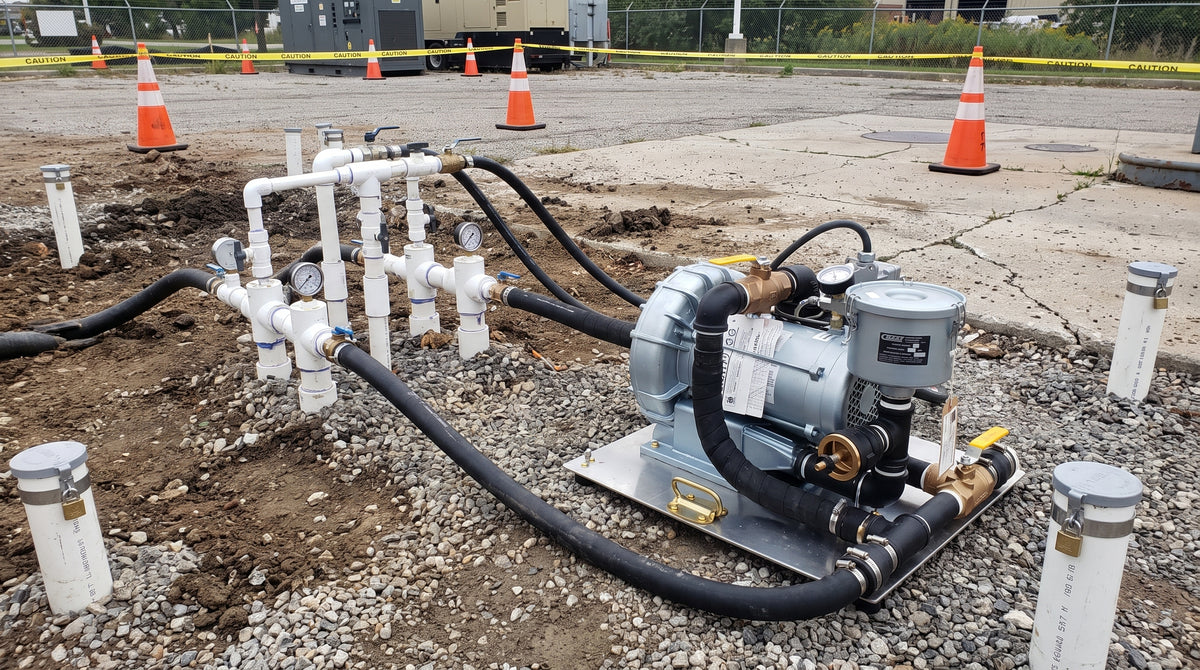
Soil vapor extraction (SVE) pulls volatile organic compounds out of contaminated soil by applying vacuum to wells screened above the water table, drawing VOC-laden vapor to the surface for treatment or release. This guide covers how SVE systems work, when the technology fits a site's contamination profile, how to size one, and ERE's EvacuSol™ line for Canadian remediation projects.
Table of Contents
- What Is a Soil Vapor Extraction System?
- When Does a Contaminated Site Need SVE?
- How Does a Soil Vapor Extraction System Work?
- SVE vs. Dual-Phase Extraction: Which Do You Need?
- How Do You Size a Soil Vapor Extraction System?
- What's Included in ERE's EvacuSol™ Systems?
- Frequently Asked Questions
What Is a Soil Vapor Extraction System?
A soil vapor extraction system applies vacuum to wells screened in the vadose zone — the unsaturated soil above the water table — to pull volatile and semi-volatile organic compounds out of soil pores as vapor. It's an in-situ technology: the contaminated soil stays where it is, and the vapor is drawn out and treated or released, rather than the soil being excavated and hauled offsite. The U.S. EPA lists soil vapor extraction and air sparging among its recognized technologies for cleaning contaminated sites, and it's one of the most established options for gasoline- and solvent-impacted vadose-zone soil in North America.
What SVE Does Not Treat
SVE is a vapor-phase technology only. It doesn't remove dissolved contamination from groundwater, and it doesn't recover free-phase product (LNAPL) floating on the water table — those need a different mechanism, covered in the SVE vs. dual-phase comparison below.
When Does a Contaminated Site Need SVE?
SVE fits when volatile contaminants sit in the unsaturated soil above the water table — leaking underground storage tanks, spilled solvents, and gasoline vapor plumes are the three most common triggers in Canada. It's a poor fit for contaminants with low volatility (heavy oils, most metals) or contamination that's fully saturated below the water table.
- Leaking underground storage tanks (USTs). Gasoline and diesel UST releases are the single most common SVE application — vapor migrates through permeable soil and needs interception before it reaches basements or utility corridors.
- Solvent spills. Chlorinated solvents (TCE, PCE) and other VOCs from industrial spills or historical dry-cleaning operations volatilize readily and respond well to vacuum extraction.
- Vapor intrusion risk. Where a VOC plume threatens indoor air in an occupied building above or near the site, SVE is often specified as an interim or long-term mitigation measure alongside sub-slab depressurization.
Whether SVE is warranted — and how long it needs to run — is usually judged against provincial or site-specific soil quality criteria; the CCME Soil Quality Guidelines for the Protection of Environmental and Human Health are the reference framework most Canadian consultants work from when setting cleanup targets by land use (agricultural, residential/parkland, commercial, industrial).
How Does a Soil Vapor Extraction System Work?
A soil vapor extraction system works by pulling a vacuum on wells screened in contaminated soil, drawing air through the pore spaces, stripping VOCs off the soil into the vapor phase, and conveying that vapor to the surface for treatment or discharge.
- Install extraction wells in the vadose zone. Wells are screened above the water table, spaced by the soil's estimated radius of influence.
- Apply vacuum with a regenerative blower. The blower draws air through the soil toward each well, pulling VOC-laden vapor out of the pore spaces.
- Convey vapor through inlet plumbing and filtration. An inline air filter and moisture knockout protect the blower from particulate and condensate before the vapor stream reaches it.
- Monitor vacuum and flow at each well. Vacuum gauges confirm the system is pulling air uniformly across the well field, not just short-circuiting through the most permeable path.
- Route vapor to atmosphere or a downstream treatment system. Depending on concentration and regulatory limits, extracted vapor either discharges directly or passes through vapor treatment equipment like a carbon or catalytic oxidation unit first.
For the full product range this system draws from, see ERE's treatment systems collection.
SVE vs. Dual-Phase Extraction: Which Do You Need?
SVE alone handles vapor-phase contamination above the water table; if the site also has free-phase product (LNAPL) or dissolved contamination that needs to come up with the vapor, dual-phase (multiphase) extraction is the right technology, not SVE.
| Factor | Soil Vapor Extraction (SVE) | Dual-Phase Extraction |
|---|---|---|
| What it extracts | Vapor-phase VOCs only | LNAPL, groundwater, and VOCs — all from one well |
| Best-fit contamination | Vadose-zone vapor, no free product | Free-phase hydrocarbon plus vapor at the same site |
| Water table interaction | Stays above the water table | Draws down groundwater to create a cone of depression that pulls migrating LNAPL toward the well |
| On-board treatment | Vapor filtration; downstream vapor treatment optional | Integrated oil/water separation, bag filtration, and vapor/water treatment media |
| ERE product | EvacuSol™ (0.5–10 HP) | Dulex™ Multiphase Extraction System |
A site assessment that shows measurable LNAPL thickness in a monitoring well is the usual signal to specify dual-phase over standalone SVE — pulling vacuum on a well with free product sitting in it wastes blower capacity on liquid the SVE system isn't built to handle.
How Do You Size a Soil Vapor Extraction System?
A soil vapor extraction system is sized on contaminant volatility, soil permeability, the radius of influence achievable per well, and whether extracted vapor needs treatment before it can be released.
- Contaminant volatility. Higher-vapor-pressure compounds (gasoline, most chlorinated solvents) strip off soil faster than heavier, less volatile fuels — this affects both blower sizing and expected remediation timeline.
- Soil permeability. Coarse, sandy soil transmits vacuum efficiently over a wide radius; tight clay or silt needs more wells at higher vacuum, each covering a smaller radius of influence.
- Radius of influence per well. A pilot test (a short-duration vacuum test at a single well, measuring vacuum response at nearby monitoring points) is the standard way to confirm how many wells a site actually needs before committing to a full-scale layout.
- Vapor treatment requirement. If discharge limits require treating the extracted vapor stream, the blower and treatment unit need to be sized as a matched pair, not independently.
Request a quote with your site's contaminant type, estimated soil permeability, and any available pilot test data for a sized recommendation.
What's Included in ERE's EvacuSol™ Systems?
ERE's EvacuSol™ is a regenerative-blower SVE system built for low-flow, high-vacuum vadose-zone extraction, available across a six-model lineup from 0.5 HP to 10 HP.
| Model | Open Flow (SCFM) | Max Vacuum (IWG) | HP | Voltage |
|---|---|---|---|---|
| ER-2000-5 | 55 | 35 | 0.5 | 115V-60-1 |
| ER-20010 | 107 | 60 | 1 | 115/230V-60-1 |
| ER-20020 | 160 | 52 | 2 | 230V-60-1 |
| ER-20030 | 212 | 70 | 3 | 230V-60-1 |
| ER-20050 | 295 | 87 | 5 | 230/460V-3-60 |
| ER-20100 | 400 | 98 | 10 | 460/575V-3-60 |
Every EvacuSol™ unit is Explosion Proof (Division 1 & 2, Class 1, Group D), UL and CSA approved, and built to NEMA frame sizes, with integrated inlet/outlet plumbing, an air filter, an ambient air valve, vacuum gauges, and motor overload protection. Three options extend the base unit: a Reverse Manifold that converts an extraction well into a sparging point for push-pull applications, a Tornado™ Moisture Knock Out Unit that protects the blower from corrosion and mineralization damage, and a Storage Aluminum Box for systems up to 2 HP. Beyond soil vapor extraction, the same blower platform covers gasoline vapor recovery, groundwater sparging, landfill off-gas evacuation, and radon gas collection. Systems are available for rental or purchase, deployed across Canada and the USA — see the full soil and groundwater remediation equipment guide for how SVE fits into a broader site cleanup.
Frequently Asked Questions
What is a soil vapor extraction system?
A soil vapor extraction system applies vacuum to wells screened in the unsaturated soil above the water table, drawing volatile organic compounds out of the soil as vapor for treatment or discharge, without excavating the contaminated soil.
When is soil vapor extraction the right remediation technology?
SVE fits sites with volatile contamination — leaking underground storage tanks, solvent spills, gasoline vapor plumes — sitting above the water table with no significant free product. Sites with LNAPL or dissolved-phase contamination usually need dual-phase extraction instead.
Can soil vapor extraction remove groundwater contamination too?
No. Standalone SVE only extracts vapor-phase contaminants from the vadose zone. Sites needing to recover free product or draw down groundwater at the same time need dual-phase (multiphase) extraction, like ERE's Dulex™ system.
How long does a soil vapor extraction system need to run?
It depends on contaminant volatility, soil permeability, and site-specific cleanup targets — timelines can run from several months to multiple years. A pilot test and periodic soil gas monitoring are how a consultant tracks progress against the site's target concentration.
What size SVE unit does a typical underground storage tank remediation need?
Most single-tank UST remediation sites run on ERE's smaller EvacuSol™ models (0.5–2 HP, 55–160 SCFM), but the right size depends on soil permeability and the number of wells a pilot test shows are needed — request a quote with your site data for a sized recommendation.
Related articles
- Soil & Groundwater Remediation Equipment: A Guide for Canada
- Air Stripping for VOC Removal in Groundwater Treatment
- Industrial Air Scrubbers: Types, How They Work, and How to Choose
- Bioremediation Products for Contaminated Soil & Groundwater: A Buyer's Guide
Need help sizing a soil vapor extraction system?
ERE Inc. has been Canada's environmental equipment specialist for 30+ years. Talk to a real engineer about your site's contaminant profile and soil conditions.
→ Request a Quote | 1-888-287-EREC | Browse Treatment Systems | sales@ereinc.com
Lire en français : Systèmes d'extraction de vapeurs du sol : fonctionnement et cas d'usage