
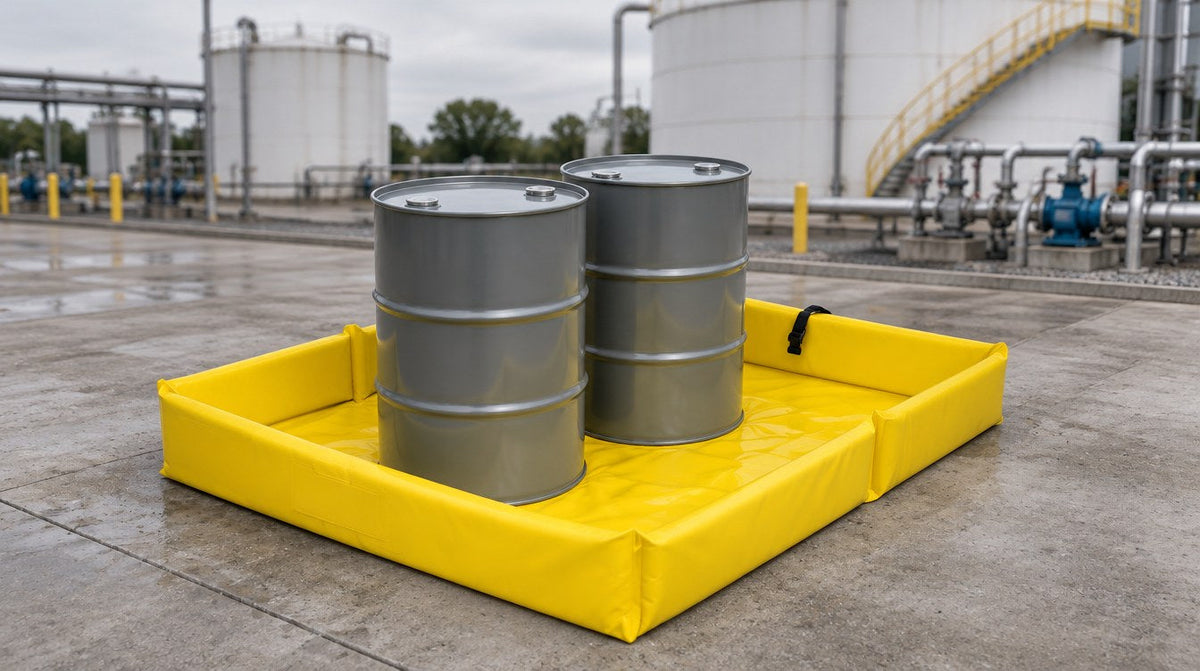
A spill containment berm is a low-walled, liquid-tight tray or barrier, usually made of coated fabric or PVC, that catches leaks and spills so they cannot spread to soil, drains or water. Choosing one comes down to four things: how much liquid it has to hold, how the walls stand up (foam, collapsible or pop-up), whether vehicles or forklifts will cross it, and how rain will be drained. This guide covers the main styles, the sizing arithmetic and the berms ERE Inc. supplies.
In this guide
- What is a spill containment berm?
- What types of portable spill berm are there?
- How do you size a spill berm?
- Which spill berms does ERE supply?
- How do you deal with rain and drainage?
- How to choose a spill berm
- Frequently asked questions
What is a spill containment berm?
A spill containment berm is a portable secondary containment device: a shallow basin or wall that sits under or around a container, vehicle or piece of equipment and holds whatever leaks out of it. Unlike a concrete dike, it can be unrolled, unfolded or popped up where the risk is and put away afterwards.
Berms are used under drums, totes and generators, around transfer points, beneath leaking hydraulic lines, and under vehicles being serviced or washed. They are the portable counterpart of the rigid options, so if you are containing drums on a fixed footprint, see our guide to spill containment pallets, and for response after a release see the spill kit guide.
What types of portable spill berm are there?
Most portable berms fall into four styles, and the difference is how the walls are held up and how small the berm folds:
- Foam-wall berms: a foam core inside the sidewall keeps the wall standing. The foam can be driven over or stepped on, so they suit vehicles and mobile equipment.
- Collapsible and roll-up berms: a flexible tray that folds or rolls to a very small size. They suit small leaks, fill points and truck-box storage.
- Pop-up and snap-up berms: walls fold down for storage and snap or spring up on site. Large versions cover frac tanks, tanker unloading and generator pads.
- Drip-pan style berms: a weighted base keeps a lightweight tray from tipping in wind, for leaks under hydraulic lines and parked equipment.
Some systems are modular: sections are joined with adhesive or connectors to build a berm of any footprint around an unusual layout.
How do you size a spill berm?
Multiply the inside length by the inside width by the wall height to get the volume, then convert it to the unit your container is rated in. One cubic foot holds about 7.48 US gallons, and one US gallon is 3.785 litres. A US gallon is not an imperial gallon, so check which one a product or tank label uses.
The berm then has to hold more than the container it protects. For aboveground petroleum tanks, the Environment and Climate Change Canada code of practice for storage tank systems (Section 3.9) calls for a secondary containment system with a volumetric capacity of not less than 110% of the capacity of a single tank; with several tanks, the largest tank plus 10% of the greater of that figure or the combined capacity of the others. In the United States, the EPA SPCC rule asks for containment for the entire capacity of the largest single container plus sufficient freeboard for precipitation.
| Container | Capacity | Minimum berm volume at 110% |
|---|---|---|
| One 205 L (55 US gal) drum | about 55 US gal | about 61 US gal |
| One 1,000 L tote | about 264 US gal | about 291 US gal |
| Two drums on one berm | largest 55 US gal | at least 55 US gal plus margin; check the rule that applies to your site |
These figures are arithmetic, not a compliance opinion. Provincial rules, municipal bylaws, the type of liquid and whether the site is a fixed storage facility all change what is required, so confirm the requirement with your environmental or EHS lead. Also check material compatibility: the berm fabric has to resist the liquid it may hold, and the product listing or data sheet is where that is stated.
Which spill berms does ERE supply?
ERE Inc. supplies berms from ENPAC, UltraTech and Zenith. Specifications below come from the product listings, so confirm ratings and chemical compatibility on the data sheet for your liquid.
- Zenith Collapsible Roll-Up Spill Berm is a flexible chemical-, fuel- and oil-resistant fabric tray that folds and rolls to about the size of a closed umbrella, for small leaks, fill points and under small equipment.
- UltraTech Ultra-Mini Berm holds 60 US gal in a 4 ft x 4 ft x 6 in. footprint, with foam sidewalls that can be driven over and heavy-duty 18 oz PVC construction.
- ENPAC Folding Duck Ponds Mini-Berm holds 74 US gal in a 6 ft x 4 ft x 6 in. footprint with a foam wall, a securing strap for folding, and a listed cold tolerance down to -48 degrees C.
- ENPAC Standard DripPillow Berm with Pad is a drip-pan style berm with a weighted base that resists flipping in wind, a grounding strap and a removable UV-resistant pad, for leaks under vehicles and hydraulic lines.
- UltraTech Ultra-Pop Up Spill Containment Pool is 53 in. in diameter and holds 66 US gal; a foam ring raises the walls as liquid collects, and it shakes open from its case.
- Zenith IBX Wall Pop-Up Berm holds 1,077 US gal in a 12 ft x 12 ft x 12 in. single-piece unit with integrated snap-up brackets, for frac tanks, generators and tanker unloading.
- UltraTech Ultra-Berm Builder Vinyl Adhesive supports building custom-footprint berms from sections.
The full range is on the spill containment collection, with pallets and sumps on the spill pallets collection.
How do you deal with rain and drainage?
An outdoor berm collects rain as well as spills, so rainwater has to be removed before it eats into the capacity set aside for the container. Sizing rules such as the SPCC "sufficient freeboard" requirement exist for exactly this reason. Water that has touched a spill or a leaking container may itself be contaminated, so it must not be released until it has been checked.
For berms that stay out, a drain accessory can help: the HFF Berm Drain Kit is listed to safely drain rainwater from spill containment berms. For temporary berms, a cover over the contained equipment or regular inspection and pump-out is the simpler plan. Whichever you choose, write down who checks the berm, how often and where the water goes.
How to choose a spill berm
- Find the largest container. Note its capacity, and whether the berm sits under one container or several.
- Calculate the volume. Length x width x wall height, converted to gallons or litres, then compare it with the container at 110%.
- Pick the wall style. Foam wall if vehicles will cross it, collapsible for small, portable jobs, pop-up for large footprints, drip-pan style for equipment leaks.
- Check compatibility. Confirm the fabric or PVC resists the liquid, and the temperature range suits the season.
- Plan the footprint. Allow for access, ground contact and anchoring in wind.
- Plan drainage and inspection. Decide how rain is removed and who checks the berm.
Not sure which berm fits your container or site? Request a quote with the container size and the liquid, and we will match the berm, or call us in Montreal.
Need help with spill containment?
ERE Inc. has been Canada's environmental and safety equipment specialist for 30+ years. Talk to a real specialist about your containers, liquids and site.
→ Request a Quote | 1-888-287-EREC | Browse Spill Containment | sales@ereinc.com
Frequently Asked Questions
What is the main purpose of a berm?
A berm holds a leak or spill in one place, so it cannot reach soil, drains or surface water and can be cleaned up from a defined area. A portable spill berm does this under a container, vehicle or piece of equipment without any permanent construction.
How do you calculate the capacity of a spill berm?
Multiply the inside length, width and wall height in feet to get cubic feet, then multiply by 7.48 for US gallons. For example, 4 ft x 4 ft x 0.5 ft is 8 cubic feet, or about 60 US gallons. Then compare that with the container it protects; the Canadian code of practice for aboveground tanks asks for not less than 110% of a single tank's capacity.
Can you drive over a spill berm?
Foam-wall berms are built for it: the product listings state that the foam sidewalls can be driven over or stepped on, so a vehicle can be positioned onto the berm. For collapsible and pop-up styles, check the product listing before putting vehicle or forklift traffic on them.
Is secondary containment required by law?
It depends on what is stored, how much and where. The Canadian code of practice for storage tank systems is a model code written for adoption by legislative authorities, so requirements come from federal, provincial and municipal rules. In the United States, the EPA SPCC rule covers bulk oil storage. Confirm the rule that applies to your site with your environmental or EHS lead.
Related articles
- Spill containment pallets: sump capacity, hardcovers and drum handling
- Spill kit guide: oil-only, universal and hazmat kits
- Flammable storage cabinets: sizes, types and fire code rules
Lire en français : Bacs de rétention souples : types, dimensionnement et choix au Canada