
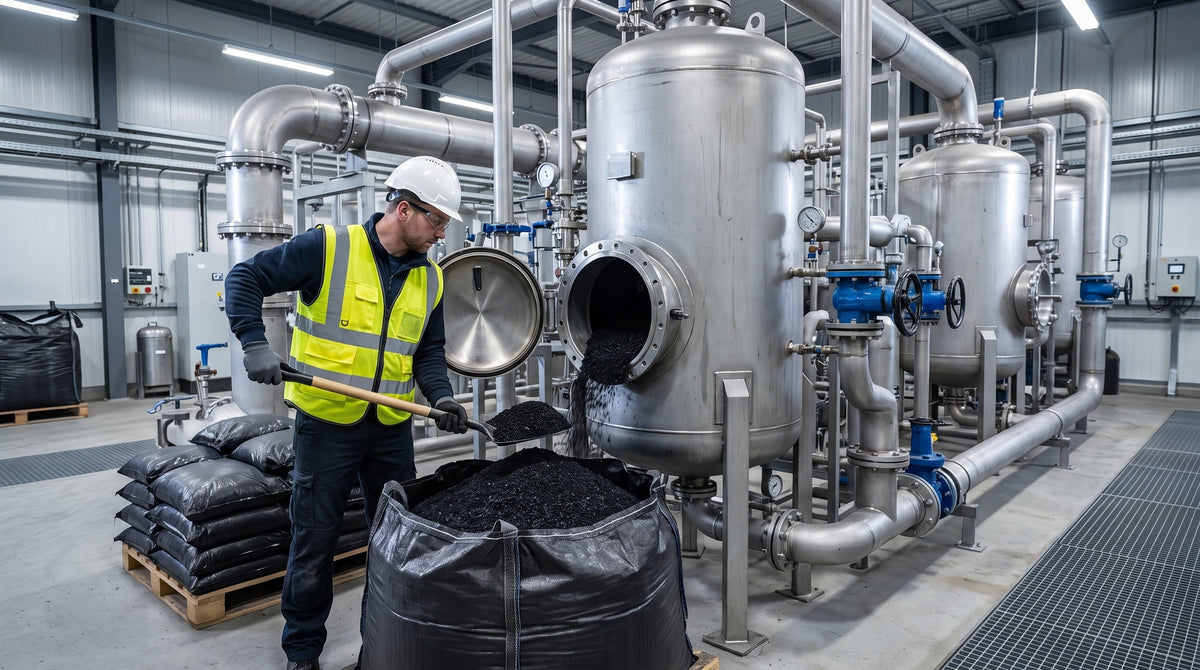
Activated carbon filtration media removes chlorine, chloramines, taste and odour compounds, and a wide range of organic contaminants from water by adsorption — trapping them in a microscopically porous carbon structure rather than converting them chemically. If your facility needs to polish process water, protect downstream membranes, or meet effluent taste/odour targets, activated carbon is the default media, and the choice between standard GAC and catalytic carbon depends entirely on what you're removing.
What Is Activated Carbon Filtration Media?
Activated carbon is a highly porous form of carbon — manufactured from bituminous coal, coconut shell, or other carbon-rich raw material and "activated" with steam or chemical treatment to open an enormous internal pore network. A single gram of activated carbon can carry several hundred square metres of internal surface area. That surface area is what does the work: dissolved organic molecules, chlorine, and taste/odour compounds physically adsorb onto the pore walls as water passes through the bed.
This is fundamentally different from oxidative media like Filox, which chemically converts dissolved iron and manganese into filterable solids. Activated carbon doesn't change the chemistry of what it removes — it captures it. That makes it the standard choice for organic contaminants, chlorine residual, and taste/odour, and the wrong choice for dissolved metals like iron or hardness, which pass through a carbon bed largely untouched. See our filtration media types guide for how activated carbon fits alongside the rest of ERE's media lineup.
How Does Activated Carbon Remove Contaminants From Water?
Water passes down through a bed of granular activated carbon (GAC), and as it contacts the carbon granules, dissolved organic molecules and chlorine migrate into the pore structure and adsorb onto the internal surface. The bed keeps working until the accessible pore surface is saturated — at which point contaminants begin to "break through" into the treated water, signalling that the media needs replacement or regeneration.
Two properties govern how well and how long a carbon bed performs: iodine number (a lab measurement of adsorption capacity, expressed in mg of iodine adsorbed per gram of carbon) and empty bed contact time (EBCT — how long water actually spends in contact with the media at a given flow rate). Higher iodine number means more available adsorption sites; longer EBCT means more complete removal per pass. Both are set by matching bed size to flow rate, covered below.
What's the Difference Between Standard GAC and Catalytic Activated Carbon?
Standard GAC removes chlorine, taste, odour, and organic compounds through pure adsorption. Catalytic activated carbon is manufactured with a modified surface chemistry that adds a catalytic function on top of adsorption — it concentrates reactants at the pore surface and then promotes their reaction, which lets it remove contaminants standard GAC can't touch at meaningful rates: hydrogen sulfide, chloramines, and dissolved iron.
| Property | Standard GAC (Coconut Shell) | Catalytic Activated Carbon |
|---|---|---|
| Primary mechanism | Adsorption only | Adsorption + catalyzed surface reaction |
| Removes | Chlorine, taste/odour, organics, sediment | Chloramines, H₂S, iron, taste/odour, organics, VOCs |
| Mesh size | 12x40 (also 8x30 available) | 12x40 |
| Iodine number | Typically ≥1,000 mg/g | Min. 1,000 mg/g |
| BET surface area | Media-dependent | ~1,060 m²/g |
| Ball-pan hardness | High (low-fines grades available) | Min. 98% |
| Best for | Municipal/residential chlorine + taste/odour | Well water with H₂S/iron; chloraminated water |
The practical rule: if your water is chlorinated municipal supply and the complaint is taste or odour, standard GAC is the economical choice. If the source is well water with a sulfur smell, elevated iron, or the utility has switched to chloramine disinfection (which standard GAC is much slower to remove than free chlorine), specify catalytic carbon.
Which Contaminants Does Activated Carbon Remove — and What Are Its Limits?
Activated carbon is effective against a specific class of contaminants and ineffective against another — knowing both sides prevents an expensive misapplication.
- Removes well: free chlorine, chloramines (catalytic grade), taste and odour compounds, hydrogen sulfide (catalytic grade), volatile organic compounds (VOCs), many pesticides and herbicides, and dissolved iron at low concentrations (catalytic grade).
- Does not remove: water hardness (calcium/magnesium), total dissolved solids, nitrate, arsenic, or most heavy metals. Those require ion exchange, reverse osmosis, or adsorptive media such as activated alumina (arsenic, fluoride) rather than carbon.
Health Canada's Guidelines for Canadian Drinking Water Quality set aesthetic objectives for chlorine taste/odour and organic parameters that activated carbon directly addresses — free chlorine above roughly 0.5–1 mg/L is when most people begin to notice taste. GAC and catalytic carbon are also listed treatment technologies in the U.S. EPA Drinking Water Treatability Database, which documents removal effectiveness across the same contaminant classes covered above and is a useful cross-reference when specifying a treatment train for a Canadian industrial site.
How Do You Size an Activated Carbon Filter Bed?
Sizing an activated carbon bed comes down to matching flow rate to bed volume so water spends enough time in contact with the media. Undersize the bed and contaminants break through before the carbon is exhausted; oversize it and you pay for capacity you don't need.
- Establish your design flow rate (peak GPM the system must treat, not average flow).
- Select bed volume from the peak service flow table below — do not exceed the peak service flow for a given bed size.
- Confirm backwash capacity is available at the corresponding backwash flow rate to fluidize and clean the bed.
- Verify empty bed contact time is adequate for your target contaminant — chloramine and H₂S removal typically need longer EBCT than simple chlorine taste/odour polishing.
| Bed Volume | Peak Service Flow | Backwash Flow |
|---|---|---|
| 1 ft³ | 4 GPM | 4.2 GPM |
| 1.5 ft³ | 6 GPM | 5.3 GPM |
| 2 ft³ | 8 GPM | 7.5 GPM |
| 3 ft³ | 11 GPM | 10 GPM |
| 4 ft³ | 14 GPM | 11 GPM |
Operating limits: maximum water temperature 110°F (43°C), maximum operating pressure 125 psig, minimum inlet pressure 30 psig. Exceeding the peak service flow for your bed size is the single most common cause of early breakthrough in the field. For flows beyond a single 4 ft³ vessel, ERE sizes multi-vessel or lead-lag configurations — contact us with your flow rate and target contaminants.
What Iodine Number and Mesh Size Should You Specify?
Iodine number is the standard benchmark for activated carbon adsorption capacity — a lab test that measures how much iodine (a stand-in for small organic molecules) a given mass of carbon can adsorb. Higher is better. Mesh size controls both pressure drop and contact efficiency — finer mesh has more surface area per volume but higher pressure drop; coarser mesh is used where flow and pressure drop are the constraint.
| Product | Media | Iodine Number | Mesh | Hardness |
|---|---|---|---|---|
| ERE Activated Carbon Media (BC) | Bituminous coal GAC | ≥1,000 mg/g | 8x30, 12x40, powder | ≥97% |
| Watts Catalytic Activated Carbon | Catalytic coconut shell | Min. 1,000 mg/g | 12x40 | Min. 98% |
| Watts Granular Activated Carbon | Coconut shell GAC | Media-dependent | 8x30, 12x40 | High, low-fines grades |
As a specification rule of thumb: for general dechlorination and taste/odour polishing, an iodine number of 900–1,000 mg/g in a 12x40 mesh is the standard industrial specification. For higher-demand applications — heavier organic loading, or where the bed needs to run longer between change-outs — specify 1,000+ mg/g. Ash content and moisture (both should be near the low single digits) affect handling and shelf life more than performance.
Coconut Shell or Bituminous Coal — Which Activated Carbon Should You Choose?
Coconut shell carbon has a naturally microporous structure that gives it a higher iodine number and hardness per unit cost, which is why it dominates catalytic and premium GAC grades. Bituminous coal carbon has a broader pore size distribution (micro-, meso-, and macropores), which makes it more effective at adsorbing a wider range of larger organic molecules and gives it strong performance in TOC reduction and general industrial process water applications.
- Choose coconut shell for chlorine/chloramine/taste-odour polishing, catalytic H₂S/iron removal, and applications where mechanical hardness (low dust, long life) matters most.
- Choose bituminous coal for TOC reduction, broader organic contaminant removal, and general industrial process and wastewater treatment where a wider pore size range is an advantage.
Both raw materials are available from ERE in 8x30, 12x40, and powder gradations. If you're not sure which fits your water chemistry, send ERE your source water analysis and target contaminants — the correct raw material and mesh follow directly from that.
What Does ERE Supply for Activated Carbon Filtration Media?
ERE Inc. has supplied industrial and environmental water treatment media across Canada for 30+ years. ERE stocks bituminous-coal Activated Carbon Media (BC) for TOC reduction and general contaminant removal, Catalytic® Granular Activated Carbon for chloramine, H₂S, and iron removal, and Watts® Granular Activated Carbon (GAC) in multiple coconut-shell gradations for standard dechlorination and taste/odour polishing.
Activated carbon is one media in ERE's full filtration media range alongside Filox for iron/manganese and activated alumina for arsenic/fluoride — see the filtration media types guide for how they compare. Browse the full filtration media collection or send ERE your water analysis for a media recommendation.
Need activated carbon media sized for your facility?
ERE Inc. sizes GAC and catalytic carbon systems based on your actual water chemistry and flow rate — not a generic sizing chart. Send us your target contaminants and design flow.
→ Request a Quote | 1-888-287-EREC | Browse Filtration Media | sales@ereinc.com
Frequently Asked Questions
What's the difference between GAC and catalytic activated carbon?
Standard GAC removes contaminants by adsorption alone — chlorine, taste, odour, and organics. Catalytic activated carbon adds a catalyzed surface reaction on top of adsorption, which lets it also remove hydrogen sulfide, chloramines, and dissolved iron — contaminants standard GAC removes slowly or not at all.
What is a good iodine number for activated carbon?
An iodine number of 900–1,000 mg/g is the standard industrial specification for dechlorination and taste/odour polishing. For heavier organic loading or longer service life between change-outs, specify 1,000 mg/g or higher. ERE's catalytic and bituminous-coal carbon both meet or exceed 1,000 mg/g.
How often does activated carbon media need to be replaced?
Replacement interval depends on contaminant loading and bed size, not a fixed calendar schedule — track it by monitoring effluent for breakthrough (chlorine residual returning, taste/odour returning, or H₂S smell returning for catalytic beds). Undersized beds or high-organic-load water shorten the interval; correct sizing per the peak-service-flow table above extends it.
Can activated carbon remove hydrogen sulfide from water?
Standard GAC removes H₂S poorly. Catalytic activated carbon removes it effectively through its catalyzed surface reaction, which is why H₂S ("rotten egg" odour) well water calls for catalytic carbon specifically, not standard GAC.
Is activated carbon suitable for industrial process water, not just drinking water?
Yes — activated carbon is widely used in industrial process water, wastewater polishing, and environmental remediation for TOC reduction and organic contaminant removal ahead of reverse osmosis or discharge. ERE supplies bulk activated carbon for industrial, environmental, and commercial applications across Canada.
Related articles
- Water Filtration Media Types: Applications & Selection Guide
- Filox Filtration Media: Iron, H₂S & Manganese Removal Guide for Canada
- Activated Alumina for Water Treatment: Guide for Canada
- Industrial Water Filtration Systems: Guide for Canada
Lire en français : Médias filtrants au charbon actif : guide de sélection pour le Canada