
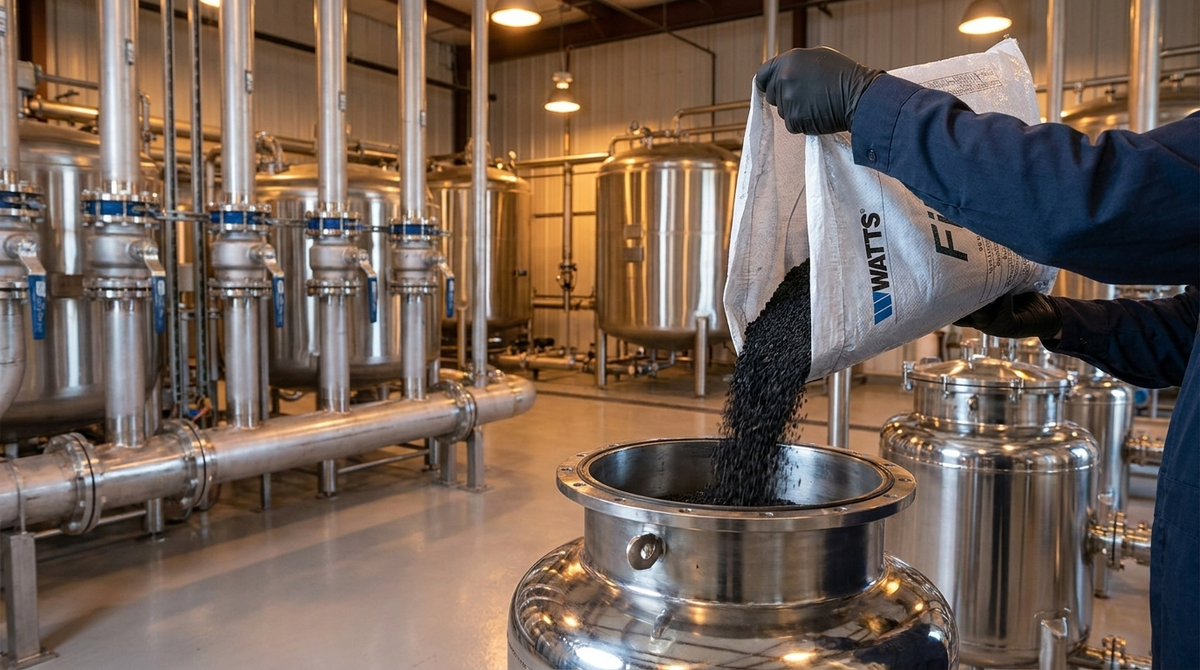
Filox filtration media removes iron, hydrogen sulfide (H₂S), and manganese from groundwater without chemical oxidants. If your facility draws from well water or treats contaminated groundwater with elevated iron or a "rotten egg" odour, Filox is one of the most effective catalytic media available in Canada. This guide covers the mechanism, sizing math, pH limits, regeneration, and where Canadian industrial users apply it.
What Is Filox and How Does It Remove Iron, H₂S, and Manganese?
Filox is a natural mineral filtration media composed primarily of manganese dioxide (MnO₂) — typically 75 to 85% by weight. This high MnO₂ content is what sets it apart from older iron removal media: the manganese dioxide acts as a catalytic oxidant, stripping electrons from dissolved ferrous iron (Fe²⁺), hydrogen sulfide (H₂S), and manganous manganese (Mn²⁺), converting them into insoluble particles that are trapped in the filter bed and backwashed to drain.
Unlike conventional Greensand — which requires continuous or intermittent potassium permanganate (KMnO₄) dosing per AWWA design guidance — Filox replenishes its MnO₂ surface continuously using dissolved oxygen in the feedwater. That means no chemical addition for standard iron and manganese removal — a significant operating cost advantage for facilities that prefer chemical-free treatment.
How Filox Compares to Birm and Greensand
| Media | MnO₂ Content | Chemical Regenerant | Typical Lifespan | Best For |
|---|---|---|---|---|
| Filox (Watts A8033) | 75–85% | None (O₂-based) / NaOCl for high H₂S | 8–15+ years | Iron, H₂S, Mn — industrial and environmental |
| Birm | ~10% MnO₂ coating | None — requires dissolved O₂ ≥15% of Fe | 5–8 years | Low-iron well water, residential |
| Greensand | 2–12% MnO₂ coating | KMnO₄ (continuous or batch) | 5–10 years | Municipal systems with KMnO₄ infrastructure |
The Watts Filox™ Media (A8033) ERE distributes is the standard industrial grade. For applications with H₂S exceeding 3 ppm or requiring higher flow capacity, ask our team about Filox-Plus. Browse our filtration media collection or contact us for engineered sizing.
What Contaminants Does Filox Remove — and What Are the Limits?
Filox targets three groundwater contaminants that commonly co-occur in Canadian shield and sedimentary aquifers: dissolved iron, hydrogen sulfide, and manganese. Each has a specific removal capacity and an operational threshold you need to design within.
Iron (Fe)
Filox removes dissolved ferrous iron up to approximately 15 ppm under normal operating conditions. Health Canada's Guidelines for Canadian Drinking Water Quality set an aesthetic objective of 0.3 mg/L for iron — a level routinely exceeded in Ontario Shield, Quebec Laurentian, and Atlantic Canada well water. Properly sized and maintained Filox beds consistently achieve sub-0.1 mg/L iron in treated effluent.
Hydrogen Sulfide (H₂S)
Filox removes H₂S up to approximately 5 ppm. At H₂S concentrations above 3 ppm, a periodic sodium hypochlorite (NaOCl) regeneration dose is recommended to prevent media fouling. Note that H₂S is detectable by smell at concentrations as low as 0.05 mg/L — far below Health Canada's drinking water guideline threshold — which means odour complaints appear long before the concentration reaches the treatment design limit.
Manganese (Mn)
Filox removes manganous manganese up to approximately 3 ppm. Health Canada sets a MAC (Maximum Acceptable Concentration) of 0.12 mg/L for manganese in drinking water (lifetime guidance), with an operational guideline of 0.02 mg/L for systems with continuous distribution — one of the strictest manganese standards in the world. Filox achieves treated manganese below both values in properly designed systems.
What Filox Does Not Remove
Filox is not effective for arsenic, nitrate, water hardness (calcium/magnesium), total dissolved solids, or heavy metals such as lead or chromium. Those require adsorptive media (activated alumina, ion exchange resins), reverse osmosis, or coagulation-filtration. See our guide to industrial water filtration systems for a full technology comparison.
What pH Does Your Source Water Need for Filox to Work?
pH ≥ 6.8 is the operational minimum for effective iron removal with Filox. Below pH 6.5, MnO₂ catalytic activity drops sharply and iron breakthrough becomes likely. This is the most common cause of Filox underperformance observed in Canadian installations.
- pH 7.0–8.5: Optimal operating range. Iron removal is consistent and predictable.
- pH 6.8–7.0: Acceptable. Monitor effluent iron quarterly; adjust backwash frequency as needed.
- pH 6.5–6.8: Marginal. Add upstream pH correction (calcite filter, soda ash, or caustic soda) before the Filox bed.
- pH < 6.5: Do not use Filox without pre-treatment. Consider aeration combined with a calcite upflow contactor first.
Acidic groundwater (pH 5.5–6.5) is common in the Canadian Shield, parts of Nova Scotia, and organic-rich aquifers in the Prairie provinces. A water chemistry analysis — including pH, alkalinity, dissolved CO₂, and full metals scan — is essential before specifying a Filox system. ERE can assist with media selection based on your site water analysis. Contact us for a quote.
How to Size a Filox Filter Bed: Flow Rate, Bed Depth, and Backwash
Correct sizing prevents iron breakthrough and premature media degradation. The following design parameters follow industry-standard practice consistent with AWWA filtration system design guidance. Confirm with ERE for any industrial or multi-media application.
Service Flow Rate
Maximum service flow: 5 GPM per square foot of bed cross-sectional area. Exceeding this drives source water through the bed before oxidation is complete, causing iron breakthrough.
Minimum Bed Depth
Filox requires a minimum bed depth of 30 inches (2.5 feet) for adequate contact time. Shallower beds reduce residence time and permit breakthrough at higher iron concentrations.
Vessel Sizing Reference
| Vessel Diameter | Bed Area (ft²) | Max Service Flow (GPM) | Min Backwash Flow (GPM) |
|---|---|---|---|
| 8" | 0.35 | 1.7 | 3.5–5.2 |
| 10" | 0.54 | 2.7 | 5.4–8.1 |
| 12" | 0.79 | 3.9 | 7.9–11.8 |
| 16" | 1.40 | 7.0 | 14.0–21.0 |
| 24" | 3.14 | 15.7 | 31.4–47.1 |
| 30" | 4.91 | 24.5 | 49.1–73.6 |
Backwash Specifications
Backwash rate: 10–15 GPM/ft² to fluidize the bed and flush oxidized iron particles. Duration: 10–15 minutes per cycle, or until effluent runs clear. Backwash frequency depends on iron loading — for feedwater iron above 5 ppm, daily backwash is typical. For 1–3 ppm, every 2–3 days is standard.
Cold-water design note: Canadian groundwater temperatures of 4–8°C in winter significantly reduce backwash expansion compared to warm water. Design backwash flow for worst-case cold-water conditions — or specify a flow controller with a seasonal adjustment protocol — to maintain the required 30–50% bed expansion.
For multi-vessel systems, a lead-lag configuration — two vessels in series — allows the lead vessel to operate to near-breakthrough while the lag vessel polishes the remaining iron. This is common design in Canadian municipal and industrial water treatment systems. Contact ERE via quote request for lead-lag sizing assistance.
Does Filox Need Chemical Regeneration?
For standard iron and manganese removal: no chemical regeneration is required. Filox replenishes its MnO₂ oxidizing surface using dissolved oxygen in the feedwater — the key operational advantage over Greensand. However, H₂S removal creates a sulfur coating on the media that gradually suppresses catalytic activity.
When to Add Sodium Hypochlorite (NaOCl) Regeneration
- H₂S in feedwater exceeds 3 ppm
- Iron breakthrough detected despite correct sizing and backwash schedule
- Media has not been chemically regenerated in 12+ months in a high-H₂S application
Regeneration procedure: dose 2–5% NaOCl solution (25–50 mL of 10% bleach per cubic foot of media), allow 30-minute contact, then backwash fully to drain. Annual regeneration is typical for H₂S applications; iron-only applications can go several years without chemical regeneration. Always flush treated water to below detectable chlorine levels before returning to service — particularly in NSF/ANSI 61-compliant potable water systems.
Media Lifespan
With correct pH, flow rate, and backwash maintained: 8–15+ years of service life. The leading cause of premature failure is sustained low-pH operation below 6.5, which dissolves the MnO₂ surface. The second cause is over-aggressive backwash above 20 GPM/ft², which physically erodes the media granules. Document your pH readings, backwash logs, and influent iron loading from commissioning — this operational data accurately predicts media replacement windows.
Where Is Filox Used in Canadian Industrial and Environmental Applications?
Canadian geology delivers naturally iron-rich groundwater across wide swaths of Ontario, Quebec, the Maritimes, and northern Manitoba and Saskatchewan — making Filox one of the most relevant filtration media for Canadian water treatment. The following sectors represent ERE's primary industrial customers for Filox.
Industrial and Process Water
Food and beverage processing facilities drawing from wells must meet federal Health Canada food safety water quality requirements, which mirror drinking water standards. Iron above 0.3 mg/L causes product staining and equipment fouling. Filox is commonly used upstream of reverse osmosis or deionization systems in Canadian food-grade water treatment skids.
Environmental Remediation
Contaminated groundwater remediation systems frequently encounter naturally high background iron in the aquifer matrix — iron unrelated to the contaminant of concern, but that fouls activated carbon beds and membrane systems. Filox iron removal upstream of treatment extends the life of downstream treatment media and reduces operating costs. See our filtration media types guide for a full list of media applications in remediation contexts.
Municipal Well Water Systems
Small and mid-sized municipalities across Ontario, Quebec, and Atlantic Canada rely on well water with iron levels well above Health Canada's 0.3 mg/L aesthetic objective. Filox installations in community water systems are straightforward to operate at a scale where chemical dosing systems are difficult to justify. The CCME Canadian Environmental Quality Guidelines provide reference concentrations for iron and manganese in surface water that municipal operators use alongside provincial regulations when assessing discharge impacts.
Mining and Mineral Processing
Acid rock drainage (ARD) treatment commonly involves pH correction followed by iron removal before discharge to receiving waters. Filox is used in interim and permanent ARD polishing systems — though highly acidic influent requires multi-stage neutralization before Filox becomes appropriate. Contact ERE for site-specific media selection in mining and mineral processing applications.
For our full range of water filtration media — including Filox™ Media (Watts A8033), activated alumina, catalytic activated carbon, and multimedia blends — browse our filtration media collection.
Need a Filox filtration system for your facility?
ERE Inc. has been Canada's industrial and environmental water treatment equipment specialist for 30+ years. Our team sizes Filox systems based on your actual water chemistry — iron, H₂S, manganese, pH, flow rate, and temperature — not a generic sizing chart.
→ Request a Quote | 1-888-287-EREC | Browse Filtration Media | sales@ereinc.com
Frequently Asked Questions
How long does Filox filtration media last?
Filox typically lasts 8–15+ years when operated within design parameters: pH ≥6.8, service flow ≤5 GPM/ft², and backwash at 10–15 GPM/ft² every 1–3 days depending on iron loading. The primary causes of premature replacement are sustained low-pH operation (below 6.5) and infrequent backwash that allows oxidized iron to cement within the bed.
Can Filox remove arsenic?
No. Filox targets dissolved iron, hydrogen sulfide, and manganese via catalytic oxidation. Arsenic removal requires adsorptive media such as activated alumina, iron-based adsorptive media (GFH, MetSorb), or coagulation-filtration. If your groundwater contains both iron and arsenic — a common combination in Canadian well water — ERE can help you design a sequential treatment train that addresses both contaminants.
What is the difference between Filox and Greensand?
Filox contains 75–85% manganese dioxide versus Greensand's 2–12% MnO₂ coating. Filox does not require potassium permanganate (KMnO₄) for continuous regeneration — a significant chemical handling and cost advantage. Filox also supports higher service flow rates and typically delivers 8–15+ years of service life versus 5–10 years for Greensand. New installations in Canada generally specify Filox or Filox-Plus over Greensand for these reasons.
Does Filox meet NSF/ANSI 61 for drinking water contact?
Watts Filox™ media (A8033) is tested for compliance with NSF/ANSI 61 — the standard for material safety in drinking water system components. Confirm the current certification status and applicable provincial approval requirements with ERE before specifying for potable water applications.
Is Filox appropriate for hydrogen sulfide removal in a private well?
ERE focuses on industrial, environmental, and commercial water treatment — our system sizing and minimum quantities target industrial scale. For private residential wells, consult a local certified water treatment dealer. For commercial applications such as food plants, campgrounds, golf courses, or RV parks drawing from a well — those are within ERE's scope.
Related articles
- Water Filtration Media Types: Applications & Selection Guide
- Activated Alumina for Water Treatment: Guide for Canada
- Industrial Water Filtration Systems: Guide for Canada
- Industrial Reverse Osmosis Water Treatment: Guide for Canada
Lire en français : Filox Média Filtrant : Guide d'élimination du fer, de l'H₂S et du manganèse pour le Canada