
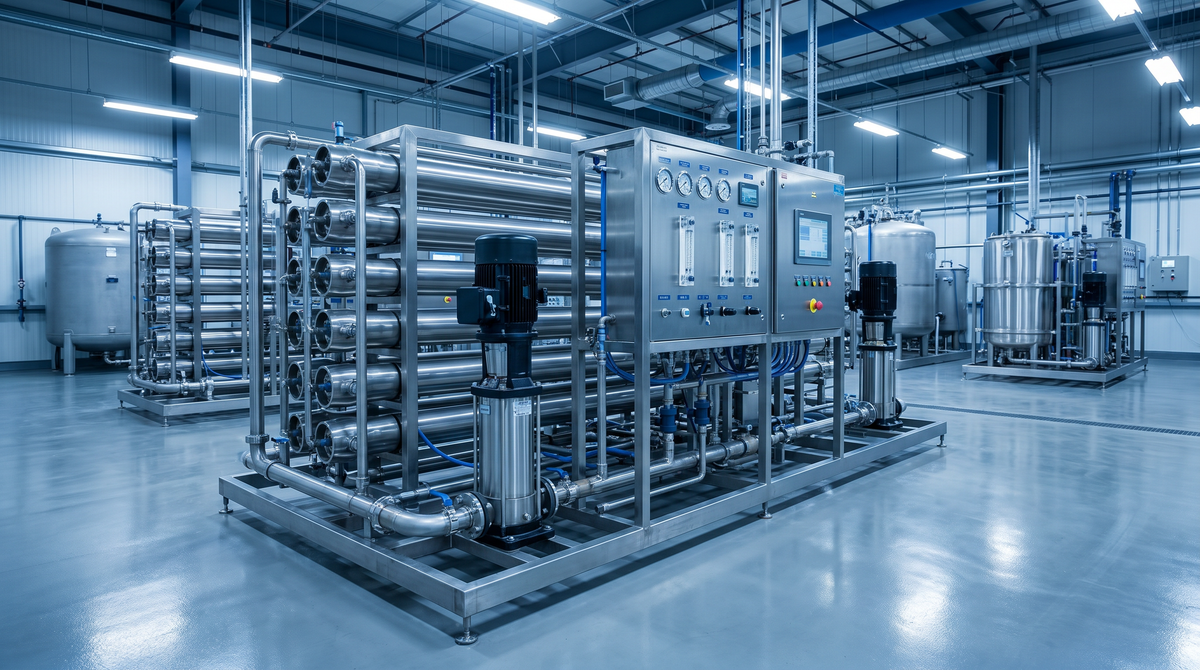
Industrial reverse osmosis removes dissolved salts, heavy metals, nitrates, and organic compounds from process water — but only when the system is properly sized and backed by the right pre-treatment train. This guide covers how industrial RO works, when it outperforms conventional filtration, how to size your system, and what the Watts Canada PUR-O Series can deliver for your facility.
In this article:
- What Is Reverse Osmosis and How Does an Industrial RO System Work?
- What Industries in Canada Use Industrial RO?
- What Does RO Remove That Conventional Filtration Cannot?
- Does Industrial RO Require Pre-Treatment?
- How Do You Size an Industrial RO System?
- Is RO the Right Technology for Your Application?
- Canadian Compliance Context for Industrial RO
- Frequently Asked Questions
What Is Reverse Osmosis and How Does an Industrial RO System Work?
Reverse osmosis forces pressurized feed water through a semi-permeable membrane with pores of approximately 0.0001 microns — small enough to block dissolved salts, heavy metals, bacteria, and most organic molecules. The process splits the feed stream into two outputs: permeate (purified water, typically 75–95% of feed) and concentrate (reject stream carrying removed contaminants).
Unlike conventional filtration — which physically traps suspended particles — RO relies on solution-diffusion mechanics: water molecules dissolve into the membrane and diffuse across, while ions and larger molecules cannot. This allows RO to target species at the ionic level, well below what any mechanical filter reaches.
Standard industrial RO configurations use spiral-wound polyamide thin-film composite (TFC) membranes, operating at 150–250 psi for brackish water (TDS up to 10,000 mg/L). For most Canadian industrial applications — process water polishing, boiler feed, food-grade water, pharmaceutical purification — brackish-water RO membranes are sufficient and significantly more energy-efficient than seawater-grade systems.
What Industries in Canada Use Industrial RO Systems?
Industrial RO is widely deployed wherever dissolved solids, heavy metals, or organics must be reduced below regulatory or process thresholds. Common Canadian applications include:
- Boiler feed water: High TDS causes scale deposition on boiler tubes, reducing efficiency and risking tube failure. RO pre-treatment brings TDS below 10 mg/L, eliminating scale without continuous chemical softening.
- Food and beverage production: Health Canada's Guidelines for Canadian Drinking Water Quality set maximum acceptable concentrations for nitrates (10 mg/L as N), chloramines, and disinfection byproducts. RO reliably meets these thresholds for process water used in food and beverage production.
- Pharmaceutical and laboratory water: USP Purified Water specifications require conductivity ≤1.3 µS/cm and TOC ≤500 ppb — achievable only with RO followed by electrodeionization (EDI) or mixed-bed polishing.
- Mining and heavy industry: RO treats process water contaminated with sulphates, heavy metals, and TDS above 2,000 mg/L before discharge or reuse — essential for meeting CCME Canadian Environmental Quality Guidelines discharge thresholds.
- Commercial car wash and fleet wash: RO rinse water prevents spotting and extends wash water recycling loops — reducing municipal water consumption and effluent discharge volume.
- Electronics and semiconductor facilities: Ultra-pure water (UPW) specifications require resistivity ≥10 MΩ·cm, achieved with RO + EDI + polishing resin.
- Oil and gas produced water: High-TDS water from oil sands and conventional wells requires RO or thermal treatment before surface disposal under provincial effluent permits.
What Does RO Remove That Conventional Filtration Cannot?
Conventional bag and cartridge filtration removes suspended particles down to 0.1–1 micron. Industrial RO goes 1,000 times deeper, targeting dissolved species that physical filters cannot capture. The comparison below shows where RO is necessary versus where simpler (and cheaper) alternatives suffice.
| Contaminant Type | Bag / Cartridge Filter | Activated Carbon | Industrial RO |
|---|---|---|---|
| Suspended solids (>1 µm) | ✓ Yes | ✓ Yes | ✓ Yes |
| Chlorine / chloramines | ✗ No | ✓ Yes | ✓ Yes |
| Dissolved salts / TDS | ✗ No | ✗ No | ✓ Yes (95–99%) |
| Nitrates / nitrites | ✗ No | ✗ No | ✓ Yes (85–95%) |
| Heavy metals (lead, arsenic, chromium) | ✗ No | Partial | ✓ Yes (95–99%) |
| PFAS / PFOA | ✗ No | Partial | ✓ Yes (90–99%) |
| Bacteria / viruses | ✗ No | ✗ No | ✓ Yes (>99.9%) |
| Dissolved organic carbon (DOC) | ✗ No | ✓ Yes | ✓ Yes |
For iron and hydrogen sulphide removal upstream of an RO system, filtration media such as Filox and activated alumina are commonly installed as pre-treatment stages, protecting the membrane from fouling before it begins.
Does Industrial RO Require Pre-Treatment?
Yes — and skipping pre-treatment is the most common reason RO membranes foul prematurely. Two failure modes dominate:
- Biofouling: Bacteria colonize the membrane surface and form biofilm. Chlorine injection upstream (followed by an activated carbon filter to quench residual chlorine before the membrane — polyamide TFC membranes are chlorine-intolerant above 0.1 mg/L) controls biofouling.
- Scaling: Calcium, magnesium, barium, and silica precipitate on the membrane surface when the concentrate stream becomes supersaturated. Antiscalant dosing and/or upstream water softening prevents this.
A standard industrial RO pre-treatment train for Canadian municipal feed water typically includes:
- 5 µm sediment cartridge filter — removes particulates and protects the high-pressure pump. ERE's range of industrial filter cartridges covers this stage in polypropylene, pleated polyester, and wound configurations.
- Activated carbon block filter — removes chlorine and chloramines that degrade polyamide membranes.
- Antiscalant dosing pump — inhibits calcium carbonate, calcium sulphate, and silica scaling at the membrane surface.
- 1 µm final security filter — catches any carbon fines before the high-pressure pump.
For feed water with elevated iron (>0.1 mg/L), manganese (>0.05 mg/L), or hydrogen sulphide, add an iron/H₂S removal stage using Filox or greensand media before the carbon filter. ERE's filtration media range covers these upstream treatment needs, including Filox, activated alumina, activated carbon, and greensand.
How Do You Size an Industrial RO System?
Industrial RO sizing comes down to three numbers: required permeate flow rate, feed water TDS, and recovery rate. Here is a step-by-step approach for Canadian facilities.
Step 1 — Define Your Permeate Flow Requirement
Calculate your average daily water demand in GPD or m³/day. Add 20–30% buffer for peak demand and future growth. This sets the minimum system capacity.
Step 2 — Measure Feed Water TDS
Feed TDS determines operating pressure and membrane selection. Typical Canadian municipal water runs 100–500 mg/L TDS; groundwater from wells varies widely (50–3,000+ mg/L TDS). Request a full water analysis from your local authority or commission an independent lab test before specifying membranes. To check feed and permeate TDS on site, see our TDS meter buyer's guide for choosing a low-range meter.
Step 3 — Select Recovery Rate
Recovery rate = permeate ÷ feed water × 100%. A 75% recovery system wastes 25% as concentrate. For municipal feed (low TDS), 75–80% recovery is standard. For high-TDS or hard water, 50–65% recovery prevents scaling. The reject stream must be safely discharged — consult your provincial environment authority for concentrate disposal limits before commissioning.
Sizing Example
| Parameter | Value |
|---|---|
| Daily demand | 5,000 GPD + 25% buffer = 6,250 GPD minimum |
| Feed TDS | 350 mg/L |
| Target permeate TDS | <25 mg/L |
| Recovery rate | 75% |
| Required feed flow | 6,250 ÷ 0.75 = 8,333 GPD |
| Matched unit | Watts PUR-O-03 Series (up to 9,600 GPD permeate output) |
For flows under 1,800 GPD, the compact Watts PUR-O-01 Series covers the requirement. For flows above 10,000 GPD, ERE configures multi-stage or parallel systems. Browse our full water filtration and treatment equipment selection or contact our team for a system recommendation based on your water analysis.
Is RO the Right Technology for Your Application?
RO is not always the best solution — and it is almost always overkill for suspended-solids removal alone. Use this decision framework to match the technology to the target contaminant:
| If Your Primary Goal Is… | Best Technology |
|---|---|
| Remove suspended particles (>1 µm) | Bag filtration or cartridge filtration — simpler, no high-pressure pump |
| Remove chlorine, taste, or odour | Activated carbon filtration — faster and lower energy than RO |
| Remove iron, manganese, or H₂S | Filox, greensand, or activated alumina filtration media |
| Reduce hardness (Ca/Mg) | Ion exchange water softener — lower operating cost than RO for hardness alone |
| Remove dissolved salts / TDS > 500 mg/L | RO — the correct tool here |
| Remove nitrates or PFAS | RO — few alternatives at commercial scale |
| Kill bacteria and viruses | UV disinfection (kills only) or RO (removes and kills) |
| Achieve USP Purified Water or UPW grade | RO + electrodeionization (EDI) or RO + mixed-bed ion exchange |
For a broader comparison of industrial water treatment technologies — including multimedia sand filtration, ion exchange, UV, and chemical precipitation — see our industrial water filtration systems guide for Canada.
What Does Canadian Compliance Require for Industrial RO Systems?
RO compliance in Canada varies by application and jurisdiction. Key reference points for facility operators:
- Drinking water and food-contact use: Systems should meet NSF/ANSI 58 (Reverse Osmosis Drinking Water Treatment Systems) for health-effects claims. Health Canada's Guidelines for Canadian Drinking Water Quality define maximum acceptable concentrations for contaminants the RO must reduce — validate your system performance against these targets.
- Industrial discharge (reject stream): The concentrate stream discharged to sewer or surface water must comply with provincial effluent guidelines. CCME Canadian Environmental Quality Guidelines set baseline thresholds for TDS, chlorides, and specific metals in discharge water. Review your provincial environmental assessment before commissioning.
- Industrial pre-treatment programs: Facilities discharging to municipal sewer under pre-treatment agreements should confirm concentrate limits comply with their permit conditions — some municipalities restrict high-TDS discharge regardless of contaminant type.
Need help selecting or sizing an industrial RO system for your Canadian facility?
ERE Inc. has supplied water treatment equipment to Canadian industry for 30+ years. Our team reviews your water analysis, recommends the right Watts PUR-O system or custom configuration, and helps you navigate pre-treatment and compliance requirements.
→ Request a Quote | 1-888-287-EREC | Browse Water Treatment Equipment | sales@ereinc.com
Frequently Asked Questions
How long do industrial RO membranes last?
With proper pre-treatment and scheduled chemical cleaning, industrial RO membranes typically last 3–5 years. Premature failure is almost always caused by inadequate pre-treatment — iron fouling, biofouling, or scaling — or by exposure to chlorine on polyamide TFC membranes. Annual membrane autopsies (inspecting a sacrificial element from the lead position) are standard maintenance practice in high-demand facilities.
Can industrial RO systems run continuously?
Yes — most industrial systems are designed for continuous-duty operation (24/7). Standby preservation protocol: flush membranes with 1% sodium bisulphite solution during scheduled shutdowns longer than 72 hours to prevent biofouling during idle periods.
What is the difference between reverse osmosis and nanofiltration?
Nanofiltration (NF) membranes have slightly larger pores than RO. NF removes multivalent ions (calcium, magnesium, sulphates) and organic molecules above approximately 200 Daltons but passes monovalent ions (sodium, chloride) at a higher rate. NF operates at lower pressure (60–150 psi vs. 150–600 psi for RO) and wastes less water — making it the better choice when the goal is hardness removal and organic reduction, not full TDS reduction.
What is the energy consumption of an industrial RO system?
For brackish-water RO at 75% recovery, energy consumption is approximately 0.5–1.5 kWh per cubic metre of permeate produced. Higher feed TDS and lower recovery rates increase energy demand proportionally. Energy recovery devices (ERDs) on large-scale systems above 100 m³/hr can reduce energy consumption by 30–50%.
Does ERE sell RO systems for Canadian facilities?
Yes. ERE distributes the Watts Canada Water Quality PUR-O Series industrial RO systems in capacities from 800 to 36,000 GPD (3,000 to 136,000 L/day). We also supply pre-treatment components including sediment cartridge filters, activated carbon filters, and filtration media for iron and H₂S removal upstream. Contact our team for a system recommendation based on your water analysis and flow requirements.
Related articles
- Industrial Water Filtration Systems: A Guide for Canadian Facilities
- Water Filtration Media: Types, Applications and Selection Guide
- Industrial Filter Cartridges: How to Choose the Right Type and Micron Rating
- Activated Alumina for Water Treatment: Guide for Canada
Lire en français : Osmose inverse industrielle : fonctionnement, quand l'utiliser et quel prétraitement choisir