
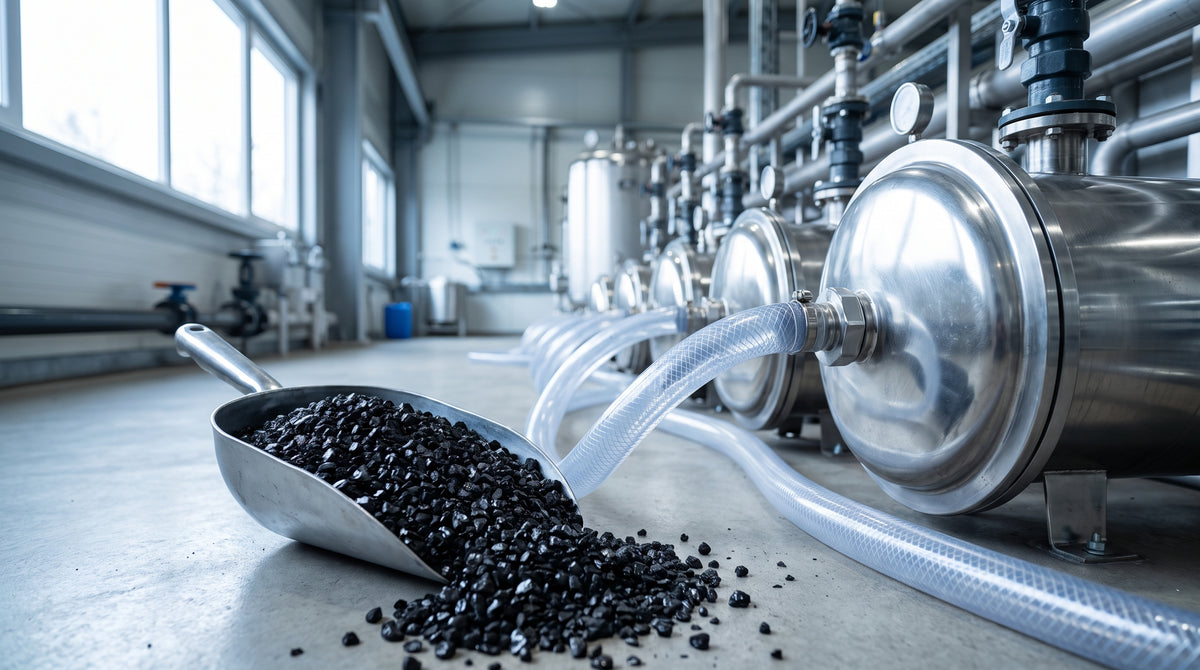
Most pages on activated carbon stop at "it depends on your contaminants." This guide goes further: it shows you how to spec a granular activated carbon (GAC) system — what it removes, when to use GAC versus PAC, how to size a bed using empty-bed contact time (EBCT), and how to tell when the carbon is spent. ERE Inc. stocks both the carbon media and the filter vessels, and we rent and calibrate the field instruments that prove your influent and effluent levels — so this is one of the few guides that takes you from "what is GAC" all the way to "here's how to size and service it."
What activated carbon removes — and what it does NOT
Adsorption is selective. Carbon excels at organic, dissolved, low-polarity compounds; it does little for dissolved inorganic ions, hardness, or living organisms. Knowing the difference is the first sizing decision — if your target is on the right column, GAC alone is the wrong tool.
| Activated carbon REMOVES well | Activated carbon does NOT remove (alone) |
|---|---|
| Free chlorine (fast); chloramine only with catalytic carbon | Nitrate & nitrite |
| VOCs & chlorinated solvents (TCE, PCE, benzene) | Dissolved iron & manganese |
| Total organic carbon (TOC) & colour | Heavy metals — lead (trace only), arsenic, chromium* |
| Taste & odour compounds | Hardness (calcium, magnesium) |
| PFAS / PFOA & PFOS — only with long contact time & specialty media** | Fluoride & dissolved salts (TDS) |
| Hydrogen sulphide (H₂S) & many pesticides/herbicides | Bacteria, viruses & microbes (not a disinfectant) |
*Standard GAC is unreliable for metals — arsenic and chromium removal is poor without surface modification, and only trace lead adsorbs. Use impregnated or specialty media (e.g., KDF, or our catalytic granular activated carbon for chloramine) matched to your target list; ask us which media fits.
**PFAS is the exception that proves the rule. Carbon can reduce PFAS, but only at long contact time (~20 min EBCT, often in a lead-lag setup) and usually with PFAS-selective specialty media — and the carbon is typically single-use, with frequent changeouts, rather than a routine standard-GAC win. See the sizing and changeout sections below.
GAC vs PAC: which to use and when
The single most-requested comparison — granular versus powdered activated carbon — and the one almost no page lays out in table form. They use the same adsorption chemistry but are dosed and serviced completely differently.
| GAC (granular) | PAC (powdered) | |
|---|---|---|
| Form | Coarse granules (e.g., 8×30, 12×40 mesh) | Fine powder |
| Dose method | Packed fixed bed in a vessel | Slurry dosed into the water, then settled/filtered out |
| Contact mechanism | Continuous flow-through; contact time set by EBCT | Batch contact; contact time set by mix/retention |
| Best application | Steady, continuous flow — wells, pump-and-treat, process water | Intermittent or seasonal slug loads (e.g., taste/odour spikes) |
| Reusability | Reactivatable / regenerable (thermal reactivation) | Single-use (lost with the sludge) |
| Typical use case | Most industrial / remediation / point-of-entry systems | Municipal plants handling variable raw-water quality |
For continuous water treatment and remediation — ERE's core work — GAC in a fixed-bed vessel is the default. The rest of this guide focuses on sizing and servicing GAC beds.
Sizing a GAC system: EBCT, contact time, and flow
This is the white space no government or encyclopedia page fills. Carbon doesn't adsorb instantly — the water has to dwell in the bed long enough for diffusion into the pores. That dwell time is governed by EBCT, the empty bed contact time.
The formula:
EBCT (min) = [ Bed Volume (ft³) × 7.48 ] ÷ Volumetric Flow Rate (gpm)
The 7.48 factor converts cubic feet to gallons (7.48 gal/ft³) so the units cancel to minutes. If you already have bed volume and flow in the same units (both gal & gpm, or both ft³ & ft³/min), drop the 7.48 and divide directly.
EBCT uses the full bed volume the carbon occupies, including void space — which is why it's called "empty bed" — so it's easy to compute straight from vessel datasheet numbers. Too short an EBCT and contaminants "break through" early; too long and you're oversizing capital.
Typical EBCT targets by contaminant class (use as a starting point — bench/pilot data refines them):
- Taste & odour, dechlorination: roughly 5–10 minutes
- VOCs & chlorinated solvents: roughly 10–15 minutes
- Recalcitrant organics & PFAS: longer — around 20 minutes is the common water-treatment target for >95% PFAS reduction (10 minutes is a frequent minimum for general use), often in a lead-lag configuration. Pilot data refines the exact number.
In a lead-lag setup, two vessels run in series: the "lead" vessel does most of the work, the "lag" vessel is the safety net that catches breakthrough. When the lead is spent, you swap it out, promote the lag to lead, and put fresh carbon in the lag position — so you never risk treated water going off-spec between changeouts. This is the standard configuration for PFAS and other low-threshold targets.
Knowing when the carbon is spent — and what to do
Carbon has a finite adsorption capacity. Past it, contaminants pass straight through. You don't guess at this — you measure it. The two reliable signals:
- Effluent breakthrough: sample the treated water and watch your target contaminant climb toward its limit. This is why ERE rents and calibrates field meters and lab-grade instruments — your changeout schedule is only as trustworthy as the numbers behind it.
- Pressure-drop creep: rising differential pressure across the bed flags fouling or fines migration, separate from adsorption exhaustion — a sign it's time to backwash or change media.
When the carbon is spent, you have two paths:
- Thermal reactivation: spent GAC is shipped to a furnace, the adsorbed organics are burned off, and the regenerated carbon comes back ready to reuse — the lower-cost, lower-waste route for continuous, high-volume systems. (This is GAC's structural advantage over single-use PAC.)
- Replacement with virgin or reactivated media: for smaller systems, contamination types that preclude reuse (e.g., some PFAS waste streams), or where downtime matters more than media cost.
ERE stocks the carbon media to match — including our UltraSorber-CNS coconut-shell granular activated carbon and the matching UltraSorber Air Treatment Vessels and MAGNUM cartridge-format housings — plus catalytic GAC for chloramine. We carry the spec sheets, the mesh grades, and the field instruments to prove the result, so "we stock it and we service it" isn't a slogan — it's the whole workflow.
Sizing a GAC bed for your site?
Send us your flow rate, target contaminants, and influent levels, and we'll work through EBCT, vessel sizing, media selection, and a changeout plan with you — no charge, no obligation. ERE Inc. stocks the carbon, the vessels, and the field instruments to prove your numbers, and we service the system after it's installed.
→ Request a Quote | 1-888-287-EREC | Browse Filtration Media — Water | sales@ereinc.com
Frequently Asked Questions
Does activated carbon remove chloramine from water?
Not standard GAC at practical contact times — standard carbon removes free chlorine fast but is nearly helpless against chloramine. Chloramine reduction requires catalytic carbon, which decomposes it across a much longer contact window. ERE stocks catalytic granular activated carbon for exactly this case.
What EBCT do I need for PFAS removal with GAC?
Around 20 minutes of empty-bed contact time is the common water-treatment target for greater than 95% PFAS reduction, typically run in a lead-lag configuration; 10 minutes is a frequent minimum for general organics. Treat these as starting points — bench or pilot data on your specific water refines the exact number.
How do I calculate EBCT for a carbon bed?
EBCT (minutes) = bed volume in cubic feet × 7.48, divided by flow rate in gpm. The 7.48 converts cubic feet to gallons so the units resolve to minutes. EBCT uses the full empty-bed volume the carbon occupies, including void space — so you can read it straight off vessel datasheets.
Does activated carbon remove heavy metals like lead or arsenic?
Standard GAC is unreliable for metals. Only trace lead adsorbs, and arsenic and chromium removal is poor without surface-modified or impregnated media. For metals you need specialty media matched to the specific ion — ask ERE which media fits your target list.
When should activated carbon be replaced or reactivated?
When effluent sampling shows your target contaminant breaking through toward its limit, or when pressure drop across the bed climbs. Spent GAC can be thermally reactivated (burned clean and reused) for continuous high-volume systems, or replaced with virgin/reactivated media for smaller systems or non-reusable waste streams.
Lire en français : Traitement de l'eau au charbon actif : guide pratique