
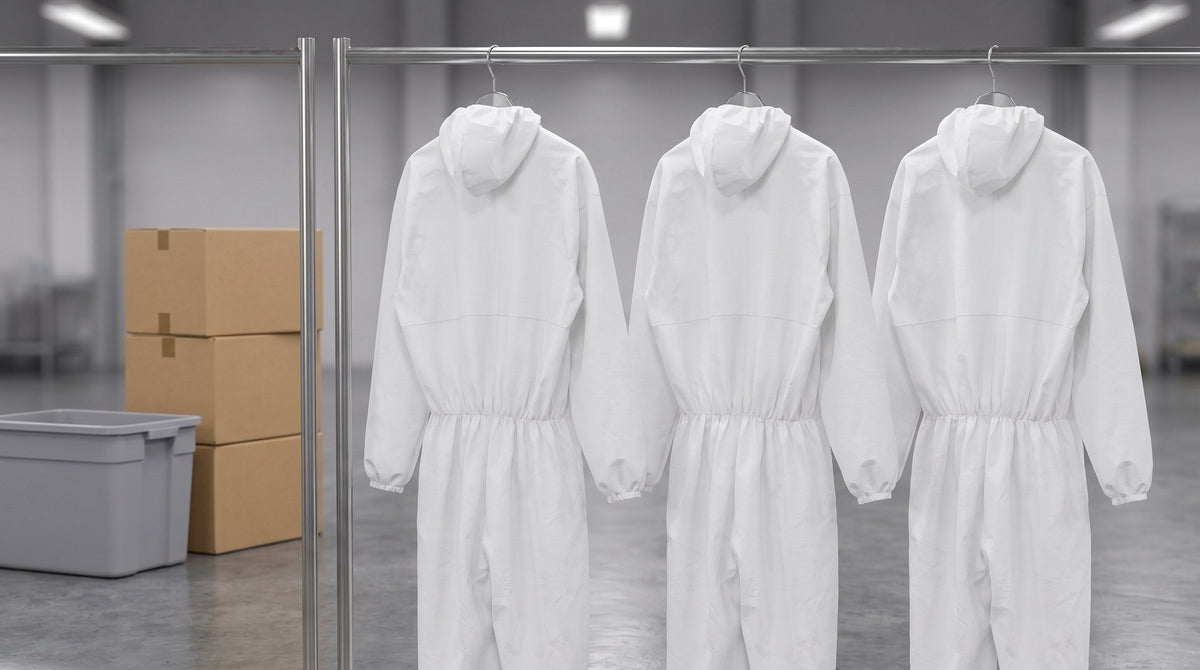
A disposable coverall is a single-use, full-body garment with a hood, made from non-woven polypropylene or a microporous film laminate. What it protects against depends on the fabric and the certification printed on the label, not on the word “disposable.” This guide sorts the six RONCO coveralls on ERE’s records by what each one states, from the RONCO Care PP for dry dust to the CoverMe XP 2000, and explains the Type 5 and Type 6 ratings that separate them.
In this guide
- What Are Disposable Coveralls and What Do They Protect Against?
- Which Disposable Coveralls Does ERE List?
- What Do Type 5 and Type 6 Mean?
- Polypropylene or Microporous: Which Fabric Do You Need?
- Do Disposable Coveralls Protect Against Chemicals?
- How Do You Choose the Right Size and Closure Details?
- What Else Do You Wear With a Coverall?
- How Do You Choose a Disposable Coverall, Step by Step?
- Frequently Asked Questions
What Are Disposable Coveralls and What Do They Protect Against?
They are one-piece, hooded garments meant to be worn once and discarded, which keeps contamination from being carried out of the work area on reusable clothing. They protect the skin and your clothes from dust, fibres and, depending on the fabric, light splash.
The protection comes from the fabric weight and construction. ERE’s polypropylene records describe a “low-cost garment solution” against “dry particulates such as dirt and dust” in industrial facilities or non-hazardous environmental management. The microporous records add a liquid-resistant film and, on three of them, a printed certification. None of these records claims protection against hazardous chemical permeation.
Which Disposable Coveralls Does ERE List?
ERE lists six RONCO coveralls in Body Protection. The table shows only what each record prints.
| Record | Fabric and weight | Rating or claim on the record | Sizes |
|---|---|---|---|
| RONCO Care PP | Non-woven polypropylene, 25 gsm, hood, elastic wrists and ankles | Dry particulate protection; CFIA accepted; compliant for contact with food | S to 5XL white; M to 3XL blue |
| RONCO CoverMe PP 50 gsm | Non-woven polypropylene, 50 gsm, hood, serged seams, elastic wrists and ankles | Dry particulate protection; CFIA accepted; latex-free | S to 5XL white; M to 4XL blue |
| RONCO CoverMe XP 1000 | Microporous film laminated to a polypropylene lining, 60 gsm, hood, elasticized wrists, waist and ankles | Chemical / solvent resistance “moderate”; fluid resistant; dry particulate protection; abrasion resistant; latex-free. No Type rating printed | S to 5XL, white |
| RONCO CoverMe XP 1800 | Microporous, 53 gsm, hood, 4.5 cm storm flap | Category III, Type 5/6; EN 368, EN 14126, EN 1149-5, EN 1073-2, ISO 14644-1; 25 per bag | M to 5XL, white |
| RONCO CoverMe XP 1800 with boots | Microporous, 53 gsm, hood and attached skid-resistant boots, 4-thread overlocked seams, 4.5 cm storm flap | Type 5-B / 6-B; EN 14126, EN 1149-5, EN 1073-2 | M to 5XL, white |
| RONCO CoverMe XP 2000 | Microporous, 63 gsm, hood, 4.5 cm storm flap, extra room in crotch and shoulder | Category III, Type 5/6; EN 368, EN 14126, ASTM F1670, EN 1149-5, EN 1073-2, ISO 14644-1; listed as suitable for cleanroom use | M to 4XL, white |
The records do not print a price comparison, a chemical permeation table or a breakthrough time for any of the six. For a specific chemical, request the maker’s data before relying on a coverall.
What Do Type 5 and Type 6 Mean?
Type 5 is protection against airborne solid particles under EN ISO 13982-1, and Type 6 is limited protection against liquid chemicals under EN 13034. A review of chemical protective clothing standards in NIH’s PubMed Central describes Type 5 as applicable only to airborne solid particulates, and Type 6 as very limited protection, tested against four chemicals with minimum performance needed on only two (NIH PMC, Current global standards for chemical protective clothing).
The same review says Type 5 clothing is often used to reduce particulate deposit on the skin in asbestos abatement and other work with hazardous dusts (NIH PMC link above). Read the label as “mist-tight and dust-tight at a minimum.” It does not mean the fabric resists a solvent for an hour.
EN 1073-2 on three of the records is a different test. The same source says it was developed for the nuclear industry, applies the Type 5 inward-leakage method, grades garments into three classes, and does not apply to protection from ionising radiation (NIH PMC link above). The ERE records do not print the class, so ask for the maker’s sheet if you need it.
Polypropylene or Microporous: Which Fabric Do You Need?
Choose polypropylene for dust, dirt and general maintenance, and microporous when liquid splash or fine particles are a concern. The decision follows the hazard, and the lighter fabric is the right answer when the hazard is only dry dust.
- 25 gsm Care PP: the lightest option, for the hospital, food-plant and general industrial settings the record names. It prints no liquid claim.
- 50 gsm CoverMe PP: the same dry-particulate claim in a heavier fabric with serged seams. Still no liquid claim on the record.
- 60 gsm XP 1000: a microporous film on a polypropylene lining. The record says it protects against non-hazardous particles, light splash and aerosols, and names automotive refinishing and waste cleanup.
- 53 to 63 gsm XP line: certified Type 5/6 (Type 5-B/6-B for the boots version) with the standards listed in the table above.
Weight in gsm is a measure of fabric mass, not of chemical resistance. A 50 gsm polypropylene coverall is not “more protective” than a 53 gsm microporous one against a liquid, because the film is what stops it.
Do Disposable Coveralls Protect Against Chemicals?
Only to the limited degree the rating states. CCOHS separates penetration, where a chemical leaks through seams, pinholes and other imperfections, from permeation, where it diffuses through intact material, and says material should be selected on permeation rate, breakthrough time, penetration and degradation (CCOHS, Chemical Protective Clothing). The page is written around gloves, but the definitions apply to any chemical protective clothing.
A Type 5/6 coverall passes particle and limited-spray tests. It is not a permeation test. If your task involves a named solvent, an acid or a pressurized liquid, a Type 5/6 label is not enough, and you need chemical protective clothing with permeation data for that chemical. The chemical gloves guide shows how the same logic works for hands.
How Do You Choose the Right Size and Closure Details?
Size by the maker’s size chart, not by your usual clothing size, and note the closure details that matter for the job. The XP 1000 and CoverMe PP records link a RONCO coverall size chart, and the sizes run from small to 5XL on most models.
- Storm flap: the XP 1800, XP 1800 with boots and XP 2000 records list a 4.5 cm storm flap over the front closure for added impermeability.
- Attached boots: the XP 1800 with boots has a hood and skid-resistant boots in one garment, so there is no gap at the ankle for dust to enter.
- Elastics: five of the six records list elastic at the wrists (the plain XP 1800 record lists none), and the polypropylene, XP 1000 and XP 2000 records list it at the ankles. The XP 1000, XP 1800 with boots and XP 2000 also list elastic at the waist.
- Colour: the Care PP and CoverMe PP come in white and blue, which makes it easy to separate zones or crews. The microporous records list white only.
What Else Do You Wear With a Coverall?
A coverall covers the body and head only, so the hands, eyes and airway need their own protection. Match each to the hazard and tape or seal the interfaces as your procedure requires.
- Airway: a dust or vapour hazard needs a respirator. See the half mask respirator guide and the PAPR guide.
- Hands: pick gloves by chemical and task, using the EN 374 guide.
- Working at height: a coverall is not fall protection; see the fall arrest harness guide.
For abatement or other regulated work, the requirements for clothing, decontamination and disposal come from your provincial or territorial regulation, not from the product label.
How Do You Choose a Disposable Coverall, Step by Step?
- Name the hazard. Dry dust, fibres, light mist, or a named chemical. Read the safety data sheet.
- Decide if a Type rating is required. If your procedure or regulation asks for Type 5 or Type 6, rule out the models that print no Type.
- Rule out chemicals that need permeation data. A Type 5/6 label does not cover them; ask for the maker’s data.
- Pick the fabric. Polypropylene for dry dust; microporous for splash and fine particles.
- Pick the details. Storm flap, attached boots, colour and size run from the maker’s chart.
- Plan the program. Donning, sealing, removal, disposal and quantities. Request a quote once the above is settled.
Need coveralls matched to your task?
ERE Inc. has been Canada’s environmental equipment specialist for 30+ years. Tell us the hazard, the work and the quantity, and we will shortlist the coverall from what each record states and request the maker’s documentation for you.
→ Request a Quote | 1-888-287-EREC | Browse Body Protection | sales@ereinc.com
Frequently Asked Questions
What is a disposable coverall?
A single-use, hooded, full-body garment in non-woven polypropylene or a microporous film laminate. It is worn once and discarded, so contamination is not carried out on reusable clothing.
What is the difference between Type 5 and Type 6?
Type 5 is protection against airborne solid particles (EN ISO 13982-1). Type 6 is limited protection against liquid chemicals (EN 13034). A review in NIH PubMed Central says Type 6 is tested against four chemicals and is much less stringent than permeation testing.
Do polypropylene coveralls protect against chemicals?
No. ERE’s Care PP and CoverMe PP records claim dry particulate protection only, for non-hazardous settings. For liquids, look at a microporous model with the rating you need, and for a named chemical, get permeation data.
Which ERE coveralls are rated Type 5/6?
The CoverMe XP 1800 and XP 2000 print Category III, Type 5/6, and the XP 1800 with boots prints Type 5-B / 6-B. The XP 1000 record prints no Type rating.
Can you wash and reuse a disposable coverall?
They are designed for single use, so follow the maker’s instructions and your site procedure for removal and disposal. ERE’s records do not describe a laundering process.
Related Articles
- Half Mask Respirator: How to Match Cartridges and Filters to the Hazard in Canada
- Chemical Resistant Gloves: How to Read EN 374 Codes and Choose in Canada
- Powered Air Purifying Respirator (PAPR): How It Works and How to Choose in Canada
Lire en français : Combinaisons jetables : comment choisir entre PP, microporeux et type 5/6 au Canada