
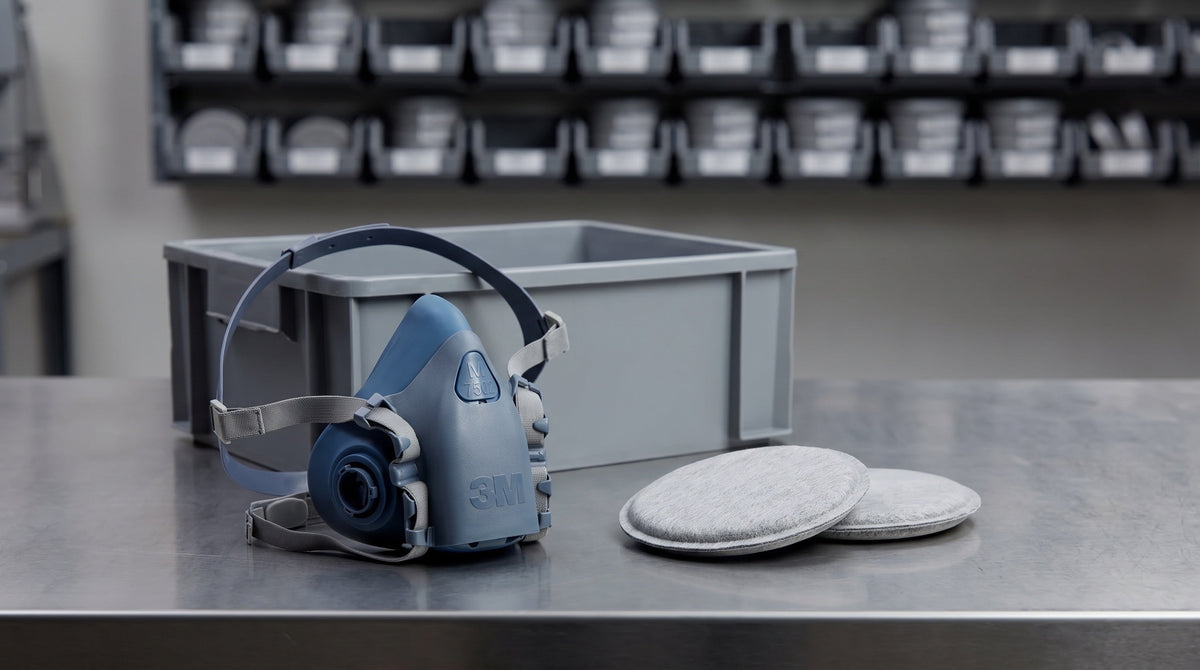
A half mask respirator is a reusable, tight-fitting facepiece that covers the nose and mouth and filters air through replaceable filters or cartridges. NIOSH describes elastomeric half masks as reusable devices with exchangeable cartridges or filters, with facepieces that allow repeated cleaning, disinfection, storage and reuse (NIOSH, Elastomeric Half Mask Respirators). The mask is only half the choice: the filter or cartridge decides what it protects against. This guide matches the consumables on ERE’s records to the hazard, starting with the 3M 7500 Series half facepiece and the Dräger X-plore 3300/3500.
In this guide
- What Is a Half Mask Respirator and What Does It Protect Against?
- Which Half Masks Does ERE List?
- Which Cartridge Matches Which Hazard?
- Which Filter Do You Need for Dust, Mist and Fume?
- Does a Half Mask Need Fit Testing?
- When Do You Replace Filters and Cartridges?
- When Is a Half Mask Not Enough?
- How Do You Choose a Half Mask, Step by Step?
- Frequently Asked Questions
What Is a Half Mask Respirator and What Does It Protect Against?
It is a negative-pressure air-purifying respirator: your breathing pulls air through the filters, so the seal on your face is what makes it work. CCOHS lists the air-purifying half-facepiece respirator among the respirators with an assigned protection factor (APF) lower than a powered air-purifying full-facepiece respirator (CCOHS link above).
What it protects against is set by the consumable you fit, not by the facepiece. Dust, mist and fume need a particulate filter. A solvent vapour or acid gas needs a cartridge certified for that class. NIOSH adds one limit worth knowing: a half mask without exhalation valves cannot be equipped with gas or vapour cartridges (NIOSH link above).
Which Half Masks Does ERE List?
ERE lists two half-mask families in Respiratory Protection. The table shows only what each record prints.
| Record | Facepiece | Sizes | What the record prints |
|---|---|---|---|
| 3M Half Facepiece 7500 Series | Silicone, 3M Cool Flow exhalation valve | Small 7501, Medium 7502, Large 7503 | NIOSH-approved, up to 10x PEL; bayonet connection for 3M 2000, 5000 and 7000 series filters and 6000 series cartridges |
| Dräger X-plore 3300 / 3500 | 3300 no-maintenance (TPE); 3500 reusable (DrägerFlex) | Small, Medium, Large | NIOSH 42 CFR 84 / EN 140; about 95 g; bayonet dual-filter connection; cartridge shelf life at least 4 years, expiry stamped on the label |
The records do not print a price comparison, a service life, or a Canadian protection factor. “Up to 10x PEL” is the 3M record’s wording for the 7500 and does not name a jurisdiction, so take the protection factor your worksite may use from its own legislation or CSA Z94.4. If you need the heavier-duty options, ERE also lists the 3M Full Facepiece 6000 Series and the 3M Powerflow PAPR.
Which Cartridge Matches Which Hazard?
Match the cartridge to the chemical class on the label and the safety data sheet. ERE’s 3M Cartridges 6001 to 6005 record is sold per pair, fits the 3M 6000 and 7000 series facepieces with bayonet holders, and lists these models:
| 3M model | Cartridge type on the record |
|---|---|
| 6001 | Organic vapour |
| 6002 | Acid gas |
| 6003 | Organic vapour / acid gas |
| 6004 | Ammonia / methylamine |
| 6005 | Formaldehyde / organic vapour |
Dräger sells the equivalent bayonet range for the X-plore masks. The X-plore Gas & Vapor Cartridges record lists organic vapour (DR-6738024), organic vapour / acid gas with formaldehyde, chlorine dioxide and hydrogen fluoride (DR-6738025), ammonia / methylamine (DR-6738027) and Multi-Gas+ (DR-6738351). The X-plore Combination Cartridges add a P100 particulate stage to each of those, for work that has both a vapour and a particle (DR-6738034, -035, -037 and -361).
Dräger’s own application table on those records pairs tasks with filter types, for example welding and sanding wood with P100, and painting with organic-solvent paints with organic vapour plus an N95 pre-filter. Treat it as a starting point, not a hazard assessment.
Which Filter Do You Need for Dust, Mist and Fume?
CCOHS groups particulate filters by oil resistance: N series are not resistant to oil, R series are resistant, and P series are strongly resistant (CCOHS link above). Where oil mist is present, that letter matters as much as the efficiency number.
ERE stocks two particulate options for the half masks:
- 3M Particulate Filter 7093, P100: the record says it is NIOSH approved for environments with certain oil and non-oil based particles, for use with 3M 5000 Series respirators, 6000 Series cartridges with the 3M 502 adapter, or 6000 and 7000 Series facepieces with bayonet filter holders. Sold 4 per pack.
- Dräger X-plore Particle Filters: P100 (DR-6740830, 22 per box), N95 and R95 filter pads, and Pure P100 pancake filters, plus the pad retainer and base parts that let you add an N95 or R95 pad to a cartridge.
Do not mix brands. Neither record says 3M and Dräger bayonet filters fit each other’s facepieces, so use the part numbers named on the facepiece record.
Does a Half Mask Need Fit Testing?
Yes. NIOSH states the facepiece of an elastomeric half mask must form a tight seal against the face, covering the nose and mouth (NIOSH link above). CCOHS describes fit testing as one element of a respiratory protection program under CSA Z94.4, alongside selection, training, inspection, cleaning, maintenance and storage, and notes that beards, long sideburns and stubble can break the seal (CCOHS link above).
Both ERE half-mask families come in Small, Medium and Large, so the first job is finding the size that passes a fit test, not the size that feels comfortable. A user seal check each time the mask is put on is a routine check, not a substitute for the fit test.
When Do You Replace Filters and Cartridges?
On the maker’s schedule. CCOHS says both cartridges and filters must be replaced regularly using the manufacturer’s recommendations, usually determined by warning properties or end-of-service indicators (CCOHS link above). ERE’s records do not print a breakthrough time or an hours-of-use figure for any 3M or Dräger cartridge, so ask for the maker’s documentation for your specific chemical and concentration.
NIOSH also lists cleaning and disinfecting as an ongoing task for an elastomeric half mask, and says to follow the manufacturer’s guidelines when cleaning (NIOSH link above). The Dräger records note a minimum 4-year cartridge shelf life with the expiry date stamped on the label; check it before fitting.
When Is a Half Mask Not Enough?
Three cases. First, oxygen-deficient or IDLH atmospheres: an air-purifying respirator, powered or not, cannot be used, and supplied-air equipment is required (CCOHS link above). Second, hazards that also reach the eyes or face: a half mask gives no eye protection, so pair it with eyewear or step up to a full facepiece such as the 3M 6000 Series. Third, long shifts or high concentrations where breathing resistance or a higher protection factor is the problem: see the PAPR guide.
CCOHS is also clear that respirators are not the first control. They belong after elimination, substitution, engineering and administrative controls, or while those controls are being installed or repaired.
How Do You Choose a Half Mask, Step by Step?
- Name the contaminant. Particle, gas, vapour or a mix, and the concentration against the exposure limit. Read the safety data sheet.
- Rule out atmospheres a half mask cannot serve. Oxygen-deficient or IDLH atmospheres need supplied air.
- Get the protection factor from your own rules. Use your jurisdiction’s legislation or CSA Z94.4.
- Pick the consumable. A P100 filter for particles, a certified cartridge for a vapour or gas, or a combination cartridge for both.
- Pick the facepiece to match. Same brand bayonet system as the consumable; size by fit test.
- Plan the program. Fit testing, replacement schedule, cleaning, storage and training. Request a quote once the above is settled.
Need a half mask matched to your hazard?
ERE Inc. has been Canada’s environmental equipment specialist for 30+ years. Tell us the contaminant, the exposure limit and your jurisdiction, and we will shortlist the mask, filters and cartridges from what each record states and request the maker’s documentation for you.
→ Request a Quote | 1-888-287-EREC | Browse Respiratory Protection | sales@ereinc.com
Frequently Asked Questions
What is a half mask respirator?
A reusable, tight-fitting facepiece covering the nose and mouth, with exchangeable filters or cartridges. NIOSH says the facepieces allow repeated cleaning, disinfection, storage and reuse.
Does a half mask respirator need fit testing?
Yes. NIOSH says the facepiece must form a tight seal against the face. CCOHS places fit testing inside a CSA Z94.4 respiratory protection program and notes that beards, long sideburns and stubble can break the seal.
Which cartridge do I need for organic vapours?
A cartridge certified for organic vapour. On ERE’s records that is the 3M 6001 (or 6003 if acid gas is also present) and the Dräger X-plore DR-6738024. Check the safety data sheet and the maker’s documentation first.
Does a half mask protect my eyes?
No. A half mask covers the nose and mouth only. If the hazard reaches the eyes, add eye protection or choose a full facepiece.
How often should filters and cartridges be replaced?
On the manufacturer’s recommendation, usually set by warning properties or an end-of-service indicator, according to CCOHS. ERE’s records print no service-life figure, so request the maker’s data for your chemical.
Related Articles
- Powered Air Purifying Respirator (PAPR): How It Works and How to Choose in Canada
- Chemical Resistant Gloves: How to Read EN 374 Codes and Choose in Canada
- Fall Arrest Harness: How to Read CSA Z259.10 Classes and Choose in Canada
Lire en français : Demi-masque respiratoire : choisir cartouches et filtres selon le danger au Canada