
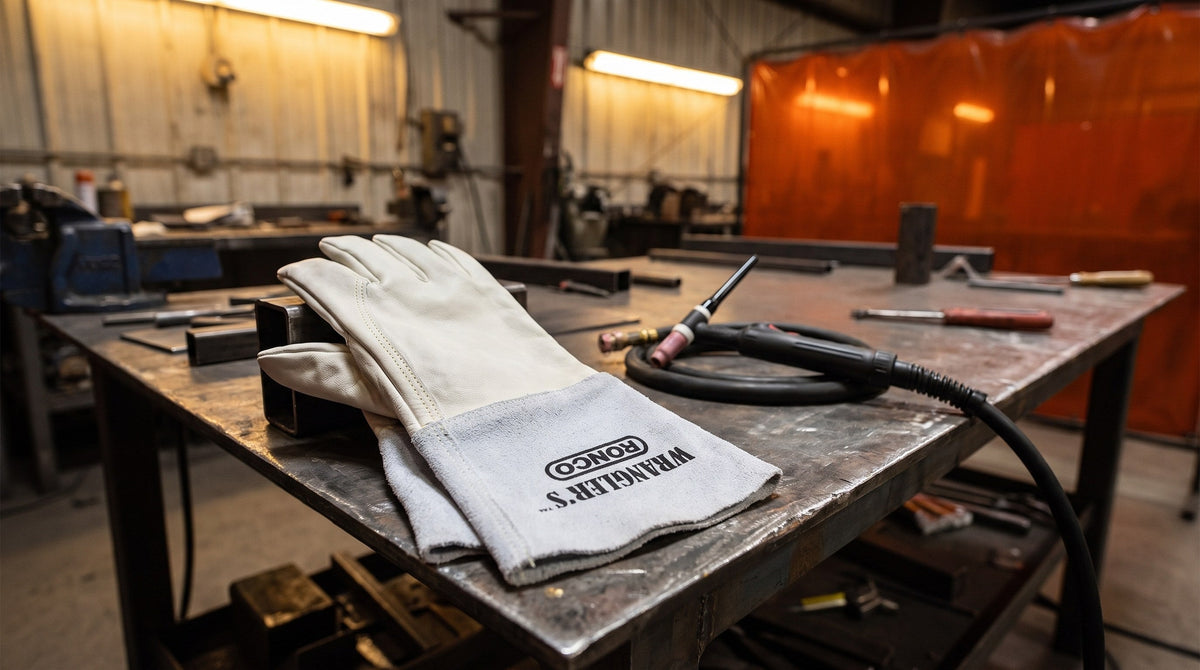
A welding glove is defined by a standard, not by a word on the label. EN 12477 sets the minimum mechanical and heat performance for gloves used in welding and allied processes, and it splits them into Type A for general work and Type B for dexterity, such as TIG. This guide sets out what each type requires, how to match a glove to MIG, TIG or stick work, and what the three Ronco welding gloves in ERE’s hand protection collection actually state on their product records, including what they leave unsaid.
In this guide
- What Makes a Glove a Welding Glove?
- What Do EN 12477 Type A and Type B Require?
- Which Welding Gloves Suit MIG, TIG or Stick Welding?
- Which Welding Gloves Does ERE Carry?
- What Do the Ronco Records Print, and What Do They Leave Out?
- Are Leather Work Gloves the Same as Welding Gloves?
- Why Does the Cuff Length Matter?
- How Do You Choose Welding Gloves, Step by Step?
- Frequently Asked Questions
What Makes a Glove a Welding Glove?
A glove earns the name by being designed for welding operations and tested to the welders’ standard. SATRA describes EN 12477 as the standard specifically intended for gloves designed for welding and allied processes, and it refers to EN 420 so the glove does not itself cause harm, is comfortable and is correctly sized (SATRA, EN 12477).
In Canada the practical baseline comes from occupational health guidance. CCOHS recommends gauntlet-type cuff leather gloves, or protective sleeves of similar material, to protect wrists and forearms, and notes that leather is a good electrical insulator if kept dry (CCOHS, Welding – Personal Protective Equipment and Clothing). Gloves are one item in that PPE chart, alongside eye and face protection, respirators, flame-resistant clothing and boots.
What Do EN 12477 Type A and Type B Require?
They require different minimum levels on the same nine tests, and Type A asks for more on most lines (cut and contact heat are the same for both). The table reproduces SATRA’s summary of EN 12477:2001 + A1:2005.
| Requirement | Test standard | Type A minimum | Type B minimum |
|---|---|---|---|
| Abrasion resistance | EN 388 | Level 2 | Level 1 |
| Blade cut resistance | EN 388 | Level 1 | Level 1 |
| Tear resistance | EN 388 | Level 2 | Level 1 |
| Puncture resistance | EN 388 | Level 2 | Level 1 |
| Burning behaviour | EN 407 | Level 3 | Level 2 |
| Contact heat resistance | EN 407 | Level 1 | Level 1 |
| Convective heat resistance | EN 407 | Level 2 | Not required |
| Resistance to small splashes of molten metal | EN 407 | Level 3 | Level 2 |
| Dexterity | EN 420:1998 | Level 1 | Level 4 |
Read the last row carefully: dexterity level 4 is the higher, more nimble result, which is why Type B trades protection for feel. If you want the heat side of this decision explained on its own, see Heat Resistant Gloves: How to Read the Temperature and Level Claims in Canada.
Which Welding Gloves Suit MIG, TIG or Stick Welding?
Match the type to how much protection versus feel the process demands. SATRA’s guidance is that Type B gloves suit work that needs higher dexterity with lower protective properties, such as TIG welding, while Type A gloves suit more general welding and cutting operations where higher protection is needed (SATRA, EN 12477).
- TIG: fine torch and filler control favours a thin, dexterous glove, which is the Type B case. ERE’s Wrangler’s 75-251 record names TIG welding and uses grain leather, the record’s wording for comfort and dexterity.
- MIG: spatter and radiant heat sit closer to the hand, and the Wrangler’s 75-282 record describes a MIG welder glove with a fleece-lined back and a 6 in. gauntlet cuff.
- Stick and heavy cutting: the general, higher-protection case that SATRA assigns to Type A. The Wrangler’s 75-450-10 record describes a fully lined split cowhide glove for welding and general material handling.
These are the makers’ product descriptions matched to SATRA’s process guidance; they are not a claim that a given glove holds Type A or Type B, because the records do not print one.
Which Welding Gloves Does ERE Carry?
ERE lists three Ronco Wrangler’s gloves that their records describe for welding. The table repeats what each record states.
| Glove (ERE record) | Named use | Leather and liner | Cuff and construction | Colour, sizes, pack |
|---|---|---|---|---|
| Wrangler’s 75-251 | TIG welding and general material handling | Premium cow grain leather | 4.5 in. gauntlet cuff; Twaron stitching resistant to abrasion | Grey; Large and X-Large; 6 pairs/bag |
| Wrangler’s 75-282 | MIG welding | Cow grain palm, suede leather back and cuff; aramid fibre liner; fleece-lined back of hand | 6 in. gauntlet cuff; padded palm and cushioned wrist | Black; Small to X-Large; 6 pairs/bag |
| Wrangler’s 75-450-10 | Welding and general material handling | Premium cow split leather; jersey insulated liner with cotton canvas cuff lining | Gauntlet cuff; Twaron stitching resistant to abrasion and contact heat from molten material; one-piece back so no seams are exposed to sparks | Grey; X-Large; 6 pairs/box |
The 75-282 is the only one of the three that prints numeric levels. Its record lists ANSI/ISEA 105 cut level 5 from the aramid liner, heat level 4 from the fleece-lined back, and abrasion level 3. Those are ANSI/ISEA levels, a different system from the EN levels in the EN 12477 table above, so the two must not be read across as equivalent. For how cut ratings work, see Cut Resistant Gloves: How to Read the Ratings and Choose a Cut Level in Canada.
What Do the Ronco Records Print, and What Do They Leave Out?
They print the materials, the cuff and the intended process, and they leave out the standard marking. None of the three records prints an EN 12477 type, an EN 407 burning-behaviour, convective-heat or molten-metal-splash level, or a contact-heat temperature. The wording “heat resistant protection” on the 75-251 and 75-450-10 is a description, not a tested level.
That is a gap in what is printed, not proof that the gloves fall short. It does mean a buyer whose site, insurer or customer specifies EN 12477 Type A or B needs the maker’s certificate before ordering, and ERE will request it on your behalf.
Are Leather Work Gloves the Same as Welding Gloves?
No. A leather glove is a welding glove only if its maker designs and describes it for welding. ERE’s other Wrangler’s leather gloves, such as the 74-061 double-palm split leather fitter with a 4 in. gauntlet cuff and the unlined 74-091 with a 4.5 in. gauntlet, are described for general maintenance, industrial, warehouse, shipping and oil and gas tasks. Their records do not name welding.
Use them for material handling around the work, not at the arc, unless the maker’s data says otherwise.
Why Does the Cuff Length Matter?
The cuff covers the wrist and forearm where spatter and sparks land between the glove and the sleeve. CCOHS specifically recommends gauntlet-type cuff leather gloves or protective sleeves to protect wrists and forearms (CCOHS, Welding – Personal Protective Equipment and Clothing).
On the ERE records the range is 4.5 in. on the 75-251, 6 in. on the 75-282, and an unspecified gauntlet length on the 75-450-10. CCOHS also says pant legs should have no cuffs, shirt pockets should be closed and clothing should not be synthetic; the same care applies at the sleeve-and-glove overlap, so overlap the sleeve over or under the gauntlet as your site’s procedure sets.
How Do You Choose Welding Gloves, Step by Step?
- Name the process. TIG, MIG, stick or cutting; SATRA links TIG to dexterity-led Type B and general welding and cutting to Type A.
- Check what your site or customer specifies. If EN 12477 Type A or B is required, that requirement decides the shortlist before comfort does.
- Match the leather to feel versus protection. Grain leather is described on the ERE records for comfort and dexterity; split leather with a full liner for heavier work.
- Choose the cuff. Compare 4.5 in. and 6 in. gauntlets and how they overlap your sleeves.
- Ask for the maker’s data. The records print no EN 12477 type, so request the certificate and any EN 407 levels.
- Size and pack. Confirm size availability (the 75-251 is Large and X-Large; the 75-282 runs Small to X-Large) and the pair count per bag, then request a quote.
Need welding gloves matched to your process?
ERE Inc. has been Canada’s environmental equipment specialist for 30+ years. Tell us the process, the standard your site requires and the sizes you need, and we will shortlist Ronco welding gloves by what each product record states and request the maker’s certificates for you.
→ Request a Quote | 1-888-287-EREC | Browse Hand Protection | sales@ereinc.com
Frequently Asked Questions
Do you need welding gloves for TIG welding?
Yes. CCOHS recommends gauntlet-type cuff leather gloves for welding to protect wrists and forearms, and SATRA notes that Type B gloves are the more suitable choice for TIG where higher dexterity is needed. ERE’s Wrangler’s 75-251 record names TIG welding.
What is the difference between EN 12477 Type A and Type B?
Type A has higher minimums for abrasion, tear, puncture, burning behaviour, convective heat and molten-metal splash, and only requires dexterity level 1. Type B has lower protection minimums and requires dexterity level 4, which is why SATRA points it at work such as TIG.
Can you use cut resistant gloves for welding?
Only if the glove is designed and described for welding. The Wrangler’s 75-282 is a MIG welding glove that also carries an ANSI/ISEA 105 cut level 5 on its record, but a cut rating on its own says nothing about heat, sparks or molten metal.
Why do welding gloves have a long cuff?
To cover the wrist and forearm from sparks and spatter. CCOHS recommends gauntlet-type cuff leather gloves or protective sleeves of similar material for this reason.
How do I get the EN 12477 certificate for a Ronco welding glove?
Ask ERE. None of the three welding glove records prints an EN 12477 type or EN 407 levels, so we request the maker’s certificate and levels for the model you name and quote the glove that meets your specification.
Lire en français : Gants de soudeur : MIG, TIG ou électrode, comment lire la norme EN 12477 au Canada