
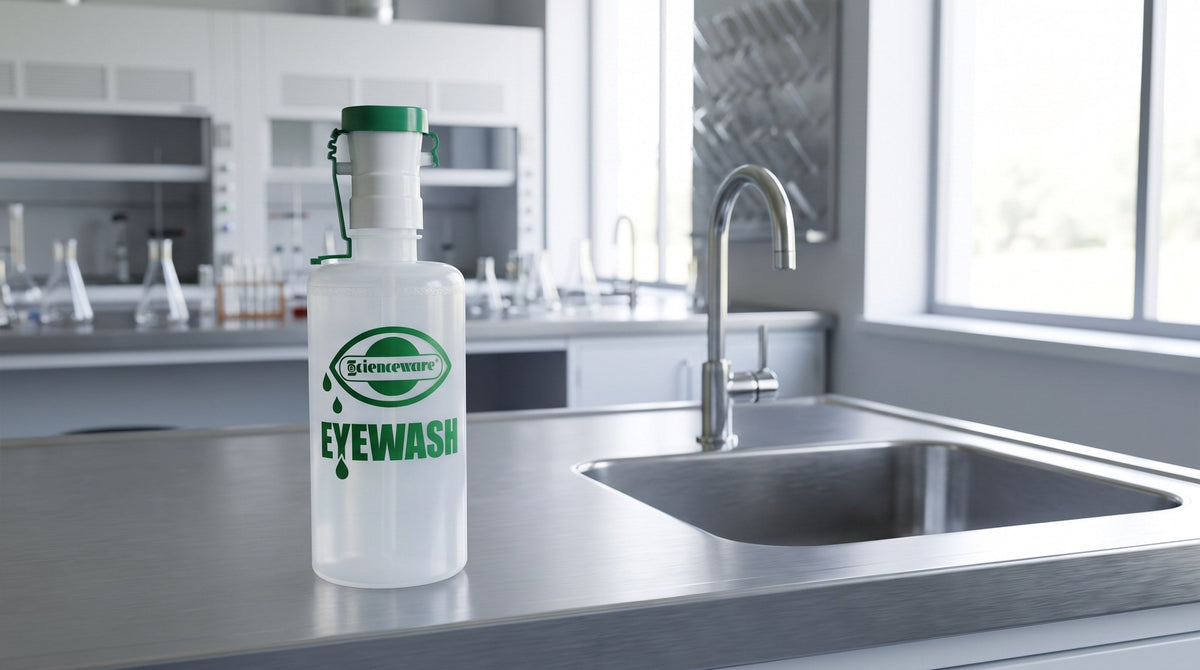
An eyewash station must deliver fluid to both eyes at 1.5 litres per minute for 15 minutes, which is 22.5 litres, according to the ANSI Z358.1 figures that CCOHS uses as its guide in Canada. A 1 L bottle covers about 40 seconds of that. So the real choice is not "which product", it is which of three roles you are filling: a plumbed or self-contained station for the full flush, and a personal bottle for the first seconds on the way to it. ERE carries wall stations, refill solutions and bottles from PIP, Safecross, WASIP and Cederroth.
In this guide
- Do Canadian rules require an eyewash station?
- How much fluid does an eyewash need to deliver?
- Which type fits: plumbed, self-contained or personal bottle?
- Which eyewash products does ERE carry?
- Where should an eyewash station go?
- How warm should the flushing fluid be?
- How often should an eyewash be inspected?
- Frequently asked questions
Do Canadian rules require an eyewash station?
Your provincial or territorial occupational health and safety agency decides whether you need one, and there is no Canadian design standard for the equipment itself. CCOHS states that "there is no Canadian standard for the design or placement of eyewash stations or emergency showers", so ANSI Z358.1-2014 (R2020) is generally used as the guide. For the US reference point, 29 CFR 1910.151(c) requires suitable facilities for quick drenching or flushing of the eyes wherever they may be exposed to injurious corrosive materials.
The need follows your chemicals and tasks. A job hazard analysis and the safety data sheet (Section 4, First Aid Measures) tell you whether an eyewash alone or a combination shower and eyewash fits. CCOHS lists battery charging, laboratories, spraying, dipping, dispensing and high-dust areas as typical locations.
How much fluid does an eyewash need to deliver?
At least 1.5 L/min for 15 minutes, which works out to 22.5 L per flush. The table converts what each ERE record lists into minutes of flushing at that rate, using the product records' own capacities.
| Product (record capacity) | Time at 1.5 L/min | Role |
|---|---|---|
| Cederroth Eyewash Solution (500 ml) | about 20 seconds | Personal bottle, first flush |
| Safecross Empty Eyewash Bottle (946 ml) | about 38 seconds | Refillable personal bottle |
| Safecross Eyewash Station and Solution (1 L) | about 40 seconds | Wall bracket with one bottle |
| Dynamic Isotonic Eyewash Solution (135 oz, roughly 4 L) | about 2 minutes 40 seconds | Refill for stations |
| Required for a full flush | 15 minutes (22.5 L) | Plumbed or self-contained station |
CCOHS adds a practical caution: studies show users flush for five minutes or less when the water is uncomfortable, so a station that is hard to use or too cold is a station that under-delivers.
Which type fits: plumbed, self-contained or personal bottle?
Plumbed and self-contained stations are built for the 15-minute flush, and personal bottles are built for the first seconds. CCOHS describes the roles this way:
- Plumbed station: continuous supply, so it can sustain the full flush. It needs tepid water and a weekly activation.
- Self-contained station: a limited fluid supply, so maintenance is critical to keep it fully charged. Once activated, the bladder must be replaced, and the solution has a shelf life.
- Personal wash or bottle: immediate flushing while the person is taken to a permanent station or medical care. It cannot flush both eyes at once and the supply is short.
That is why the PIP and Cederroth records state that their products do not meet the ANSI Z358.1-2009 15-minute flushing requirement. They are the right tool for a supplementary position, not a primary one.
Which eyewash products does ERE carry?
ERE lists seven active eyewash items, from wall stations to refill solutions, in the Eyewash Stations collection.
Wall stations
- The WASIP Single Eyewash Station with Eyewash Solution is a white high-impact plastic wall unit with a mirror, four pre-drilled mounting holes and bilingual instructions. The solution contains 1.9% w/v boric acid per the record.
- The Safecross Eyewash Station and Solution adds an acrylic mirror and bilingual instructions. Its specification table lists ANSI Z358.1 under standards met, but its bottle is 1 L, about 40 seconds at the CCOHS rate. Ask us what that line refers to before you specify it as your primary station.
- The PIP Saline Eyewash Wall Station, Single holds one saline bottle behind an overhang that keeps dust off, with trilingual instructions. The record states it does not meet the 15-minute requirement.
Solutions and bottles
- The Safecross Eyewash Solution comes in 500 ml and 1 L bottles, and its record includes a safety data sheet.
- The Dynamic Isotonic Eyewash Solution (PIP) is made in Canada and has English and French safety data sheets in its record.
- The Cederroth Eyewash Solution is a buffered 500 ml bottle that the record says neutralises acid or alkali splashes, with an integral dust cover.
- The Safecross Empty Eyewash Bottle takes water or the solution of your choice and has an integral eyecup.
Our records do not list plumbed stations, wash flow rates or tank sizes for these items. If you need a 15-minute self-contained or plumbed unit, send us the application and we will confirm what we can supply.
Where should an eyewash station go?
Within 10 seconds of the hazard, on an unobstructed path, on the same floor. CCOHS notes the average person walks 16 to 17 m (55 ft) in 10 seconds, but an injured person who cannot see will be slower, so corrosives call for closer placement. CCOHS and the ANSI figures it cites add these points:
- Mount the unit 83.8 to 134.6 cm (33 to 53 in.) from the floor and at least 15.3 cm (6 in.) from the wall or nearest obstruction.
- Keep it out of doorways and machinery paths, and do not separate it from the work area by a partition.
- Mark it with a highly visible symbol sign and light the location well.
- Protect outdoor units from freezing and keep them away from electrical equipment that could become a hazard when wet.
How warm should the flushing fluid be?
Tepid, which ANSI defines as 16 to 38 °C (60 to 100 °F). CCOHS warns that hotter water harms the eyes and that long flushes with cold water can cause hypothermia and cut the rinse short; indoor plumbed water in cold climates can sit at 2 to 7 °C. For Canadian sites that means a tempering valve on plumbed units, and a heated or indoor location for bottles.
Solutions freeze too. Every ERE solution record warns that the liquid freezes easily in cold-weather shipping and that a frozen product cannot be used and must be discarded. The PIP wall station record adds that a frozen saline bottle can be thawed and shaken, but a collapsed bottle has a pinhole and must be discarded.
How often should an eyewash be inspected?
Activate it weekly and inspect it fully each year. CCOHS recommends one named person activate each station weekly to confirm fluid is available and to clear sediment and stagnant water, keep a signed, dated record, and complete a full inspection annually, following ANSI.
- Check expiry dates on bottles and solution, and replace expired product. CCOHS notes that bacteria-control agents work for limited periods and that amoebae capable of serious eye infections have been found in portable and fixed stations.
- Replace a self-contained bladder once it has been activated.
- Keep spares on hand so a used or expired unit is back in service the same day.
- Train workers on where the station is, how to use it and how to start flushing before removing contact lenses.
Pair the station with the rest of the splash kit: safety glasses to CSA Z94.3, chemical-resistant gloves and the right spill kit. For chemical exposure first aid, see the CCOHS page on first aid for chemical exposures.
Need help choosing eyewash equipment?
ERE Inc. has been Canada's environmental and safety equipment specialist for 30+ years. Tell us your chemicals, your layout and how many workers share an area.
→ Request a Quote | 1-888-287-EREC | Browse eyewash stations | sales@ereinc.com
Frequently Asked Questions
How long should an eyewash station flow?
The ANSI Z358.1 figure CCOHS cites is at least 1.5 L/min for 15 minutes, which is 22.5 L, delivered to both eyes at once.
Can an eyewash bottle replace an eyewash station?
No. CCOHS says bottles supplement plumbed and self-contained stations but cannot replace them. One bottle cannot flush both eyes at once and its supply is short, so use it for the first seconds on the way to a station.
Is there a Canadian standard for eyewash stations?
CCOHS states there is no Canadian standard for design or placement, so ANSI Z358.1-2014 (R2020) is generally used as the guide. Check your provincial or territorial occupational health and safety agency for any installation requirement.
How close should an eyewash station be to the hazard?
Reachable within 10 seconds, about 16 to 17 m on a clear path, and closer where highly corrosive chemicals are used.
How often should you test an eyewash station?
Activate it weekly and keep a signed, dated record, with a full inspection every year. Replace expired solution and used bladders.
Do you quote eyewash equipment across Canada?
Yes. Send the product, quantity and delivery location through the quote form and we confirm availability for delivery across Canada.
Related articles
- Safety Glasses: How to Read CSA Z94.3 and Choose in Canada
- Chemical-Resistant Gloves: How to Read EN 374 Codes
- Spill Kit Guide: Oil-Only, Universal and Hazmat Kits
- Confined Space Gas Monitoring Requirements in Canada
Lire en français : Douche oculaire : fixe, autonome ou flacon ? Ce qu'exigent 15 minutes de rinçage au Canada