
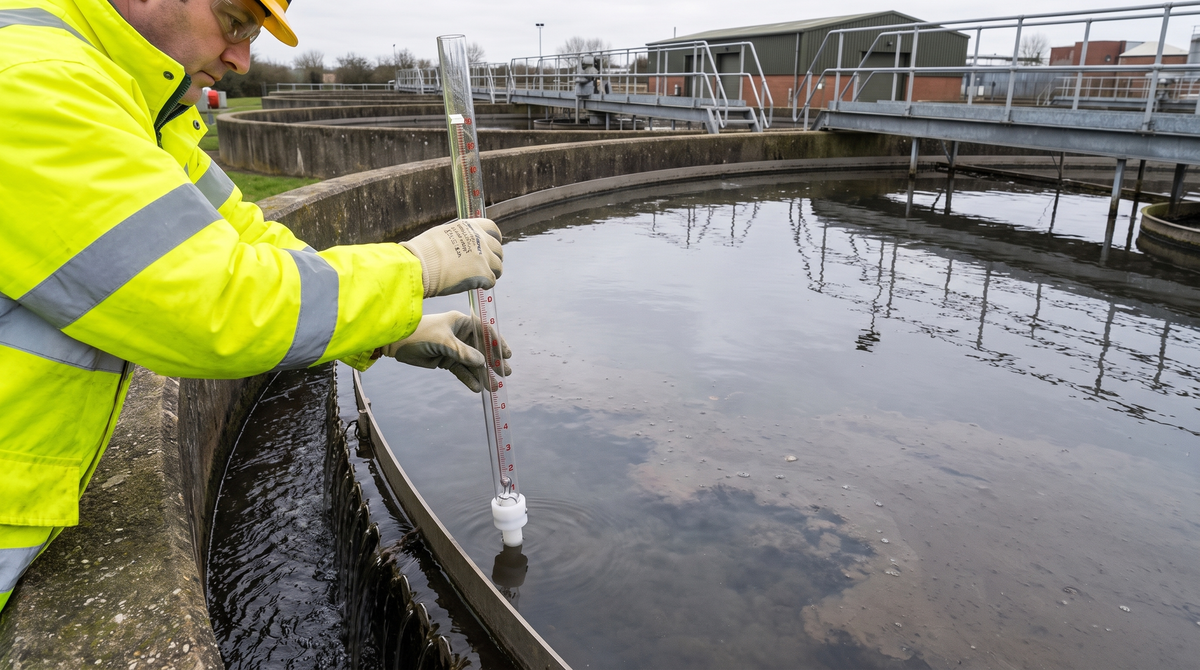
Reading sludge depth in a clarifier, lagoon, or holding tank comes down to one tool used correctly: lower the Sludge Judge to the bottom, let the check valve seat, raise it slowly, and read the graduated markings where the solids interface sits. Get the technique wrong and you'll under- or over-report the sludge blanket by a foot or more — enough to misjudge a pump-out schedule or fail a compliance inspection.
What Is a Sludge Judge and How Does It Work?
A Sludge Judge is a sectional core sampler — 5-ft lengths of graduated plastic tubing with a spring-loaded check valve at the base — that captures a vertical column of liquid and settled solids in a single lowering. As the tube descends open, liquid flows through it freely. Once it hits the tank or lagoon bottom, the valve seats and traps the column above it, letting you read total liquid depth and settled-solids depth off the same 1-ft markings when you pull it back up.
It's the standard field tool for sludge and sediment sampling in municipal and industrial wastewater operations because it needs no power, no lab turnaround, and gives a repeatable number any operator can read on-site. ERE stocks three configurations — the Sludge Judge®, the Sludge Judge® Ultra, and the Sludge Judge® II — each built from the same 5-ft screw-fit sections so length is adjustable in the field.
How Do You Use a Sludge Judge to Sample a Tank or Lagoon?
Assemble enough 5-ft sections to reach bottom, lower the unit slowly and vertically along the same path every time, let the check valve seat on contact, then raise it at a controlled rate and read both the liquid line and the sludge interface off the graduations. The full sequence below is what keeps readings consistent from one sample point — and one technician — to the next.
- Assemble the sections. Screw together enough 5-ft sections (top, extension, bottom-with-valve) to exceed the expected total depth. Check the O-ring seats on each threaded joint before lowering — a loose joint lets liquid bypass the column and skews the reading.
- Lower the sampler vertically to the bottom. Feed it down the nylon top-section line at a steady, unhurried pace. Dropping it fast can cause the valve to bounce off the sludge surface instead of seating flush, which under-reports depth.
- Let the valve seat. Contact with the tank or lagoon floor closes the spring-loaded check valve, sealing the liquid and settled solids column inside the tube. Give it a second of dwell time before raising — don't yank it back up immediately.
- Raise the sampler at a controlled rate. Pull hand-over-hand on the line, keeping the tube as vertical as possible. Rapid or angled retrieval can disturb the solids interface inside the tube and blur the reading line.
- Read the graduations. With the sampler at the surface, read total column depth at the liquid line, then read the settled-solids depth where the sample visibly transitions from liquid to compacted solids. Record both numbers, not just one — the ratio is what tells you how full the tank actually is.
- Rinse and decontaminate between points. Flush the tube with clean water (or the cleaning brush + rod for units with a carrying case) before moving to the next sample location, especially when moving between basins that shouldn't cross-contaminate.
Take readings at multiple points across a clarifier or lagoon rather than one center reading — sludge blankets are rarely level, and a single point can miss a mounding or channeling problem that's already affecting effluent quality.
Which Sludge Judge Model Should You Choose — Standard, Ultra, or II?
The Standard Sludge Judge covers most municipal and industrial clarifier work at the lowest cost; step up to the Ultra when the unit sees UV exposure or temperature swings, and to the II when you need double the sample volume per foot for thicker or more variable sludge.
| Model | Tube diameter | Capacity | Best for |
|---|---|---|---|
| Sludge Judge® (Standard) | 3/4" (1.9 cm) | ~3 oz/ft | General clarifier and lagoon sampling, indoor or short-term outdoor storage |
| Sludge Judge® Ultra | 3/4" (1.9 cm) | ~3 oz/ft | Outdoor lagoons and open tanks — polycarbonate with UV stabilizer, rated to 280°F (138°C) |
| Sludge Judge® II | 1-1/4" (3.2 cm) | ~6 oz/ft (177 mL/ft) | Thicker or highly variable sludge where a larger sample volume gives a more representative reading |
All three are rated for settleable solids of 5% or less by volume and assemble from interchangeable 5-ft sections, so a facility running mixed applications can standardize spare parts (cleaning brush, carrying case, extension sections) across models.
How Do You Read and Interpret Sludge Judge Depth Measurements?
Read total liquid depth first, then settled-solids depth, and compare that ratio against your last sampling round rather than judging a single reading in isolation. A clarifier holding steady at 15–20% sludge-to-liquid ratio is typically stable; a jump to 40%+ from the previous week signals it's time to pump down before solids carry over into the effluent.
Because the tube captures a true vertical core, the reading reflects compaction, not just surface accumulation — a channelized or mounded blanket can read very differently at three points across the same tank. That's the practical reason to sample multiple locations per basin rather than relying on a single center-point reading, particularly in larger lagoons where wind-driven currents cause uneven solids distribution.
How Do You Clean and Maintain a Sludge Judge Between Samples?
Rinse the tube with clean water after every sample and run the spiral cleaning brush through it whenever solids residue remains visible on the interior wall — a coated tube reads inaccurately on the next drop because the graduations become hard to see through residue, and cross-contamination between sample points can compromise a compliance data set. Store assembled units in the canvas carrying case between uses to protect the graduated markings from UV fading and the threaded joints from grit.
The Ultra's polycarbonate construction resists UV degradation better than the Standard's for units left on a truck or stored outdoors between rounds, which matters for facilities sampling weekly rather than monthly.
Where Is Sludge Judge Sampling Required in Canada?
Federally regulated wastewater systems fall under the Wastewater Systems Effluent Regulations (Environment and Climate Change Canada), which set effluent quality limits that depend directly on how well a facility manages its sludge inventory — a clarifier running an unmonitored sludge blanket is the most common root cause of a suspended-solids exceedance. Settleable solids testing itself follows the same core principle used across North American Standard Methods and EPA-recognized wastewater analytical methods: a graduated cone or column reading of the settled fraction after a defined period.
Sampling from the edge of a tank, clarifier catwalk, or lagoon bank also puts technicians in proximity to open water and, on some sites, confined-space-adjacent conditions. CCOHS guidance on confined space and working-near-water hazards is the reference point for the fall-protection and buddy-system precautions that should be standard procedure whenever sampling happens off a catwalk or lagoon edge rather than solid ground.
For the full range of grab and core samplers ERE stocks for surface water, sludge, and sediment work, see our water and sediment grab sampler selection guide.
Need help specifying sludge or sediment sampling equipment?
ERE Inc. has supplied environmental and wastewater sampling equipment across Canada for 30+ years. Talk to a real specialist about your clarifier, lagoon, or tank program.
→ Request a Quote | 1-888-287-EREC | Browse Sludge & Sediment Samplers | sales@ereinc.com
Frequently Asked Questions
How often should I sample sludge depth with a Sludge Judge?
Most municipal clarifiers are sampled weekly to monthly, but facilities running close to capacity or seeing variable influent loading should sample weekly at minimum. Lagoons with slower turnover are often checked monthly or quarterly unless a specific compliance concern is being tracked.
What's the difference between the Sludge Judge Standard and the Ultra?
Both use the same 3/4" tube diameter and capacity. The Ultra is built from UV-stabilized polycarbonate rated to 280°F (138°C), making it more durable for outdoor lagoons and units left in direct sun between sampling rounds. The Standard is the lower-cost option for indoor or short-exposure use.
Can I use a Sludge Judge in a lagoon, or only in tanks?
Both. The sectional design means you assemble as many 5-ft lengths as needed to reach the bottom, so it works in shallow clarifiers and deeper lagoons alike, as long as you can safely access the sampling point from a bank or catwalk.
How accurate is a Sludge Judge reading?
It gives a direct, repeatable field measurement of settled-solids depth — accurate enough for routine pump-out scheduling and trend tracking. It is a field indicator, not a laboratory total-suspended-solids test; facilities under strict compliance monitoring should pair it with periodic lab analysis rather than relying on it alone.
Do I need confined space training to sample with a Sludge Judge?
Not for open-top tanks or lagoons sampled from a catwalk or bank. If the sample point is inside an enclosed vessel or a space with restricted entry/exit or potential atmospheric hazards, CCOHS confined-space protocols apply and the same certified procedures required for any confined-space entry on site should be followed.
Related articles
- Water & Sediment Grab Samplers: Selection Guide
- Groundwater Bailers: Types, Materials & Selection Guide
- Environmental Sampling Equipment Guide for Canada
- Phase II ESA Equipment Checklist for Canadian Consultants
Lire en français : Comment utiliser un échantillonneur Sludge Judge : protocole pour bassins et lagunes