
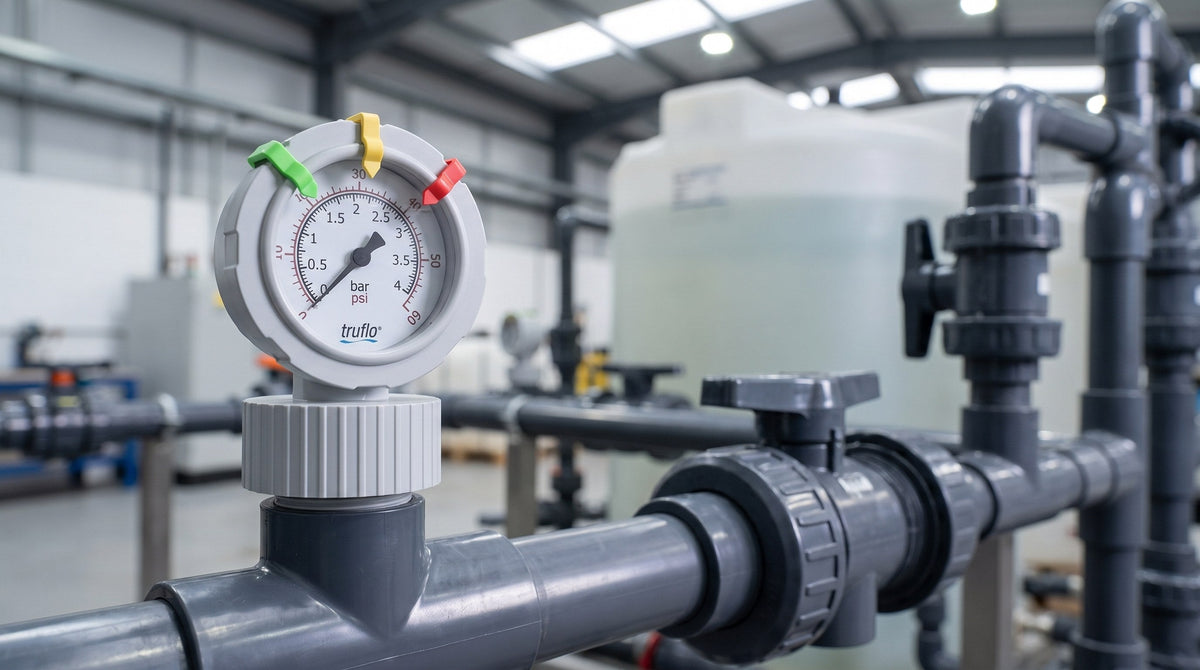
Choose a process pressure gauge by what touches it, not by the dial. For corrosive chemical, water-treatment and wastewater lines, start with the wetted material and temperature limit, decide whether the gauge needs a guard between the process and the sensing element, then match the range, dial size and mounting to the job. ERE carries the Icon Process Controls plastic gauge range for exactly these lines, plus the switches, transmitters and pulsation dampeners that go with it, so you can match one set of part numbers to your skid before you ask for a quote.
In this guide
- What does a pressure gauge read: gauge, compound or differential pressure?
- Which wetted material and temperature limit fit your media?
- Does the gauge need a guard?
- Which model fits which job?
- What range and accuracy should you choose?
- How do you deal with pulsation from metering pumps?
- When do you need a switch or transmitter instead of a dial?
- When is a plastic gauge the wrong tool?
- How do you choose a pressure gauge, step by step?
- Frequently Asked Questions
What Does a Pressure Gauge Read: Gauge, Compound or Differential Pressure?
Most dial gauges read gauge pressure, which is the pressure above the surrounding atmosphere. A Bourdon-tube gauge senses it with a curved tube that straightens slightly as pressure rises and drives the pointer through a small linkage. Three variants cover most process work:
- Gauge pressure: the normal case, such as a filter inlet or a pump discharge. Ranges in the ERE collection run from 0-15 to 0-200 psi.
- Compound (vacuum and pressure): one dial that reads both sides of zero, for suction lines. The Icon OBS-V reads -30 to 30 psi.
- Differential pressure: the difference between two points, used to see a filter or strainer loading. The Icon DPS50i is the digital differential sensor in the same Pressure Gauges & Transmitters collection; ask us for its range before you specify it.
The standard for the gauge itself is published by ASME as B40.100, Pressure Gauges and Gauge Attachments. Ask us which grade applies to a model before it goes into a specification that cites the standard.
Which Wetted Material and Temperature Limit Fit Your Media?
Pick the body material that your chemical will not attack at your operating temperature. The integral-guard OBS gauges list PVC, PP or PVDF wetted parts with operating limits of 140 °F (PVC), 190 °F (PP) and 240 °F (PVDF). The OBS-GO family lists a polypropylene enclosure rated to 190 °F (88 °C) and a 316 stainless steel 1/4 in MNPT connection, so the wetted metal is 316 SS rather than plastic.
No gauge record replaces a compatibility check. Read the chemical's Safety Data Sheet, which suppliers must provide under WHMIS, and the manufacturer's compatibility chart for the exact body and diaphragm (PTFE or FPM) before you order. If the chart is silent for your mix or concentration, send us the chemical and temperature and we will confirm with the manufacturer.
Does the Gauge Need a Guard?
Yes, whenever the process fluid is corrosive, viscous, crystallizing or dirty enough to attack or clog the Bourdon tube. A gauge guard puts a flexible diaphragm between the process and the gauge, and the fill fluid carries the pressure across. The sensing element then never touches the media.
Icon builds the guard into the gauge on the OBS series: the gauge and guard are one molded piece, factory pre-filled, with glycerin fill (silicone optional) and a PTFE or FPM diaphragm, so there is nothing to fill or assemble on site. The OBS-GO family is the other route: a pre-filled gauge that mates with Icon's separate GI Series gauge guards. The OBS-V compound gauge is not compatible with the GI guards, so a vacuum-service gauge needs a different plan.
Which Model Fits Which Job?
The table sorts the gauges in the collection by how they mount and what they read. Figures come from the product records; part numbers, ranges, connection options and bulk terms are confirmed on a quote.
| Model | Dial | Accuracy listed | Wetted / connection | Ranges listed | Best for |
|---|---|---|---|---|---|
| OBS, 1/2 in | 2-1/2 in | ±1.5% | PVC / PP / PVDF; 1/2 in FNPT | 0-15 to 0-200 psi | Standard in-line mount on corrosive lines |
| OBS-A / OBS-B | 2-1/2 in | ±1.5% | PVC / PP / PVDF; 1/2 in FNPT | 0-15 to 0-200 psi | Panel mount (A) or center mount (B) |
| OBS-2VU | 2-1/2 in, two sides | ±1.5% | PVC / PP / PVDF; 1/2 in FNPT | 0-15 to 0-200 psi | Reading from two directions |
| OBS-BAG | 3 in, dual scale | ±1.5% | PVC or PP; 1/2 in FNPT | 0-60, 0-100, 0-160 psi | Reading from a distance |
| OBS-GO / OBS-GO-C | 2-1/2 in | ±0.75% | PP enclosure; 316 SS 1/4 in MNPT | 15-200 psi family | Tighter accuracy; pairs with GI guards |
| OBS-DGO | 2-1/2 in, two sides | ±0.75% | PP enclosure; 316 SS 1/4 in MNPT | 15-200 psi family | Two-direction reading, tighter accuracy |
| OBS-GO4 | 4-1/2 in | ±0.75% | PP enclosure; 316 SS 1/4 in MNPT | 0-60, 0-100, 0-160 psi | Large dial, far reading |
| OBS-TT | 2-1/2 in | ±0.75% | PP enclosure; 316 SS 1/4 in MNPT | 0-60, 0-100, 0-160 psi | Catching the highest pressure reached |
| OBS-V | 2-1/2 in | ±0.75% | PP enclosure; 316 SS 1/4 in MNPT | -30 to 30 psi | Suction and vacuum lines |
| OBS-LE / OBS-C-LE / OBS-P-LE | LED display | ±1.0% | PVC / PP / PVDF | 0-145 psi | One unit as gauge, switch and 4-20 mA transmitter |
The range tabs on the OBS and OBS-GO dials are movable red, yellow and green markers that show an operator at a glance where normal pressure sits.
What Range and Accuracy Should You Choose?
Choose a range that puts your normal operating pressure in the middle of the dial, not against the end stop. A gauge that lives near full scale ages faster and leaves no headroom to show a fault. If a line normally runs at 45 psi, a 0-100 psi dial reads that comfortably, while a 0-60 psi dial would leave a surge nowhere to go.
Accuracy is a second, separate choice. The records list ±1.5% for the integral-guard OBS gauges and ±0.75% for the OBS-GO family. For a line you only need to see, either is usually enough. For a gauge that is used to verify a setpoint or to log a pump discharge, the tighter family is the better starting point. The records do not say what the percentage is of, so confirm that against the manufacturer datasheet before it goes into a test procedure.
How Do You Deal With Pulsation From Metering Pumps?
Smooth the pulse before it reaches the gauge, because a pointer that flutters wears out and is hard to read. Diaphragm and metering pumps send a pulse with every stroke, and the gauge sees every one of them. The PulsePro all-plastic dampener needs no pre-charging and is listed to reduce pulsation by up to 90%. The PulsePro PV (PVC) and PulsePro PF (gas-filled) models are pre-charged, field adjustable, listed at up to 95% reduction and ship with an OBS gauge.
Downstream of a metering pump, a back-pressure valve holds a steady pressure so the pump meters accurately. The Icon BRP is listed at 5 to 150 psi in PVC, CPVC, PP or PVDF, and the BRP3 is the 316 stainless version. Both can also act as a relief valve in a tee branch. If your gauge sits on a chemical feed line, see our guide to chemical pot feeders for the sizing side of the same loop.
When Do You Need a Switch or Transmitter Instead of a Dial?
When something other than a person has to act on the pressure. A dial tells an operator; a switch trips an alarm or a pump; a transmitter sends a 4-20 mA signal to a controller. The collection lists three options:
- Pressure switch: the Icon LPS50 is an in-line digital switch with ranges from 14.5 to 232 psi, switching accuracy of ±0.5% of range or better, under 10 ms response and a PNP or NPN relay output on 12 to 30 VDC.
- Transmitter and switch together: the Icon LPS50i adds a 4-20 mA output and IO-Link to the same body.
- In-line transmitter: the Icon LP200 / LP250 is listed at 30 to 300 psi, 0.5% of full scale, 4-20 mA on 18 to 36 VDC, with PP, PVDF or 316 SS wetted parts.
The LED OBS-LE family combines a gauge, a switch, a transmitter and an isolator in one all-plastic body: 0 to 145 psi, ±1.0%, a 4-20 mA output with two relays, and a display that turns from green to red when a relay is on. For how to scale and wire a 4-20 mA loop, see our 4-20 mA pressure transmitter buyer's guide.
When Is a Plastic Gauge the Wrong Tool?
When the line is hotter or higher in pressure than the records allow, or when the service is not a process-water or chemical one. The plastic OBS gauges top out at 200 psi and 240 °F (PVDF), and the LED family at 145 psi. Steam, hydraulic oil, high-pressure gas and hot process lines call for stainless instruments built for that service, and we will say so on the quote rather than force a fit.
It is also not the right page for tire, automotive or air-compressor gauges. ERE sells process instruments for water, wastewater and chemical lines, not consumer pressure gauges.
How Do You Choose a Pressure Gauge, Step by Step?
- Name the media and temperature. Chemical, concentration and operating temperature decide the body and diaphragm.
- Check compatibility. Read the SDS and the manufacturer's chart for that material.
- Decide on a guard. Corrosive or dirty media get an integral guard or a separate one.
- Set the range. Put normal pressure mid-dial and note the peak.
- Choose accuracy and dial size. Tighter accuracy for setpoint work, larger dial for distance.
- Pick the mounting. In-line stem, center mount or panel mount, single or double-sided.
- Add output and protection. Switch or transmitter if a controller needs it, dampener if a pump pulses.
- Send the details. Quote by model, range and connection and we confirm availability and bulk terms.
Need a pressure gauge for a chemical or water line?
Send us the media, temperature, range and connection and we will confirm the model, part number and availability.
Frequently Asked Questions
What is the difference between psi and bar on a pressure gauge?
They are two units for the same reading. One bar is about 14.5 psi, so a dual-scale dial such as the 3 in OBS-BAG lets operators read either without converting.
What does a gauge guard do?
It separates a corrosive or dirty process fluid from the gauge's sensing element with a flexible diaphragm and a fill fluid, so the Bourdon tube is never wetted by the process. On the OBS series the guard is built into the gauge and factory pre-filled.
What is the difference between a pressure gauge and a pressure transmitter?
A gauge shows pressure on a dial for a person. A transmitter converts it to an electrical signal, usually 4-20 mA, for a controller or data logger. The LED OBS-LE models combine both.
Can I use a plastic pressure gauge above 200 psi or on hot lines?
Not on the models in the records. The plastic OBS gauges list ranges to 200 psi and temperature limits of 140 °F (PVC), 190 °F (PP) and 240 °F (PVDF). Beyond that, ask us for a stainless instrument.
Do you quote pressure gauges across Canada?
Yes. Send the model, range, connection and quantity through the quote form and we confirm availability and bulk terms for delivery across Canada.
Related articles
- 4-20 mA Pressure Transmitter Buyer's Guide for Canada
- Chemical Pot Feeders: How Bypass Feeders Work and How to Size One
- Industrial Reverse Osmosis Water Treatment Guide for Canada
Lire en français : Manomètre : guide de choix selon le matériau mouillé, la garde, la plage et la sortie pour les procédés au Canada