
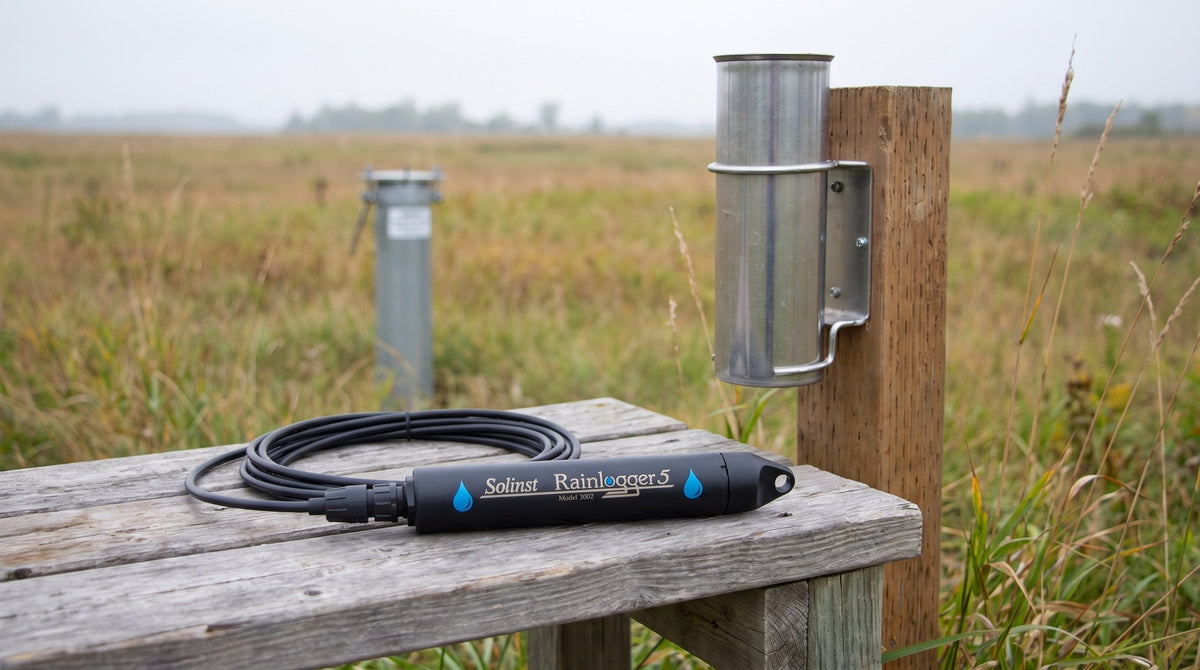
A rain gauge data logger records each time a tipping-bucket rain gauge tips, with a time stamp, so you can see when rain fell and how hard, not just how much. The Solinst Rainlogger 5 is the logger half of that setup: ERE carries it as a compact, event-based unit with a 10-year battery and memory for 100,000 time-stamped readings, built to sit next to the same Levelogger groundwater data you may already collect.
In this guide
- What is a rain gauge data logger and how does it work?
- Does the Rainlogger 5 include a rain gauge?
- What does the Rainlogger 5 record and how long does it last?
- Why log rainfall next to groundwater data?
- How do you get the data off a remote site?
- Is this the same as a weather-station rain gauge?
- Where should the gauge go, and what are the limits?
- How do you specify a rain gauge data logger, step by step?
- Frequently Asked Questions
What Is a Rain Gauge Data Logger and How Does It Work?
It is a tipping-bucket rain gauge paired with a datalogger that counts and time-stamps each tip. Rain falls into the funnel and fills a small bucket; when the bucket holds a set depth of rain it tips, empties and closes a switch; the logger saves that event. Total rainfall for any period is the number of tips times the depth each tip represents, so the depth per tip printed on your gauge matters as much as the logger.
The Solinst Model 3002 Rainlogger 5 is built for exactly this job. The record describes it as an inexpensive datalogger designed to record the tips of a standard tipping-bucket rain gauge, with event-based sampling that saves each tip as it happens.
Does the Rainlogger 5 Include a Rain Gauge?
No. The part number, SO-114622, is the 3002 Rainlogger 5 complete with its connection cable, and the record does not list a rain gauge with it. You supply a standard tipping-bucket gauge, or tell us which one you want to use and we confirm what we can supply and that the connection suits it. Check the gauge's datasheet for its depth per tip and its switch output before you order.
What Does the Rainlogger 5 Record and How Long Does It Last?
It saves every bucket tip with its time stamp in non-volatile memory, for up to 100,000 readings, on a battery the record lists at 10 years. Figures below come from the product record; confirm anything critical against the datasheet on a quote.
| Item | Listed value |
|---|---|
| Sampling | Event based: records and saves each tip |
| Memory | Up to 100,000 time-stamped readings |
| Battery | 10-year battery |
| Operating temperature | -20 °C to 80 °C |
| Size and weight | 22 mm x 160 mm, 44 g |
| Communication | Single-eye optical, 57,600 bps with USB |
| Housing | ABS, for ESD (electrostatic discharge) protection |
| Telemetry | Compatible with Solinst Telemetry Systems |
Event-based logging has a practical edge in storms. A logger that stores only a total every 15 minutes hides whether the rain fell in five minutes or fifty; one that stores each tip keeps the intensity, which is what stormwater and peak-flow work needs.
Why Log Rainfall Next to Groundwater Data?
Because a water-level trace without rainfall is a trace you cannot explain. The record lists correlating precipitation with groundwater and surface-water data, watershed and drainage-basin studies, and agricultural and forestry studies as applications, alongside stormwater management and determining peak rainfall events.
If you already run Levelogger 5 units, a rain record next to them separates recharge from pumping, tide or barometric noise. Pair it with a Barologger 5 where absolute loggers need compensation. Our guides cover the full set: the water level data logger buyer's guide, the Levelogger 5 guide and the barologger explainer.
How Do You Get the Data Off a Remote Site?
Download on site with the optical connection, or send it by telemetry. The record lists the Rainlogger 5 as compatible with Solinst Telemetry Systems, which puts it on the same remote-reporting options as your level loggers. The choice between the Model 9500 LevelSender 5, the Model 9200 RRL and the Model 9100 STS is covered in our water level telemetry guide. For on-site downloads, the Levelogger 5 App Interface and the Levelogger 5 accessories are the family of readers and cables; confirm which one your Rainlogger needs when you request a quote.
Is This the Same as a Weather-Station Rain Gauge?
No. Search results for this term are full of backyard Wi-Fi gauges that show rainfall on a phone. Those are fine for a garden. The Rainlogger 5 is a field logger for environmental and water-resources work: time-stamped tips, a 10-year battery, optical download, telemetry, and data that lands in the same software chain as your groundwater loggers. If you need a household display, this is not that product.
Where Should the Gauge Go, and What Are the Limits?
Put it in the open, level and clear of buildings and trees, and treat winter separately. Siting and exposure rules for precipitation gauges are set out in the World Meteorological Organization's Guide to Instruments and Methods of Observation (WMO-No. 8); read the current edition before you commit to a location for long-term data. For context against the official record, Environment and Climate Change Canada publishes historical climate data by station, which is a useful check on your own totals.
Two limits to plan for. A logger only counts tips, so a blocked funnel or a frozen bucket reads as a dry day, and inspection matters. And a standard unheated tipping-bucket gauge is generally for liquid rain; if your site needs winter precipitation, specify a gauge that handles it and tell us when you quote.
How Do You Specify a Rain Gauge Data Logger, Step by Step?
- Define the question. Total rainfall, storm intensity, or an explanation for water-level changes.
- Choose the gauge. A tipping-bucket gauge with a known depth per tip and a switch output the logger accepts.
- Choose the logger. The Rainlogger 5 for event-based, time-stamped tips with a long battery life.
- Plan the download. On-site optical download, or telemetry for a remote site.
- Match your other loggers. Confirm the readers and software you already use for Leveloggers.
- Site it and plan winter. Open exposure, level mounting, and a plan for frozen months.
- Send the details. Quote by model, gauge and quantity and we confirm availability and terms.
Adding rainfall to a monitoring site?
Send us the gauge you have or need, how you will download the data and which loggers it must sit alongside, and we will confirm the models, part numbers and availability.
Frequently Asked Questions
What is a rain gauge data logger?
A datalogger connected to a tipping-bucket rain gauge that counts and time-stamps every bucket tip, so rainfall can be totalled and its intensity reviewed afterward.
Does the Solinst Rainlogger 5 come with a rain gauge?
No. The part number covers the Rainlogger 5 with its connection cable. You pair it with a standard tipping-bucket rain gauge; tell us which one and we confirm what we can supply.
How much can the Rainlogger 5 store?
The record lists up to 100,000 time-stamped readings in non-volatile memory, with a 10-year battery.
Can it report from a remote site?
Yes. The record lists it as compatible with Solinst Telemetry Systems, so it can join the same remote-reporting setup as your water level loggers.
Do you supply rain gauge data loggers across Canada?
Yes. Send the models and quantity through the quote form and we confirm availability and terms for delivery across Canada.
Related articles
- Water Level Data Loggers: Buyer's Guide for Canadian Groundwater Monitoring
- Solinst Levelogger 5 Groundwater Monitoring Guide
- Water Level Telemetry: LevelSender vs RRL vs STS
Lire en français : Enregistreur de pluviomètre : associer un pluviomètre à augets au Solinst Rainlogger 5 au Canada