
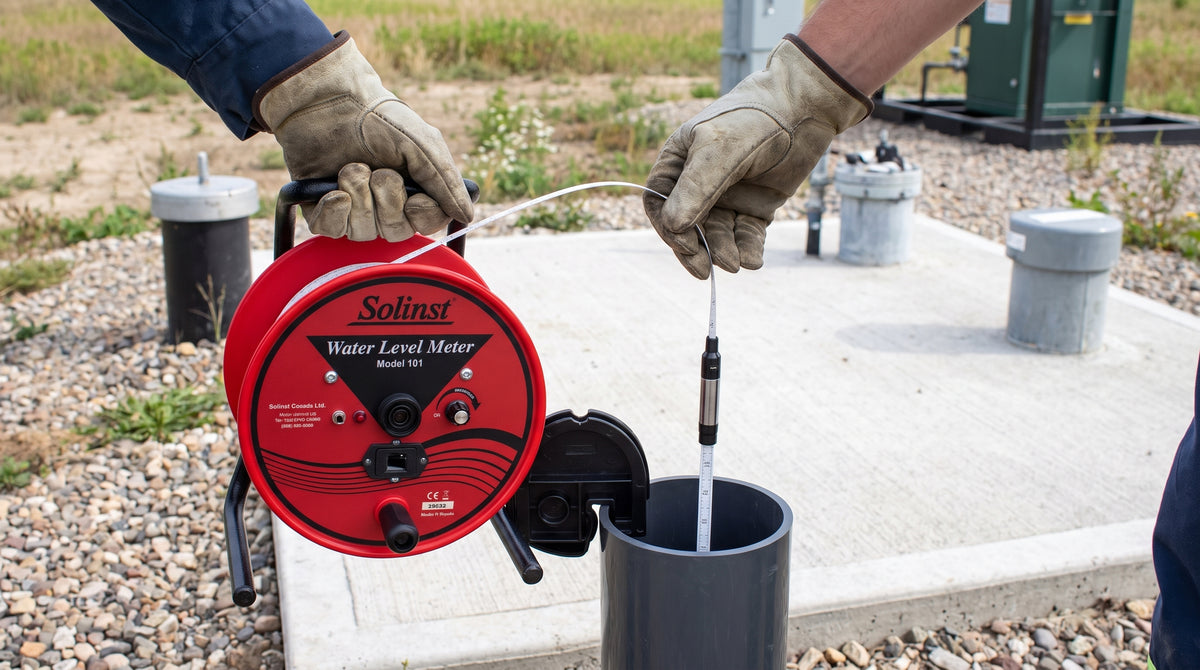
A water level meter measures depth to water in a well, borehole, or standpipe by lowering a probe on a graduated tape until it contacts water and triggers an audible and visual signal. The model you need depends on probe diameter, tape material, and whether you're taking a single spot reading or tracking drawdown during a pump test.
Table of contents
- How Does a Water Level Meter Work?
- Which Solinst 101 Model Do You Need?
- What's the Difference Between the 101 Series and the Model 102?
- Is a Manual Meter Enough, or Do You Need an Electronic Data Logger?
- How Accurate Is a Water Level Meter, and How Should It Be Checked?
- Are Water Level Records Required by Regulation in Canada?
- Frequently Asked Questions
How Does a Water Level Meter Work?
A water level meter lowers a weighted probe on a graduated tape down a well or borehole; when the probe's electrodes contact the water surface, an electronic circuit completes and triggers a buzzer and LED on the reel-mounted control panel. The operator reads the depth directly off the tape markings at the point where it enters the well.
How Do You Take a Reading?
- Lower the probe slowly into the well or borehole, tape running freely off the reel.
- Watch and listen for the buzzer/LED signal the instant the probe touches water.
- Read the depth-to-water directly off the tape at the reference point (top of casing or a marked datum).
- Use the sensitivity switch to filter out false triggers from cascading water or wet casing walls, then confirm the reading by raising and re-lowering the probe.
Two things determine reading precision: tape marking interval (millimeter markings resolve finer than centimeter markings) and probe design (a sensitivity control that tunes out condensation and cascading water reduces false triggers in wet or turbulent wells).
Which Solinst 101 Model Do You Need?
ERE stocks four tiers of the Solinst Model 101, and the difference is more than price — tape material and probe design change how the meter performs in the field.
| Model | Probe | Tape | Marking Interval | Best For |
|---|---|---|---|---|
| 101B Basic | 5/8" P1 stainless | PE heat-embossed | Every cm | Routine spot checks, budget-limited programs (30–100 m only) |
| 101 P2 | 0.55" P2 stainless | PE heat-embossed | Every mm | General environmental monitoring, mid-budget (30–300 m) |
| 101 P7 | 5/8" P7 stainless | PVDF laser-marked, non-stretch | Every mm or 1/100 ft | The industry-standard field meter — accuracy that holds up over years of use (30–600 m) |
| 101D DrawDown | 5/8" P7 stainless | PVDF laser-marked, non-stretch | Every mm or 1/100 ft | Pump tests, slug tests, aquifer tests — has a dedicated water-level/drawdown mode switch (30–300 m) |
The jump from 101B to 101 P2 is mainly tape resolution (cm to mm markings) and a sensitivity switch the Basic model lacks. The jump from P2 to P7 is tape material — PVDF laser-marked tape doesn't stretch or fade the way heat-embossed polyethylene tape does over repeated deployments, which matters if the meter is logging billable field hours every week. The 101D adds a purpose-built drawdown mode on top of the P7's hardware, so if your work includes pumping tests or aquifer evaluations alongside routine static-level checks, it replaces two instruments with one.
For a lower-cost alternative to the Solinst line, ERE also stocks the Heron Water Tape (Series 1902) — a PFAS-free, field-replaceable-probe meter with an adjustable-volume sensitivity dial, priced for programs where a Solinst P7 is more instrument than the job requires.
What's the Difference Between the 101 Series and the Model 102?
The Model 102 exists for one specific problem the 101 series can't solve: fitting a probe past downhole instrumentation or into a well too narrow for a standard 5/8" probe.
The Model 102 P10 uses a narrow 3/8" stainless steel probe on a laser-marked polyurethane coaxial cable rather than a flat tape. That smaller profile lets it pass a data logger, pump column, or other equipment already installed in a monitoring well — something a 5/8" flat-tape probe physically cannot do. It's purpose-built for small-diameter piezometers and wells with pre-existing downhole hardware, in cable lengths from 25 m to 300 m.
If your wells are standard diameter and empty of other instrumentation, the 101 series is the right starting point. Reach for the 102 specifically when probe clearance is the constraint.
Is a Manual Meter Enough, or Do You Need an Electronic Data Logger?
A manual meter answers "what's the water level right now?" — an electronic data logger answers "what has the water level been doing for the last three months?" They're complementary tools, not competing ones.
Choose a manual meter (this article) when you need a single accurate spot reading during a site visit — confirming static water level before a sampling event, checking a well before mobilizing equipment, or verifying a data logger's reading against an independent measurement. Choose an electronic logger, such as the Solinst Levelogger, when you need continuous unattended monitoring: pump tests longer than a few hours, seasonal trend data, or regulatory monitoring programs that require a documented record between site visits. See our water level data logger buyer's guide for how to choose between absolute and vented logger models.
In practice, most active monitoring wells carry both: a logger recording continuously, and a manual meter used periodically to verify the logger's readings haven't drifted. The same check applies to a 4-20mA pressure transmitter feeding a PLC or SCADA system, where the tape reading is what confirms the scaling.
How Accurate Is a Water Level Meter, and How Should It Be Checked?
A properly maintained laser-marked meter reads to the resolution printed on the tape — typically 1 mm or 1/100 ft on the P7 and 102 lines — but that accuracy depends on the tape staying unstretched and the probe contacts staying clean.
PVDF laser-marked tape (101 P7, 101D, 102) holds its calibration far longer than heat-embossed PE tape (101B, 101 P2) because it doesn't stretch under repeated tension the way polyethylene does — a stretched tape reads shallow by a growing margin the longer it's in service. Field practice for verifying accuracy: periodically check the tape length against a fixed reference point, inspect the probe tip and contacts for corrosion or buildup, and replace the 9V battery before it degrades signal sensitivity rather than after a misread costs you a site visit.
Are Water Level Records Required by Regulation in Canada?
Yes — water level measurement is a documented requirement in several Canadian regulatory contexts, not just good field practice.
In Ontario, Regulation 903 (Wells) under the Ontario Water Resources Act governs well construction and requires static water level data as part of well records for permit-to-take-water applications and well decommissioning assessments. More broadly, groundwater monitoring programs assessed against the CCME Canadian Environmental Quality Guidelines rely on documented water level records to establish hydraulic gradient and confirm a monitoring well is representative of the aquifer being assessed — Phase II ESA reports routinely include water level measurements as supporting data for every sampling round.
Browse the full water level meter collection at ERE for the complete Solinst and Heron range, including interface meters and accessories.
Need help choosing a water level meter?
ERE Inc. has been Canada's environmental equipment specialist for 30+ years. Tell us your well diameter, depth, and monitoring frequency and we'll spec the right model.
→ Request a Quote | 1-888-287-EREC | Browse Water Level Meters | sales@ereinc.com
Frequently Asked Questions
What is the difference between a P2 and a P7 water level meter probe?
The P2 and P7 are both 316 stainless steel probes, but the P7 pairs with non-stretch PVDF laser-marked tape while the P2 uses heat-embossed polyethylene tape. PVDF holds its calibration longer under repeated field use because it doesn't stretch the way polyethylene does, making the P7 the better choice for meters that see frequent deployment.
Can I use a water level meter in a well with a pump already installed?
A standard 5/8" probe (101 series) may not clear a pump column or existing downhole instrumentation. The Model 102 P10 uses a narrower 3/8" probe specifically designed to pass equipment already in the well — check clearance against your well's installed hardware before ordering a 101-series meter for an occupied well.
How long is a water level meter tape, and can I get a custom length?
Solinst 101-series meters are stocked at ERE from 30 m up to 600 m (P7) depending on model, and the Model 102 from 25 m to 300 m. Standard lengths cover the large majority of monitoring wells; contact ERE if your application needs a length outside the standard range.
Do I need a carrying case for a Solinst water level meter?
Yes — carrying cases are sold separately from the meter on Solinst 101-series models. A small case covers 30–100 m tape lengths and a medium case covers 150–300 m; match the case size to your tape length when ordering.
What's the difference between a water level meter and a water level data logger?
A water level meter is a manual instrument for spot readings — you lower the probe and read the depth on the spot. A data logger (such as the Solinst Levelogger) is deployed inside the well and records water level continuously and unattended over days, weeks, or months. Most monitoring programs use both: a logger for continuous data, a meter to verify the logger's readings periodically.
Related articles
- Water Level Data Loggers: A Buyer's Guide for Canadian Groundwater Monitoring
- Solinst Levelogger 5: Groundwater Monitoring Guide for Canada
- What Is a Barologger? Barometric Compensation for Water Level Dataloggers Explained
- Phase II ESA Equipment Checklist for Canadian Consultants
Lire en français : Sondes de niveau d'eau : guide d'achat pour la surveillance des eaux souterraines au Canada