
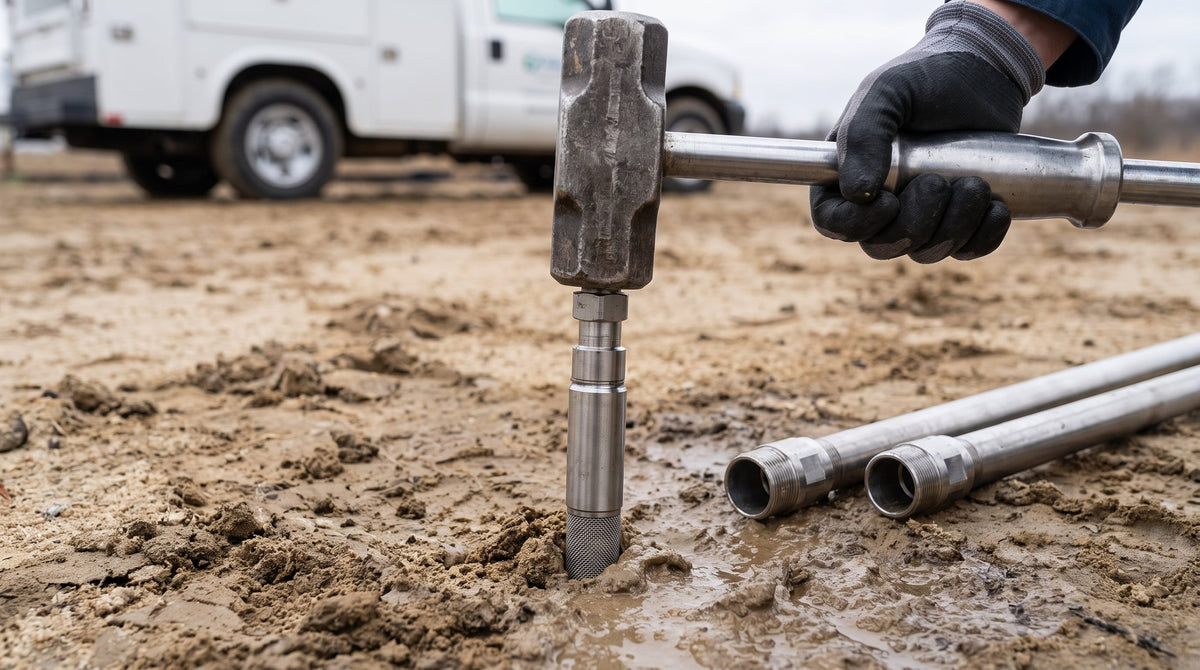
A drive-point piezometer is a stainless-steel well screen that installs by hammering or direct-pushing it into shallow soil — no drill rig, no borehole, no casing to grout. It gives environmental consultants a low-cost way to check shallow groundwater or soil vapor at a site where a fully drilled monitoring well isn't justified. This guide compares the two Solinst drive-point systems ERE Inc. stocks and when to reach for each.
Table of contents
- What Is a Drive-Point Piezometer?
- How Does Direct-Push Installation Differ From a Drilled Monitoring Well?
- Which Drive-Point Configuration Should You Use?
- How Do You Install and Sample a Drive-Point Piezometer?
- When Should You Use the Drive-Point Profiler Instead?
- Why Do Depth Limitations Matter for Drive-Point Systems?
- Frequently Asked Questions
What Is a Drive-Point Piezometer?
A drive-point piezometer is a small-diameter, screened stainless steel well point that attaches to inexpensive 3/4" (20 mm) NPT drive pipe and is driven directly into the ground — by hand with a slide hammer, or with any direct-push or drilling rig. Once seated, it functions as a single-use monitoring well: groundwater or soil vapor samples are drawn up through the screen using a narrow-diameter sampler, and water levels can be checked with a standard water level meter.
Because there's no borehole to drill, no cuttings to manage, and no casing string to install and grout, a drive-point installation is faster and cheaper than a conventional monitoring well — the tradeoff is a shallower practical depth and a single-use, non-recoverable point rather than a permanent, re-enterable well.
How Does Direct-Push Installation Differ From a Drilled Monitoring Well?
A conventional monitoring well is drilled, cased, screened, and grouted — a multi-step process that needs a drill rig, generates cuttings and purge water, and typically costs several times more per point. A drive-point piezometer skips all of that: the screened point and drive pipe are pushed or hammered directly into the formation, sealing the screen against the surrounding soil by displacement rather than by an engineered sand pack and bentonite seal.
That makes drive points a fit for shallow, minimal-disturbance site assessments — preliminary delineation, base-flow monitoring in stream beds, or a quick check before committing to a fully drilled well program — rather than a replacement for permanent compliance monitoring wells on every site.
Which Drive-Point Configuration Should You Use?
The Solinst Model 615 ships in five configurations built around the same 316 stainless steel body and 50-mesh cylindrical filter screen, differing in the fitting at the top of the screen and whether a protective installation shield is included.
| Configuration | Fitting | Shield | Best for |
|---|---|---|---|
| 615 | Barbed, for 5/8" OD x 1/2" ID LDPE or PTFE-lined tubing | No | Standard groundwater sampling, keeps sample water off the extension rods for higher sample integrity |
| 615 N | None | No | Water level monitoring only — lower cost, better access for a water level meter |
| 615 C | Compression fitting for 1/4" (6 mm) tubing | No | Soil vapor sampling where an air-tight connection is required |
| 615 S | Barbed | Yes, single-use 1-1/2" dia. | Formations prone to smearing or plugging the screen during installation |
| 615 SN | None | Yes, single-use 1-1/2" dia. | Water level monitoring in formations that smear or plug an unshielded screen |
All five drive into the same 3/4" NPT stainless drive pipe and accept the same Delrin caps, couplings, and extensions — sourceable from Solinst or locally at a plumbing supply house. See ERE's full water level instruments collection for the water level meters and Leveloggers used to take readings once a drive-point is installed.
How Do You Install and Sample a Drive-Point Piezometer?
- Select the configuration for the sampling goal — barbed (615) for groundwater with tubing, no-fitting (615N) for water level only, compression (615C) for soil vapor, or a shielded variant (615S/615SN) if the formation is prone to smearing.
- Attach the drive-point to the drive pipe — 3/4" (20 mm) NPT stainless steel pipe, extended with couplings as depth requires.
- Drive the assembly into the ground using a manual slide hammer or a direct-push/drilling rig, with a tubing by-pass on the drive head to protect the sample line during installation.
- Attach sample tubing (LDPE or PTFE-lined, 5/8" OD x 1/2" ID for barbed models) once the point is seated at target depth.
- Purge and sample using a narrow-diameter sampler sized to the tubing — a peristaltic pump for 1/4" ID or larger, or a mini inertial pump for wells as narrow as 3/8" ID.
- Take water level readings with a standard water level meter, or install a datalogger in a section of 1" extension pipe using a reducer coupling.
When Should You Use the Drive-Point Profiler Instead?
The Drive-Point Profiler (Model 660) solves a different problem than the 615 piezometer. Instead of installing one fixed monitoring point, the Profiler collects groundwater samples at multiple discrete depths from a single drive or drill-rig location — a screened row of inlet holes around a 1.75" (45 mm) stainless steel body feeds a single sample line to a peristaltic pump at surface, and the tool is advanced to the next depth after each sample.
That makes the Profiler a preliminary site-assessment and vertical contaminant-profiling tool — high-resolution depth-vs-concentration data and detailed plume delineation from one location — rather than a permanent point. Between sampling zones the system is flushed with deionized water to prevent cross-contamination and downward drag, and a grout-tip version is available to seal the hole as the Profiler is withdrawn in formations that won't collapse on their own.
Why Do Depth Limitations Matter for Drive-Point Systems?
Drive-point systems are not suitable for every site. The Model 615 piezometer is practical to roughly 7 m (25 ft), and depth varies further with soil conditions and the drive method used — dense or cobble-bearing formations will refuse a hand-driven point long before that. The Profiler's sampling range is limited by peristaltic suction lift rather than drive depth: it can draw a sample when the water table is within about 8 m (26 ft) of surface, regardless of how deep the tool has been advanced.
Where a site's contaminant plume delineation or free-product assessment needs to reference the numeric criteria in the CCME Canada-Wide Standard for Petroleum Hydrocarbons in Soil, confirm the drive-point's practical depth reaches the zone of concern before specifying it over a drilled well. And because direct-push work often takes place at active fuel-handling or industrial sites, follow your site's WHMIS hazard-communication protocols alongside standard drilling/direct-push health and safety procedures.
Drive-point piezometers pair naturally with the broader groundwater monitoring program covered in ERE's well development guide and the low-flow sampling pump guide — the same Model 410 peristaltic pump used to sample a drive-point is also the standard low-flow groundwater sampling pump.
Need a drive-point system for a shallow site assessment?
ERE Inc. has supplied environmental and groundwater monitoring equipment to Canadian consultants for 30+ years. Tell us your target depth and soil conditions and we'll recommend the right configuration.
→ Request a Quote | 1-888-287-EREC | Browse Water Level Instruments | sales@ereinc.com
Frequently Asked Questions
What's the difference between a drive-point piezometer and a drilled monitoring well?
A drive-point piezometer is hammered or direct-pushed into the ground with no borehole, casing, or grout seal, making it faster and cheaper for shallow, minimal-disturbance assessments. A drilled monitoring well is cased, screened, and grouted for permanent, re-enterable compliance monitoring at greater depths and in a wider range of soil conditions.
Can a Solinst drive-point piezometer be reused?
No. Solinst drive-point piezometers are designed for single-use installation, not for removal and reuse — they're most often installed as permanent well points, though they can also serve temporary, short-term monitoring applications.
How deep can a drive-point piezometer be installed?
The Model 615 is practical to roughly 7 m (25 ft), though the real limit varies with soil conditions and the drive method used — dense or cobble-bearing ground will stop a hand-driven point well short of that. The Drive-Point Profiler's sampling range is separately capped by peristaltic suction lift, at a water table depth of about 8 m (26 ft).
What's the difference between the Model 615 Piezometer and the Model 660 Profiler?
The Model 615 installs as one fixed monitoring point at a single depth. The Model 660 Profiler collects samples at multiple discrete depths from one drive location, advancing between each sample — a vertical contaminant-profiling tool rather than a permanent monitoring point.
Related articles
- Oil/Water Interface Meters: How to Detect LNAPL and DNAPL in Monitoring Wells
- Water Level Meters: A Buyer's Guide for Canadian Groundwater Monitoring
- Well Development for Monitoring Wells: How to Surge and Purge
- Low-Flow Groundwater Sampling: Peristaltic Pump Selection Guide
Lire en français : Pointes filtrantes à battage : une solution économique aux puits d'observation