
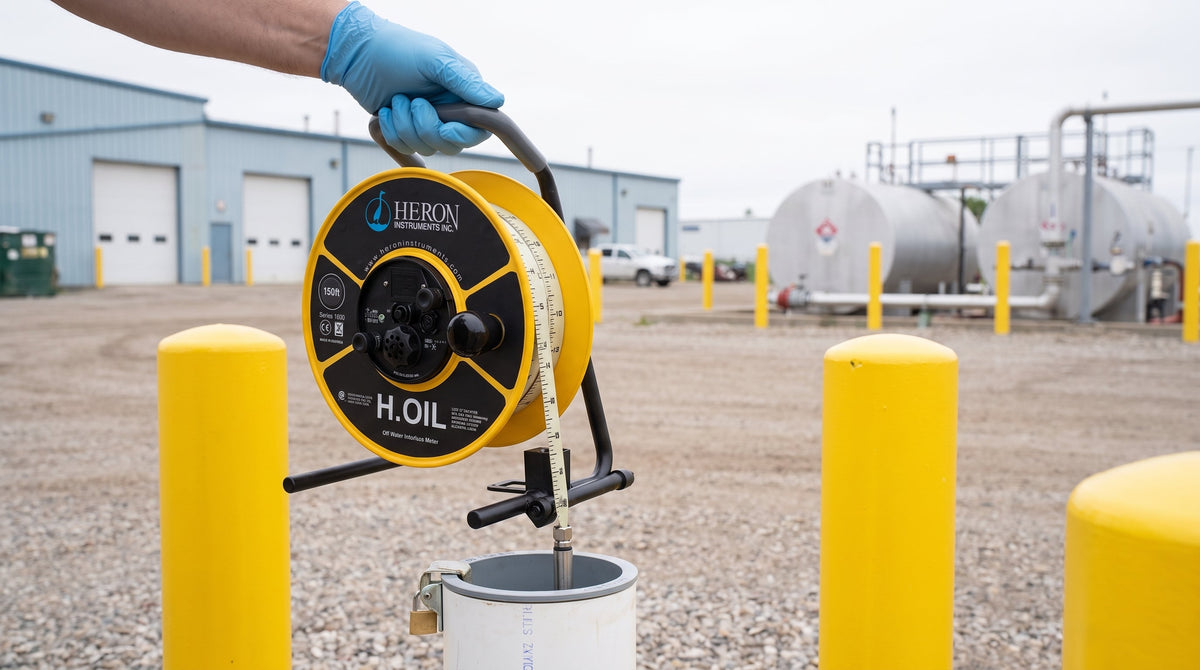
An interface probe measures the depth and thickness of a floating or sinking liquid layer in a monitoring well by combining infrared refraction (to detect any hydrocarbon) with conductivity sensing (to confirm water) — giving a real thickness reading for LNAPL or DNAPL product, not just a level. This guide compares the two interface meters ERE Inc. stocks and covers when you need one instead of a standard water level meter.
Table of contents
- What Does an Interface Probe Measure?
- How Does an Interface Probe Work?
- Which Interface Meter Should You Use?
- How Do You Measure Product Thickness With an Interface Probe?
- Why Does Interface Measurement Matter for Remediation?
- Frequently Asked Questions
What Does an Interface Probe Measure?
An interface probe — also sold as an oil/water interface meter — measures the depth to a liquid interface inside a monitoring well or tank, and the thickness of any non-aqueous product layer sitting on top of or below the water table. A standard water level meter only tells you where the water surface is; an interface probe adds a second signal that identifies whether a hydrocarbon layer is present and how thick it is.
LNAPL vs. DNAPL: Floating vs. Sinking Product
Light non-aqueous phase liquids (LNAPL) — gasoline, diesel, most crude oils — are less dense than water and float on the water table. Dense non-aqueous phase liquids (DNAPL) — chlorinated solvents, coal tar, some heavier oils — are denser than water and sink to the bottom of the well or the confining layer below it. An interface probe reports both: the floating-product thickness at the top of the water column, and, on models rated for it, a sinking-product reading at the bottom.
How Does an Interface Probe Work?
The probe combines two sensing methods in one tip. An infrared beam detects any hydrocarbon film or layer it passes through — hydrocarbons refract infrared light differently than water, so the optical sensor triggers the instant the probe crosses into product. A separate conductivity circuit confirms water specifically, since water conducts electricity and most petroleum products don't. Together, the two signals let the electronic panel report three distinct states through separate audio and visual signals: product, water, or air.
The probe is lowered on a laser-marked tape or cable, the same way a manual water level meter is used, so field crews already trained on water level meters can run an interface probe with no new technique to learn — only a new signal to read.
Which Interface Meter Should You Use?
ERE stocks two brands across three models, all built for the same core measurement with different certifications, tape formats, and portability trade-offs.
| Meter | Tape length | Probe | Certification | Best for |
|---|---|---|---|---|
| Heron H.Oil (Series 1602/1603) | 20–300 m, Kynar™-coated stainless tape | ⅝" detachable IP68 probe | ATEx, IECEx, UKEx, c-QPS-us Intrinsically Safe | Sites needing the broadest hazardous-area certification (EU + UK + North America) and longer reach (up to 300 m) |
| Solinst Model 122 | 30–300 m, PVDF laser-marked flat tape | ⅝" P8 316 stainless steel probe, 500 psi-rated | CSA Class I Div 1 Groups C&D, ATEX | Standard-diameter wells where CSA certification is the site requirement |
| Solinst Model 122M Mini | 25 m, narrow PVDF coaxial cable | Same ⅝" P8 probe, narrower cable profile | CSA Class I Div 1 Groups C&D, ATEX | Narrow-diameter wells and backpack-portable single-well checks where a compact reel matters more than reach |
All three probes share the same 5/8" probe diameter and accuracy class — the decision usually comes down to which hazardous-location certification your site's health and safety program specifies, and whether you need the H.Oil's longer 300 m reach or the 122M's narrower, more portable cable. For monitoring programs that already run Solinst water level meters or dataloggers, staying in the Solinst line keeps tape guides, carrying cases, and calibration accessories interchangeable — see ERE's water level instruments collection for the full Solinst range.
How Do You Measure Product Thickness With an Interface Probe?
The field procedure is a short extension of a standard water level check:
- Lower the probe slowly from the top of casing, watching for the first audio/visual signal change — this marks the top of any floating product layer, or the water surface if none is present.
- Record the top-of-product or water-level depth from the reference point (typically top of casing).
- Continue lowering through the product layer until the signal changes again to the water tone — this marks the product/water interface.
- Record the interface depth and subtract it from the top-of-product depth to get floating-product thickness.
- For DNAPL, continue to the base of the well on models rated for sinking-product detection, noting where the signal indicates a denser product layer at the bottom.
- Decontaminate the probe and tape between wells per your site's health and safety plan before moving to the next monitoring point.
Why Does Interface Measurement Matter for Remediation?
Free-product thickness is one of the standard field measurements used to evaluate whether a site needs active free-product recovery before it can move toward closure. Provincial site-assessment frameworks that draw on the CCME Canada-Wide Standard for Petroleum Hydrocarbons in Soil use free-product presence and thickness as a trigger for remediation action, distinct from the dissolved-phase concentration limits measured through lab sampling — an interface probe is the field tool that generates that specific reading.
Because interface probes are used inside wells at fuel-handling, remediation, and oil & gas sites — locations that can carry flammable vapours — both meters ERE stocks are certified for use in classified hazardous locations. Follow your site's WHMIS hazard-communication and hazardous-location protocols alongside the equipment's own intrinsically-safe rating when working near active product.
Interface probes are a natural companion to oil-water separator and remediation programs where free product recovery is already underway, and to the broader groundwater monitoring equipment covered in ERE's environmental sampling equipment guide.
Need an interface meter for your monitoring program?
ERE Inc. has supplied environmental and groundwater monitoring equipment to Canadian consultants for 30+ years. Tell us your well diameter and site certification requirements and we'll recommend the right meter.
→ Request a Quote | 1-888-287-EREC | Browse Water Level Instruments | sales@ereinc.com
Frequently Asked Questions
What's the difference between an interface probe and a water level meter?
A water level meter only signals when it contacts liquid, marking the water surface. An interface probe adds infrared refraction sensing on top of conductivity sensing, so it can distinguish a floating or sinking hydrocarbon product layer from water and report the product's thickness, not just a single depth.
Can one interface meter detect both LNAPL and DNAPL?
Yes — the same infrared-refraction-plus-conductivity sensing detects both floating product (LNAPL) at the top of the water column and sinking product (DNAPL) at the bottom of the well, since both are hydrocarbons the probe can distinguish from water.
Do interface meters need to be intrinsically safe certified?
For most sites, yes. Interface probes are used inside wells at fuel-handling and remediation sites where flammable vapours can be present, so both meters ERE stocks carry intrinsically-safe certification (Heron H.Oil: ATEx/IECEx/UKEx/c-QPS-us; Solinst 122/122M: CSA Class I Div 1, ATEX) for use in classified hazardous locations.
Why choose the Solinst 122M Mini over the standard Model 122?
The 122M uses a narrower coaxial cable instead of the standard flat tape, which fits narrow-diameter wells more easily and packs into a more compact, backpack-portable reel — at the cost of a shorter 25 m maximum reach versus the standard 122's 30–300 m range.
Related articles
- Water Level Meters: A Buyer's Guide for Canadian Groundwater Monitoring
- Solinst Levelogger 5 Groundwater Monitoring Guide
- Low-Flow Groundwater Sampling: Peristaltic Pump Selection Guide
- Oil-Water Separator Maintenance Guide
Lire en français : Sondes d'interface : comment détecter les LNAPL et DNAPL dans un puits d'observation