
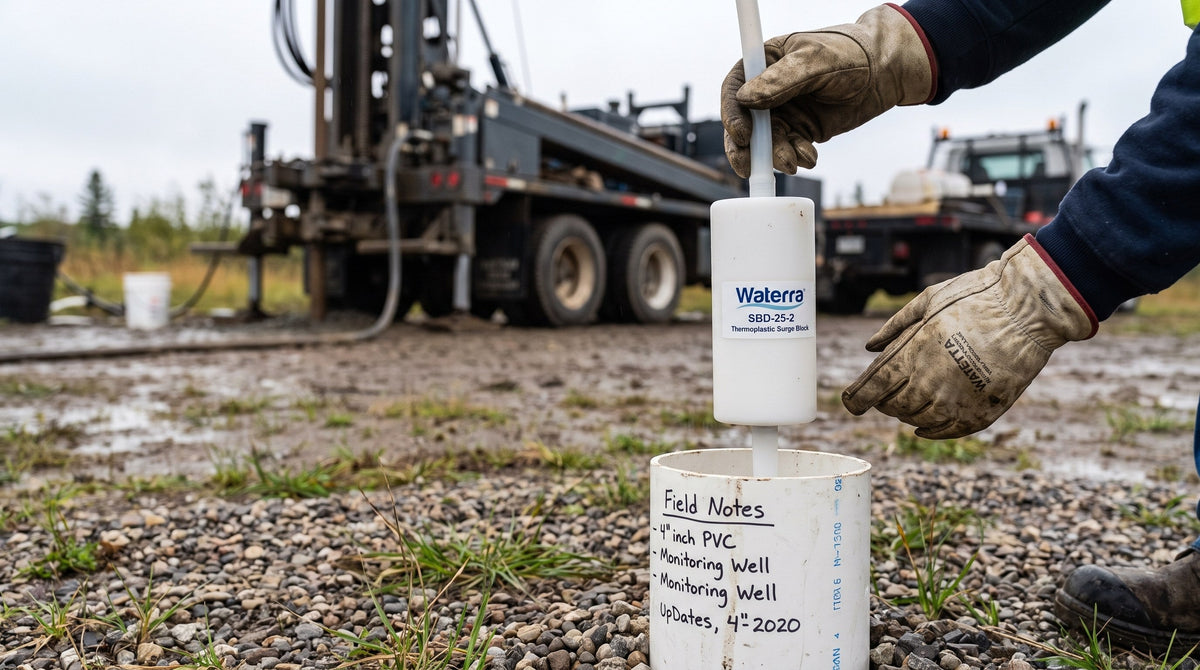
A newly installed or long-dormant groundwater monitoring well won't give you a representative sample until it's been developed. Well development means physically clearing the fine silt, drilling mud, and sand-pack fines that clog the well screen after installation — and the standard tool for doing it on a 2" or 4" monitoring well is a surge block.
What Is Well Development, and Why Does It Matter for Groundwater Monitoring?
Well development is the process of clearing fine sediment, drilling mud, and sand-pack fines from a newly installed well screen and the formation immediately around it, so the well produces clean, representative groundwater. Drilling and installation — whether hollow-stem auger, sonic, or direct-push — inevitably smears fine material across the borehole wall and packs fines into the screen slots and sand pack. Until that material is physically broken up and removed, every sample pulled from the well carries turbidity and non-representative chemistry that doesn't reflect the actual aquifer.
For environmental consultants running Phase II ESA characterization or long-term compliance monitoring, this isn't cosmetic. A turbid sample can bias metals results high (adsorbed onto suspended fine particles) and mask the water-level response the well is supposed to be tracking. ASTM D5521/D5521M, the standard guide for developing groundwater monitoring wells in granular aquifers, exists precisely because undeveloped wells produce data that doesn't hold up to review.
What Does an Undeveloped Well Look Like in the Field?
Slow recovery after purging, visibly cloudy or sediment-laden samples, and a well that never seems to "clear up" no matter how much water you pull are the three classic signs. If low-flow purging with a peristaltic pump (see our low-flow groundwater sampling guide) can't get turbidity below target after a reasonable purge volume, the well likely still needs development or redevelopment before the sampling event.
How Does Surging Develop a Monitoring Well?
A surge block develops a well by mechanical plunging: the block is lowered on rigid tubing to just above the screen and moved up and down, creating alternating pressure and suction through the screen slots. The outward stroke pushes water (and fines) into the formation; the inward stroke pulls water and loosened fines back into the well, where they're removed by bailing or pumping. Repeated surge-and-purge cycles progressively clear the sand pack without introducing any outside water, air, or chemicals into the well — important when the well's own chemistry is what you're there to measure.
ERE stocks Waterra Surge Blocks for Monitoring Well Development in Standard Flow and High Flow configurations for both 2" and 4" wells. The block is a thermoplastic ring that press-fits onto a Waterra D-25 (Standard Flow) or D-32 (High Flow) foot valve, reducing the annular gap to roughly 1/16", which is what generates the plunging action.
How to Surge and Develop a Monitoring Well — Step by Step
- Confirm well construction. Note the well diameter (2" or 4"), screen interval, and sand-pack material before selecting equipment — surge-block sizing depends on the casing ID.
- Select and attach the surge block. Press-fit the correctly sized block onto a Waterra D-25 or D-32 foot valve and connect to rigid PVC or polyethylene tubing sized for the well. A tubing cutter and foot-valve wrench make field assembly and disassembly faster.
- Lower the assembly to just above the screen. Positioning too close to the screen bottom risks damaging it; positioning too high reduces development effectiveness.
- Surge in controlled strokes. Move the tubing up and down in steady, moderate strokes — start gently and increase intensity gradually rather than surging aggressively from the first stroke, which can bridge fines instead of breaking them down.
- Purge the loosened sediment. After each surge interval, remove the water and fines pulled into the well casing using a bailer (ERE's Reusable CarboBailer or a disposable bailer from the bailers collection) or a low-flow pump.
- Repeat until the discharge runs clear. Continue surge-and-purge cycles, checking turbidity between cycles, until water quality stabilizes and turbidity meets your project's target before moving to the sampling event.
What Other Well Development Methods Exist Besides Surging?
Surging is the most common method for narrow-diameter monitoring wells because it requires no outside water or air and works within standard 2"–4" casing. Other methods used in the water-well and monitoring-well industry include jetting (high-pressure water directed through nozzles to blast open screen slots), airlifting (compressed air lifts water and fines out of the casing), and overpumping (running a pump well above its normal rate to pull remaining fines through the screen). Jetting and airlifting typically require specialized equipment and are more common on larger-diameter production or water-supply wells than on 2"–4" environmental monitoring wells, where surging plus bailing or low-flow purging is the standard field approach.
Can a Peristaltic Pump Substitute for Surging?
No — a peristaltic pump purges and samples a well, but it doesn't generate the plunging pressure differential surging does, so it won't break down bridging or clear fines packed into the screen. The two are sequential steps, not alternatives: develop the well with a surge block first, then use a peristaltic pump such as ERE's Ezyflow Water Sampling Pump for routine low-flow purging and sampling once the well is producing clean water.
How Do You Choose the Right Surge Block Size?
Surge-block selection comes down to two variables: well diameter and desired flow. ERE stocks four Waterra Surge Block configurations covering standard 2" and 4" monitoring wells:
| Model | Well Diameter | Foot Valve | Outer Diameter |
|---|---|---|---|
| Standard Flow — 2" | 2" wells | D-25 | 1.88" |
| Standard Flow — 4" | 4" wells | D-25 | 3.88" |
| High Flow — 2" | 2" wells | D-32 | 1.88" |
| High Flow — 4" | 4" wells | D-32 | 3.88" |
All four are thermoplastic, press-fit directly onto the matching Waterra foot valve, and hold roughly a 1/16" annular gap against the casing wall to generate the plunging action. High Flow configurations pair with the D-32 foot valve for faster development on wells where time in the field is the constraint.
When Should a Monitoring Well Be Redeveloped?
Redevelop a well whenever turbidity climbs on samples that used to run clear, recovery slows noticeably after purging, or a well has sat unused for an extended stretch between monitoring events — sand packs and screens can re-clog over time even on a well that was properly developed at installation. Wells affected by iron- or manganese-related bacterial fouling are a common redevelopment trigger; a Biological Activity Reaction Test (BART) can confirm bacterial fouling as the cause before deciding on a redevelopment or rehabilitation approach. Redevelopment uses the same surge-and-purge procedure as initial development, repeated until turbidity and yield return to baseline.
Well data only means something if the sample it's built on is representative — the Canadian Groundwater Quality Guidelines that most provincial site-assessment frameworks reference assume comparably clean, representative samples going into that comparison. A well that's never been properly developed — or one that's silted back up since — undermines that comparison before the lab even runs the analysis.
For the broader sampling toolkit around a developed well, see our water level data loggers buyer's guide and the full environmental sampling equipment guide.
Need surge blocks or well development equipment?
ERE Inc. has supplied environmental consultants and drilling contractors across Canada for 30+ years — talk to a real engineer about sizing surge blocks, bailers, or purge pumps for your well program.
→ Request a Quote | 1-888-287-EREC | Browse Bailers & Well Development | sales@ereinc.com
Frequently Asked Questions
How long does well development take?
A typical 2"–4" monitoring well takes 30 minutes to a few hours of surging and purging, depending on formation type and how much fine material the drilling method introduced. Fine sand and silt formations generally take longer than clean gravel packs.
What's the difference between well development and well redevelopment?
Development is the initial clearing of a newly installed well before its first use. Redevelopment is the same surge-and-purge procedure applied later, when turbidity or yield has declined on a well that was already producing clean samples.
Do I need a surge block, or can I develop a well by bailing alone?
Bailing alone removes water and loose sediment but doesn't generate the plunging pressure differential that breaks down bridging in the sand pack. Surging with a block first, then purging with a bailer or pump, clears a well faster and more completely than bailing on its own.
Can the same surge block be used across multiple wells?
Yes, as long as it's decontaminated between wells per your project's field sampling plan — the same cross-contamination protocol you'd apply to a bailer or pump.
Related articles
- Groundwater Bailers: Types, Materials & Selection Guide
- Low-Flow Groundwater Sampling: Peristaltic Pump Selection Guide
- Water Level Data Loggers: Buyer's Guide for Canadian Groundwater Monitoring
- Environmental Sampling Equipment Guide for Canada
Lire en français : Développement de puits de surveillance : comment purger un puits avec un bloc de surgeage