
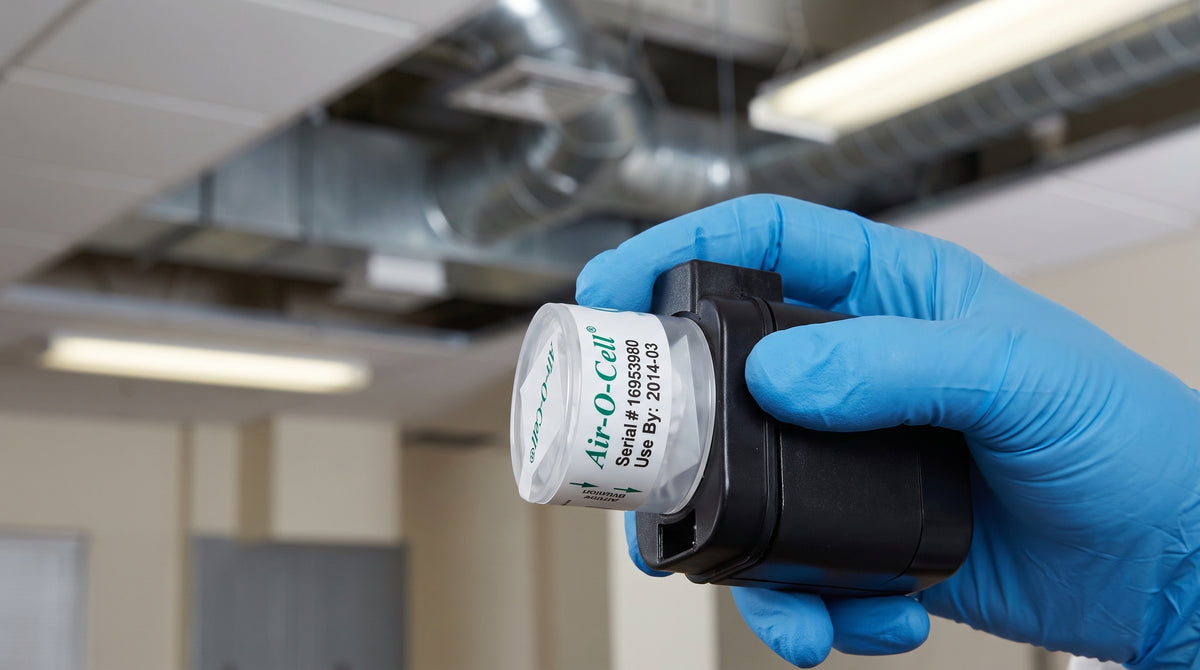
The right air sampling cassette depends on what you're testing for, not what pump you own: use Air-O-Cell or Allergenco-D for mold and bioaerosol screening, Micro5 for a tighter fungal-spore count, a PCM/MCE filter cassette for asbestos and fiber counting, and a sorbent tube for VOCs and gases. Match the cassette to the contaminant first, then confirm your pump hits the required flow rate.
Which Cassette Detects Mold and Bioaerosols?
For airborne mold spores, pollen, insect parts, skin cells, and other bioaerosols, the choice is between the Zefon® Air-O-Cell® cassette, the Allergenco-D cassette, and the Micro5 MicroCell cassette. All three collect both viable and non-viable aero-allergens onto an adhesive-coated slide for lab microscopy; the difference between them is collection geometry and flow rate.
Air-O-Cell vs. Allergenco-D vs. Micro5
| Cassette | Flow rate | Collection method | Best for |
|---|---|---|---|
| Air-O-Cell | 15 LPM | Slit impaction | General mold/bioaerosol screening, the industry-standard reference cassette most labs are set up to read |
| Allergenco-D | 15 LPM | Patented laminar-flow venturi | A more defined impaction trace than Air-O-Cell, useful when the lab wants cleaner particle separation for counting |
| Micro5 | 5 LPM | 360° impaction chamber | Near-total collection efficiency across the full fungal spore size range, at a lower flow rate for longer sample times |
Any of the three works with a standard sampling pump capable of the cassette's rated flow. The Zefon® Bio-Pump® Plus covers Air-O-Cell and Allergenco-D at 15 LPM, and lower-flow personal pumps handle the Micro5's 5 LPM. See our air sampling pumps buyer's guide for pump selection by flow rate and application.
Mold assessment protocols in Canada generally follow the same collection principles the U.S. EPA's guide to mold and moisture lays out: sample where visible growth or musty odour is present, and always pair an indoor cassette with an outdoor control sample for comparison.
Which Cassette Is Used for Asbestos and Fiber Counting?
Asbestos and general fiber counting use a different family entirely: PVC and MCE preloaded filter cassettes, not the bioaerosol cassettes above. These are built to NIOSH, OSHA, and EPA methods, manufactured in two- or three-piece configurations, and preloaded under quality-assurance standards with membrane and support pads already installed. No field assembly required.
Fiber counting under OSHA's asbestos standards specifies mixed-cellulose-ester (MCE) filter media and a defined field-of-view count method; PVC filters are the standard choice for gravimetric (mass-based) particulate analysis instead of fiber counts. Confirm which filter media your lab requires before ordering; the two aren't interchangeable for a given analysis method.
Determining Sample Mass, Not Just Fiber Count
When the analysis is gravimetric (total dust or particulate mass rather than a fiber count), use gravimetric pre-weighed cassettes instead. Each cassette ships labeled with its pre-sampling filter weight and serial number, so the lab only has to weigh it once post-sampling to determine collected mass. That eliminates a pre-weighing step most labs would otherwise have to run in-house.
Which Cassette Handles VOCs and Gases?
None of the cassettes above collect vapors or gases. For VOC and gas sampling, you need Zefon® sorbent tubes: glass tubes packed with accurately weighed, high-purity sorbent media that adsorb the target compound as air is drawn through with a low-flow sampling pump. Most sorbent tubes are split into two sections, with the front section roughly twice the size of the back, so the lab can check the back section for breakthrough (confirmation the front section didn't reach saturation during the sample run).
Sorbent tubes fit standard tube holders, including the Zefon® Gemini® twin-port sorbent tube sampler, which lets you run two tubes off one pump for a duplicate sample or two different sorbents in a single deployment.
How Do You Know If Your Cassette Data Is Accurate?
Cassette data is only as good as the flow rate it was collected at. Every cassette above has a rated LPM, and a pump running fast or slow shifts your reported concentration even if the cassette itself performed correctly. Verify pump flow before and after every sampling run with a calibrator like the Zefon® DigiCal™ flow calibrator, which replaces a bubble-tube calibration setup with an instantaneous digital flow readout.
Log the pre- and post-sample flow rate on the chain-of-custody form alongside the cassette lot number. If the two readings drift more than a few percent, the sample's flow-rate assumption, and therefore its reported concentration, is no longer reliable.
Browse the full air sampling collection for cassettes, pumps, tube holders, and calibration equipment in one place.
Need help matching a cassette to your sampling protocol?
ERE Inc. has been Canada's environmental equipment specialist for 30+ years, stocking Zefon, Gilian, and Buck air sampling equipment. Talk to a real technical rep before you order the wrong cassette for your lab's method.
→ Request a Quote | 1-888-287-EREC | Browse Air Sampling | sales@ereinc.com
Frequently Asked Questions
Can I use an Air-O-Cell cassette for asbestos testing?
No. Air-O-Cell and other bioaerosol cassettes are built for mold spores and organic particulate, read by direct microscopy on the cassette's adhesive trace. Asbestos fiber counting requires a PCM/MCE preloaded filter cassette analyzed under NIOSH/OSHA phase-contrast microscopy methods. The two aren't interchangeable.
What flow rate do I need for a Micro5 cassette?
5 LPM. That's lower than the 15 LPM rating on Air-O-Cell and Allergenco-D, so confirm your pump can hold a steady 5 LPM rather than just running it at a higher-flow pump's default setting.
How often should I calibrate my sampling pump?
Calibrate immediately before and after every sampling run, not on a fixed weekly or monthly schedule. Flow rate can drift between uses, and a digital flow calibrator like the DigiCal™ takes under a minute per check, so there's no reason to skip it.
Do I need a different cassette for gravimetric vs. fiber analysis?
Yes. Gravimetric (mass-based) analysis uses pre-weighed PVC filter cassettes so the lab can determine collected mass from a single post-sample weighing. Fiber counting uses MCE filter media read under phase-contrast microscopy. Confirm which method your lab runs before ordering cassettes.
Related articles
- Air Sampling Pumps: A Buyer's Guide for Environmental & Occupational Hygiene Professionals in Canada
- Air Sampling Pump Rental in Canada: What to Rent, When to Buy
- Indoor Air Quality Monitoring for Commercial Buildings: A Buyer's Guide for Canada
Lire en français : Types de cassettes d'échantillonnage de l'air : lesquelles choisir?