
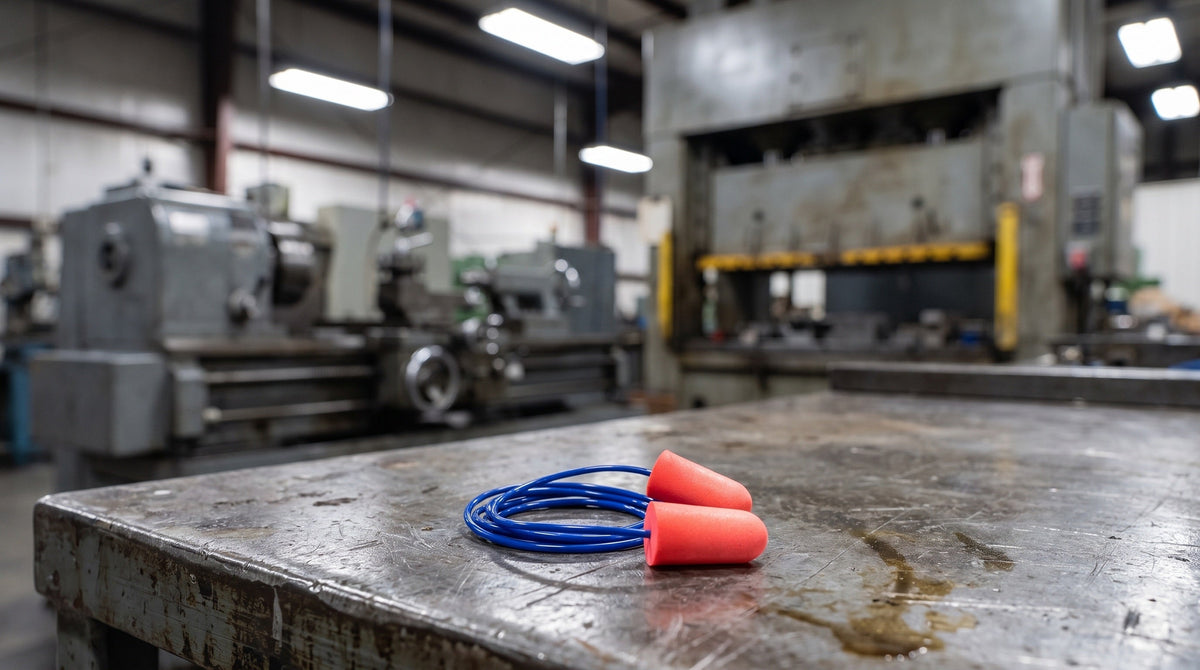
Industrial earplugs are chosen on four things: the noise level at the worker's ear, the Noise Reduction Rating (NRR) after derating, how long they are worn, and what the plant needs around them (metal detection, a dispenser, a corded style). This guide shows how to read an NRR, apply the Canadian derating formula, and match RONCO Hush™ earplugs and earmuffs to the job.
In this guide
- When Do Workers Need Earplugs?
- How Do You Read an NRR and Derate It?
- Which Type of Earplugs Fits Which Job?
- Which Hush™ Earplugs Does ERE List?
- When Are Earmuffs or Dual Protection Better Than Earplugs?
- How Do You Choose Industrial Earplugs, Step by Step?
- Frequently Asked Questions
When Do Workers Need Earplugs?
Workers need hearing protection when their noise exposure is close to or above the occupational exposure limit, which is 85 dBA in most Canadian jurisdictions (CCOHS). CCOHS also recommends a noise assessment under CSA Z107.56 whenever a worker is likely to be exposed above 80 dBA, so the decision starts with a measurement, not a guess.
Whether a written program is mandatory depends on the province. CCOHS reports that nine jurisdictions require a hearing conservation program, while Ontario, Quebec, New Brunswick, Nova Scotia and Yukon have no specific requirement but still impose a general duty of due diligence (CCOHS, Hearing Conservation Program). Hearing protection is the last control, after eliminating or reducing the noise at the source.
How Do You Read an NRR and Derate It?
An NRR is a single laboratory number, and the real protection on the shop floor is lower. CSA Z94.2-14 (R2024) defines the NRR from lab attenuation data and gives derating factors so the estimate reflects workplace conditions (CCOHS).
| Protection | Share of NRR counted | Estimated exposure (dBA reading) |
|---|---|---|
| Earplugs | 50% | Leq − [NRR × 0.50 − 3] |
| Earmuffs | 70% | Leq − [NRR × 0.70 − 3] |
| Earplugs + earmuffs | 65% of (higher NRR + 5) | Leq − [(NRR + 5) × 0.65 − 3] |
Worked example. A press line measures 98 dBA TWA. A worker in the RONCO Hush™ 14 Series (NRR 33 on the product record) has an estimated exposure of 98 − (33 × 0.5 − 3) = 84.5 dBA, just under 85. The same worker in the Hush™ 50-436 earmuff (NRR 23) is at 98 − (23 × 0.7 − 3) = 84.9 dBA. Both pass on paper only if the fit is right, which is why fit training matters more than the number.
The Hush™ product records state that the earplugs and earmuffs meet ANSI S3.19-1974, the test method behind the NRR. Check the current user information sheet for the exact number you will derate, because ratings are set per product.
Which Type of Earplugs Fits Which Job?
Foam earplugs suit most steady-noise jobs, reusable earplugs suit people who remove and reinsert them all shift, and metal-detectable earplugs suit food and pharma plants. CCOHS lists earplug styles as premolded, moldable roll-down foam, push-to-fit and custom molded, in disposable or reusable versions (CCOHS).
- Disposable foam: low cost, soft, roll down and insert. Best for continuous noise in manufacturing, construction and mining.
- Corded: the cord keeps a pair connected and lets them hang at the neck, which suits workers who step in and out of noisy areas.
- Reusable TPR: washable, with flanges and a carrying case. Better when cost per shift matters more than convenience.
- Metal-detectable: a detectable component lets plant metal detectors catch an earplug that falls into product.
Earplugs are simple, cheaper than earmuffs and often more comfortable in hot or damp areas, but they give less protection than some earmuffs and are harder to see, so supervisors cannot check them at a glance (CCOHS). The bright citron, red and blue colours on the Hush™ line make that check easier.
Which Hush™ Earplugs Does ERE List?
ERE lists ten products on the Hearing Protection collection. The collection holds eight RONCO Hush™ earplugs and earmuffs and two dispensers. The table reads from each earplug record.
| Product | Material and style | NRR on record | Notes |
|---|---|---|---|
| Hush™ 13 Series | Soft low-pressure PU foam, tapered; uncorded, corded or refill | 32 | Citron; 200, 100 or 500 pairs per box |
| Hush™ 14 Series | PU foam, bullet shape; uncorded, corded or refill | 33 | Fluorescent red; 200, 100 or 500 pairs; individually packed |
| Hush™ 50-33C | Corded single-use foam, bell shape | 32 | Citron; individually wrapped; 100 pairs per box |
| Hush™ 50-23C | Reusable TPR, corded | 25 | Washable; carrying case; 100 pairs per box |
| Hush™ 50-25CD | Reusable TPR, corded, metal-detectable rings | 25 | Blue; food-industry use; 100 pairs per box |
| Hush™ 50-15CD | Single-use PU foam, corded, 3 mm metal ball bearing | Not stated in record | Sky blue; metal-detectable; 100 pairs per box |
For dispensing, the Hush™ Dispenser (RO-50-60) fits the uncorded Hush™ 13 and 14 refill bags of 500 pairs, wall or table mounted, with a catch basin. The Leight Source 400 dispenser holds 400 pairs and mounts on a table or wall.
When Are Earmuffs or Dual Protection Better Than Earplugs?
Earmuffs are better for intermittent noise, because CCOHS notes they are easier than earplugs to remove and put back (CCOHS). The Hush™ records add that earmuffs are more comfortable in cooler temperatures and need no preparation like earplugs, and they are easy to see on the wearer.
- Hush™ 50-436: multi-position cups so it can be worn with other PPE, NRR 23, hi-viz yellow, dielectric.
- Hush™ 50-443: dielectric ABS cups, flexible headband, soft cushions, hi-viz green. The record does not state an NRR in its text, so read the user information sheet before you derate it.
CCOHS lists it as an earplug disadvantage that they should not be used in areas exceeding 105 dBA. For those jobs use earmuffs or dual protection, calculated at 65% of the higher of the two NRRs plus 5 dB. Hearing protection also has to work with the rest of the PPE on the head, which is what the 50-436's multi-position cups are built for. See our guide to the half mask respirator for the facepiece that often shares the head with hearing protection.
How Do You Choose Industrial Earplugs, Step by Step?
- Measure the noise. Get a TWA under CSA Z107.56, or the dBA reading from your occupational hygienist, for each job.
- Pick the target exposure. Aim below the 85 dBA limit that applies in your province, and below 80 dBA where you want margin.
- Derate the NRR. Use 50% for earplugs, 70% for earmuffs and 65% for dual protection, minus 3 dB on dBA readings.
- Match the style to the job. Foam for steady noise, corded for in-and-out work, reusable for long wear, metal-detectable for food and pharma.
- Offer more than one size or type. CCOHS recommends offering a choice because comfort drives whether people keep them in.
- Train the fit and supervise. Poor insertion, part-time wear and short removals erase most of the protection.
If you need help matching earplugs to a noise survey, or want a dispenser sized to your headcount, request a quote and we will return a specific list.
Need help with industrial earplugs?
ERE Inc. has served Canadian industrial and environmental buyers for 30+ years. Tell us the noise level, the job and the headcount, and we will quote the matching Hush™ earplugs, earmuffs and dispensers.
→ Request a Quote | 1-888-287-EREC | Browse Hearing Protection | sales@ereinc.com
Frequently Asked Questions
What NRR do industrial earplugs need?
The NRR you need depends on the measured noise and the target exposure, not on a fixed number. Derate the printed NRR to 50% for earplugs (minus 3 dB on a dBA reading) and check the result lands below your provincial limit, usually 85 dBA.
Are foam or reusable earplugs better for industrial work?
Foam earplugs are the economical default for steady noise, and reusable TPR earplugs suit workers who remove and reinsert them often. On ERE's records, the Hush™ 14 Series foam lists NRR 33 and the reusable Hush™ 50-23C lists NRR 25.
Can you wear earplugs in noise above 105 dBA?
CCOHS lists it as an earplug disadvantage that they should not be used in areas exceeding 105 dBA. Use earmuffs or dual protection, and calculate the result with the 65% dual-protection derating.
Do I need metal-detectable earplugs?
You need them in food and similar plants where an earplug lost into product must be caught by a metal detector. ERE lists the Hush™ 50-25CD with detectable metal rings and the Hush™ 50-15CD with an enclosed 3 mm metal ball bearing.
How many pairs of earplugs does a dispenser hold?
The Hush™ Dispenser fits refill bags of 500 pairs of uncorded Hush™ 13 and 14 earplugs, and the Leight Source 400 holds 400 pairs. Both can be wall or table mounted.
Related articles
- Half Mask Respirator: How to Match Cartridges and Filters to the Hazard in Canada
- Disposable Coveralls: How to Choose Between PP, Microporous and Type 5/6 in Canada
- Fall Arrest Harness: How to Read CSA Z259.10 Classes and Choose in Canada
Lire en français : Bouchons d'oreille industriels : comment lire le NRR et choisir au Canada