
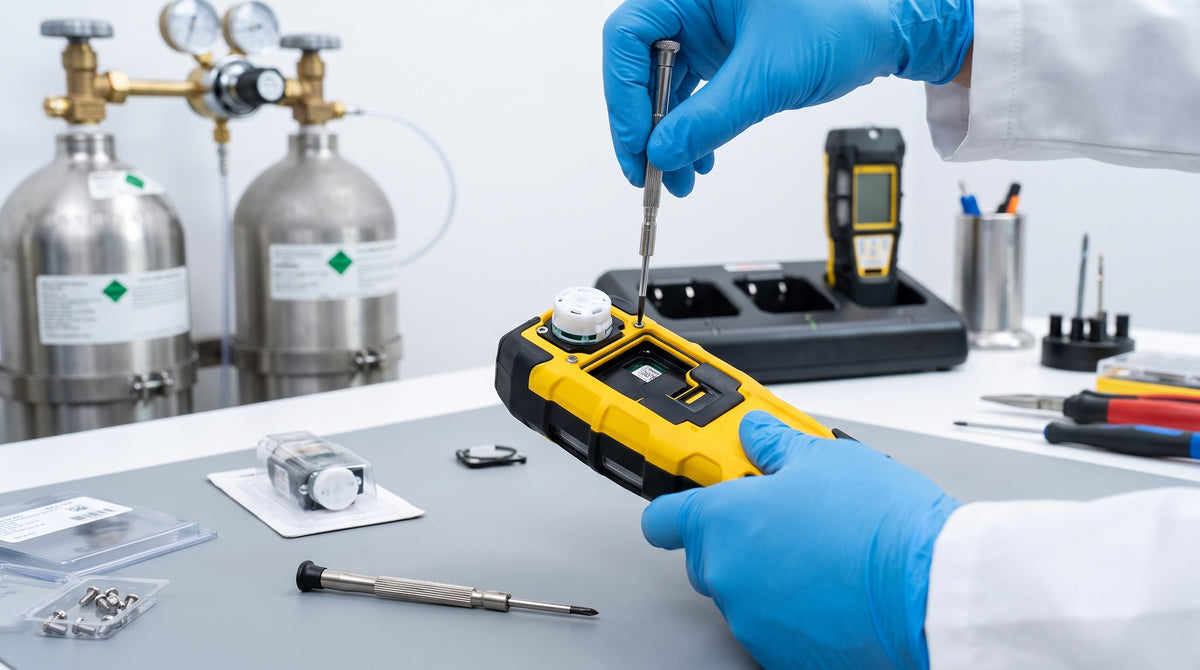
Most gas detector failures in the field aren't calibration problems — they're maintenance problems that show up as a failed calibration. A sensor that's past its service life or a battery that can't hold a charge through a full shift will fail a bump test or drift out of tolerance long before anyone schedules a calibration appointment. Knowing what to check between calibrations is what keeps an instrument reliable on the days that matter.
How Often Should You Replace Gas Detector Sensors?
Electrochemical sensors (H2S, CO, O2, SO2) last 2 to 3 years under normal use before the electrolyte depletes and response slows past a usable range — replace on that schedule regardless of how clean the calibration history looks. Catalytic bead LEL sensors and PID lamps follow different failure patterns and need their own watch points.
| Sensor Type | Typical Service Life | What Shortens It |
|---|---|---|
| Electrochemical (H2S, CO, O2, SO2) | 2–3 years | High-humidity storage, extreme cold, continuous high-concentration exposure |
| Catalytic bead (LEL) | 2–4 years | Silicone vapours, leaded compounds, high H2S concentrations (sensor poisoning) |
| Photoionization (PID lamp) | 1–2 years | High-humidity sampling, dirty lamp window, frequent high-ppm exposure |
| Infrared (NDIR) | 5+ years | Rarely a maintenance item — longest-lived sensor type |
A sensor that's chemically poisoned — most often a catalytic bead LEL sensor exposed to silicone-based products, leaded fuels, or sustained high H2S — won't recover with calibration. If a sensor needs progressively larger span-gas adjustments at each calibration to hit target, that's the sign to replace it rather than keep re-calibrating a degrading cell.
How Long Do Gas Detector Batteries Actually Last?
A NiMH rechargeable pack in a multi-gas instrument like the GX-6100 is rated for roughly 300 to 500 full charge cycles before runtime drops below a full shift — at daily use, that's 12 to 18 months, sooner in cold-weather field conditions where battery capacity derates 20% or more below 0°C. Single-gas personal monitors that run on replaceable alkaline cells have a simpler failure mode: runtime just gets shorter as the cell ages, with no rebuild option beyond a fresh battery.
- NiMH rechargeable packs — expect 300–500 cycles before capacity fade becomes shift-limiting. A pack that reads full on the charger but drains in under 4 hours of field use has reached end of life.
- Alkaline single-gas monitors — no cycle count to track; just watch battery-life indicators and replace on the manufacturer's interval regardless of apparent charge.
- Cold-weather derating — plan for 20–30% less runtime below 0°C. A pack rated for a 12-hour shift at room temperature may only deliver 8–9 hours on a winter site.
What Are the Warning Signs of Sensor Drift or Battery Failure?
Slow response during a bump test, a zero reading that won't settle, or an instrument that needs a bigger calibration adjustment than last time are the three earliest signs something needs replacing rather than just re-calibrating. Catch these before they show up as a failed pre-entry test in the field.
- Slow bump-test response — the alarm still triggers but takes noticeably longer to reach the set point than it did last month. Early sign of sensor depletion.
- Zero drift — the reading won't settle back to zero in clean air after exposure. Common with catalytic bead and electrochemical sensors nearing end of life.
- Growing span adjustment — calibration software or the technician log shows the instrument needing a larger correction at each successive calibration. A sensor trending this way should be scheduled for replacement, not just recalibrated again.
- Shortened runtime — a battery pack that used to make it through a 10-hour shift now needs a midday top-up. That's capacity fade, not a charging problem.
How Should You Store a Gas Detector Between Field Uses?
Store instruments at room temperature with the battery at roughly 40–60% charge if it will sit for more than a few weeks, and keep sensors away from high humidity and direct sources of silicone vapour (rubber cement, some lubricants, hand sanitizers) even in storage — sensor poisoning happens on the shelf, not just in the field.
Instruments left fully charged in a hot truck cab for weeks between projects lose battery capacity faster than ones stored at moderate charge in a climate-controlled case. For fleets that see intermittent use — a common pattern for environmental consultants with seasonal fieldwork — a rented instrument that ships freshly calibrated for each project can be the more economical option than maintaining an idle fleet through the off-season; see our gas detector rental guide for that comparison.
Bump Test, Calibration, and Sensor Replacement — How Do They Fit Together?
A bump test confirms the alarm still triggers, a calibration corrects the reading against a known gas standard, and a sensor replacement is what you do when calibration alone can't bring a depleted or poisoned sensor back into tolerance — they are three different maintenance actions, not interchangeable terms. For the full breakdown of bump testing versus calibration, see our bump test vs. calibration guide, and for calibration scheduling and CSA Z1006 requirements, see our gas detector calibration guide. Calibration gas selection — mix, concentration, and cylinder sizing — is covered in our calibration gas guide.
ERE Inc. calibrates and services RKI, RAE Systems, Ion Science, and Sensidyne instruments through our repair and calibration department, and stocks replacement sensors and battery packs for the portable gas detectors we sell and rent.
How Do You Check Gas Detector Battery and Sensor Health? (5-Step Field Checklist)
Run this check monthly, or before any project where instrument failure has real consequences — a confined space entry, a remote site with no backup unit, or a long field season kickoff.
- Full charge, then time the drain. Charge the battery fully, disconnect, and note how long normal use runs before the low-battery warning. Compare against the pack's rated runtime — a significant shortfall flags capacity fade.
- Run a bump test and time the response. Note how quickly the alarm triggers against certified gas. A response that's noticeably slower than your last logged bump test is an early sensor-drift signal.
- Check the zero reading in clean air. After the bump test, confirm the display returns to zero (or the expected O2 baseline) within the manufacturer's settling time. A reading that won't settle indicates sensor depletion or contamination.
- Review the calibration log trend. Look at the last 3 to 4 calibration records for that sensor. A growing span adjustment at each calibration — not just occasional variance — means the sensor is trending toward replacement, not just needing another correction.
- Inspect the housing, filter, and connector. Check the dust/water filter over the sensor for clogging, the pump inlet (on pumped instruments) for restriction, and the charging contacts for corrosion. A blocked filter reads as a slow response that has nothing to do with the sensor itself.
Log the results against the instrument's serial number so the trend — not just a single reading — is what drives the replace-or-keep decision.
What Does Canadian Regulation Require for Instrument Maintenance?
CCOHS guidance on maintaining personal protective and monitoring equipment makes manufacturer-specified maintenance and inspection a standing requirement, not an optional best practice — an instrument that's overdue for sensor or battery service doesn't meet that standard even if its last calibration passed. Federally regulated workplaces fall under the Canada Occupational Health and Safety Regulations, which require that safety equipment — gas detection instruments included — be maintained in proper working condition and inspected at intervals that keep it that way. Provincial confined-space and OH&S frameworks (CSA Z1006 and its provincial equivalents) layer the same expectation onto pre-entry testing: an instrument that's due for sensor replacement is not compliant equipment regardless of when it was last calibrated.
Need replacement sensors, batteries, or a full fleet health check?
ERE Inc. stocks replacement sensors and battery packs for RKI, RAE Systems, Ion Science, and Sensidyne instruments, and runs full calibration and maintenance service through our repair department — coast to coast.
→ Request a Quote | 1-888-287-EREC | Repair & Calibration Services | sales@ereinc.com
Frequently Asked Questions
How do I know if my gas detector sensor needs replacing instead of just recalibrating?
Watch the calibration log trend, not a single reading. If the span adjustment needed to bring the sensor back to target grows at each successive calibration, or if a bump test shows a noticeably slower alarm response than previous checks, the sensor is depleting or poisoned and calibration alone won't fix it. Electrochemical sensors past 2 to 3 years and catalytic bead sensors with known silicone or lead exposure are the most common candidates.
Why does my gas detector battery drain faster in winter?
NiMH and lithium battery chemistries lose 20 to 30% of their rated capacity below 0°C. An instrument rated for a 12-hour shift at room temperature may only deliver 8 to 9 hours on a cold winter site. This is a chemistry limitation, not a defect — plan field battery swaps or charging breaks accordingly on cold-weather projects.
Can a poisoned sensor be recovered, or does it need replacement?
A catalytic bead LEL sensor poisoned by silicone vapours, leaded compounds, or sustained high H2S exposure generally cannot be recovered through calibration or cleaning — replacement is the only reliable fix. Prevention (keeping silicone-based products away from the instrument, both in the field and in storage) is more effective than trying to recalibrate a poisoned sensor back into tolerance.
How often should I run the 5-step battery and sensor health check?
Monthly for instruments in regular field rotation, and always before any project where a mid-shift failure has real consequences — confined space entry, remote sites without a backup unit, or the start of a busy field season. Instruments used daily benefit from folding the check into a routine service day rather than waiting for a bump-test failure to catch a problem.
Related Guides
- Gas Detector Calibration: Requirements, Schedule & Best Practices
- Bump Test vs Calibration: The Gas Detector Maintenance Guide
- Calibration Gas: Types, Mixtures, and How to Choose
- Gas Detector Rental in Canada: What to Know Before You Rent
- Portable Gas Detectors: Buyer's Guide for Canada
Lire en français : Entretien de la batterie et des capteurs de détecteurs de gaz : guide pour le Canada