
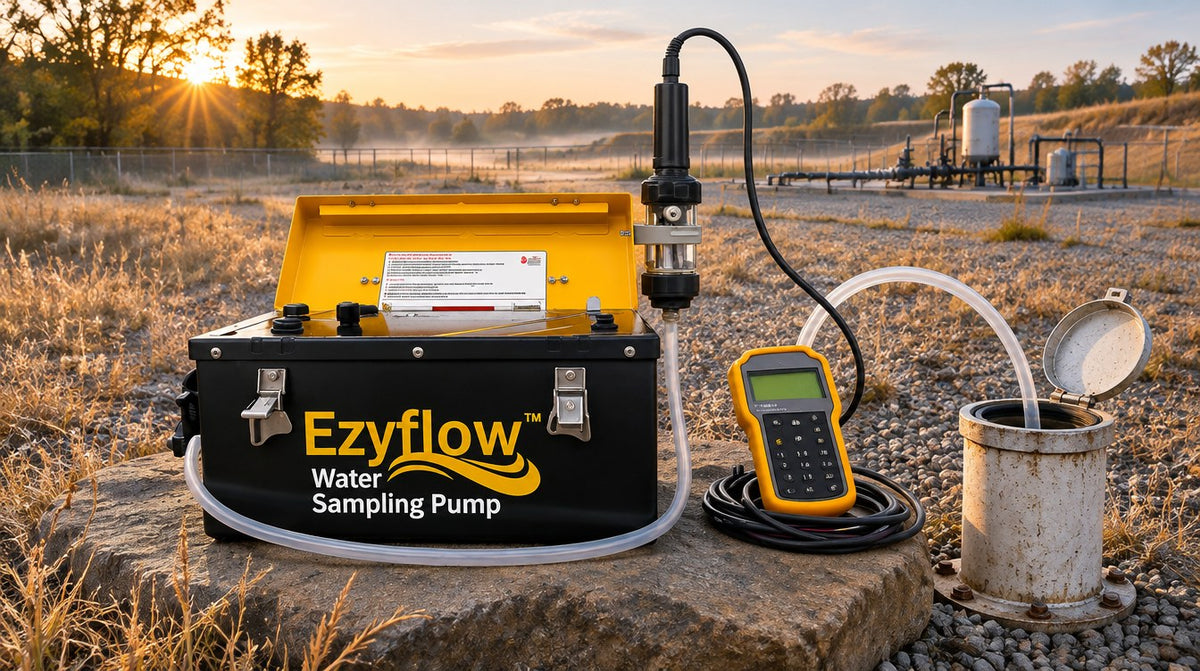
A peristaltic pump moves liquid by squeezing a flexible tube with rotating rollers, so the sample touches only the tube. Flow depends on the tube size and the roller speed, and suction lift tops out near 10 m at sea level. This guide explains how the mechanism works, how to read flow and lift specifications, and when a different pump is the better tool, using the portable models ERE Inc. supplies.
In this guide
- How does a peristaltic pump work?
- Why use a peristaltic pump for sampling?
- What sets the flow rate?
- How deep can a peristaltic pump lift?
- Which tubing should you use?
- Which peristaltic pump suits which job?
- When is a peristaltic pump the wrong choice?
- How to choose a peristaltic pump
- Frequently asked questions
How does a peristaltic pump work?
A rotor with rollers presses a flexible tube against the pump housing, and each roller pushes a pocket of liquid forward as it turns. At least one roller always pinches the tube closed, which acts as the valve, so no check valves are needed. When the tube springs back it draws liquid in behind the roller, which is what creates suction and makes the pump self-priming.
Reversing the motor reverses the flow. Field crews use that to purge a line, clear a blockage or drain the tube back into the well before they leave.
Why use a peristaltic pump for sampling?
Because the sample contacts only the tube, a peristaltic pump is easy to keep clean and low in cross-contamination risk: swap or dedicate the tube and the rest of the pump never sees the liquid. The speed is adjustable down to very low flows, which is what low-flow groundwater sampling needs. The US EPA's low-flow (minimal drawdown) sampling procedure and ASTM D6771 both rest on pumping slowly enough that the well is not stressed, and an adjustable-speed pump makes that practical. For the full method, see our low-flow groundwater sampling guide.
The same design handles surface water, effluent, stormwater and small tank or drum grab samples, as long as the liquid is compatible with the tube.
What sets the flow rate of a peristaltic pump?
Flow is set by the inside diameter of the tube and the rotor speed: a larger bore moves more liquid per revolution, and flow rises in proportion to RPM. On the EzyFlow, the rated maxima at 600 RPM work out to about 1.7 mL per revolution with the EZ-15 tube (1,020 mL/min) and about 2.9 mL per revolution with the EZ-24 tube (1,740 mL/min).
| Model | Tube / bore | Rated flow |
|---|---|---|
| EzyFlow EZ-65-000 | EZ-15: 3/8 in OD x 3/16 in ID silicone EZ-24: 0.44 in OD x 1/4 in ID silicone |
Up to 1,020 mL/min (EZ-15) Up to 1,740 mL/min (EZ-24) |
| Waterra Spectra FieldPro | L/S-15: 0.19 in ID L/S-24: 0.25 in ID (TPE) |
0 to 1,100 mL/min (L/S-15) 0 to 1,800 mL/min (L/S-24); pump range 50 to 1,900 mL/min |
| Solinst 410 Mk5 | Silicone tubing | 40 mL/min to 3.2 L/min, variable speed |
| PeriPump | Silicone, 11.1 mm OD x 6.3 mm ID | About 3 L/min with water at 2 m |
If you need more than about 1 L/min from a pump that offers two tube sizes, specify the larger tube when you order. Do not discover the limit in the field.
How deep can a peristaltic pump lift water?
About 10 m is the physical ceiling at sea level, and real pumps rate lower. A suction pump can only lift water as far as atmospheric pressure pushes it up the tube: 101.3 kPa supports a water column of roughly 10.3 m (101,300 Pa divided by 1,000 kg/m³ x 9.81 m/s²). Losses in the tube and head bring the practical rating below that.
- EzyFlow: about 26 ft (7.9 m) at sea level
- Spectra FieldPro: 27 ft (8.2 m)
- PeriPump: up to 8 m
- Solinst 410 Mk5: up to 10 m (33 ft)
Lift also falls as elevation rises, because there is less atmospheric pressure to push the water up. Check the static water level against the rating before you travel, not at the wellhead. Below the ceiling you need a pump that pushes from the bottom, such as a bladder pump (see our bladder pump guide).
Which tubing should you use in a peristaltic pump?
Use the tube the pump head was built for: the bore and wall thickness set the flow, the squeeze, and how long the tube lasts. Silicone is the usual choice for the pump-head section, and thermoplastic elastomer (TPE) is offered as an alternative for the Spectra FieldPro. Many crews run low-cost LDPE or HDPE tubing for the down-hole run and keep the elastomer tube only inside the head.
Check chemical compatibility before you pump anything other than water. Hydrocarbons and some solvents can swell silicone, so confirm with the tubing supplier's chemical compatibility chart. Stay with the manufacturer's tubing too: on the EzyFlow, other tubing can damage the head, so ask us before substituting. Tubing is a consumable, so stock spares for each tube size you run.
Which peristaltic pump suits which job?
The right model follows the job: ultra-low flow and drawdown control, long battery life, a light carry, or high flow from a shallow source.
- Low-flow groundwater purging and sampling: the EzyFlow is a light, Canadian-made portable with reversible flow, a prime/purge function and an IP54 control panel. It has a manual speed knob and no flow readout, so pair it with a flow cell or graduated container.
- All-day sampling with steady flow: the Waterra Spectra FieldPro has an electronic flow controller that holds flow regardless of battery voltage, a built-in VOA stand and about 14 hours of battery at low flow.
- Automated drawdown control: the Solinst 410 Mk5 connects to a Solinst 101D drawdown meter to start and stop pumping on water level, and covers 40 mL/min to 3.2 L/min.
- Quick liquid sampling from tanks, vessels and surface water: the PeriPump set comes with two Li-ion batteries, a 10 m silicone hose and a carry case. It is not suitable for flammable solvents.
Browse the full range in the sampling pumps collection. The EzyFlow is also available to rent, so you can try it on one site before you buy.
When is a peristaltic pump the wrong choice?
A peristaltic pump is the wrong tool when you need volume, depth, high pressure or smooth flow. Four cases come up most often:
- Bulk transfer. At 1,740 mL/min, filling a 205 L drum takes about 118 minutes (205,000 mL divided by 1,740 mL/min). Use a drum pump instead.
- Deep wells. If the water level is below the lift rating, use a bladder or other submersible pump.
- Precise dosing. Peristaltic output pulses with each roller. A metering pump with a pulsation dampener suits a chemical dosing line better.
- Incompatible liquids. Oils, solvents or aggressive chemicals that attack the tube material need a different pump or tube, and flammable liquids need equipment rated for the hazard.
How to choose a peristaltic pump
- Set the flow range. Low-flow sampling needs fine control down to a few hundred mL/min; purging and transfer need more.
- Check the lift. Compare the static water level, plus a margin for elevation, against the pump's lift rating.
- Match the tube. Pick the bore that delivers the top flow you need and confirm the material suits the liquid.
- Check the power. Compare battery life with the length of a sampling day and whether you need AC charging in the vehicle.
- Decide how you will control it. Manual knob, electronic flow control or drawdown-linked control.
- Plan consumables. Stock a spare tube for each size and a clean tube for each location or dedicated well.
Need help choosing a peristaltic pump?
ERE Inc. has been Canada's environmental equipment specialist for 30+ years. Tell us the liquid, the depth and the flow you need and we will recommend the pump and tubing, or set up a rental.
→ Request a Quote | 1-888-287-EREC | Browse Sampling Pumps | sales@ereinc.com
Frequently Asked Questions
What is a peristaltic pump used for?
A peristaltic pump is used where the liquid must touch only the tube: groundwater and surface water sampling, effluent and stormwater grab samples, and small-volume transfers. It is also used for gentle or abrasive liquids because it has no seals or impellers.
Can a peristaltic pump run dry?
Short dry running is generally tolerated because the pump works on the tube rather than on an impeller, but it will not pull liquid if the lift is too high or the tube is not sealed. Keep dry running brief and check the manufacturer's manual for your model.
How often should the tubing be replaced?
Replace it when it is worn, flattened, cracked or contaminated, or between sample locations if you do not dedicate a tube to each. Wear depends on speed, liquid and run time, so stock spares and inspect the tube at the head.
Is a peristaltic pump self-priming?
Yes. As the tube recovers behind each roller it draws liquid in, so the pump primes itself up to its lift rating without being filled first.
Related articles
- Low-flow groundwater sampling with a peristaltic pump
- Bladder pumps for groundwater sampling
- Drum pump guide
- Pulsation dampener guide
Lire en français : Pompe péristaltique : fonctionnement, débit, tube et hauteur d'aspiration