
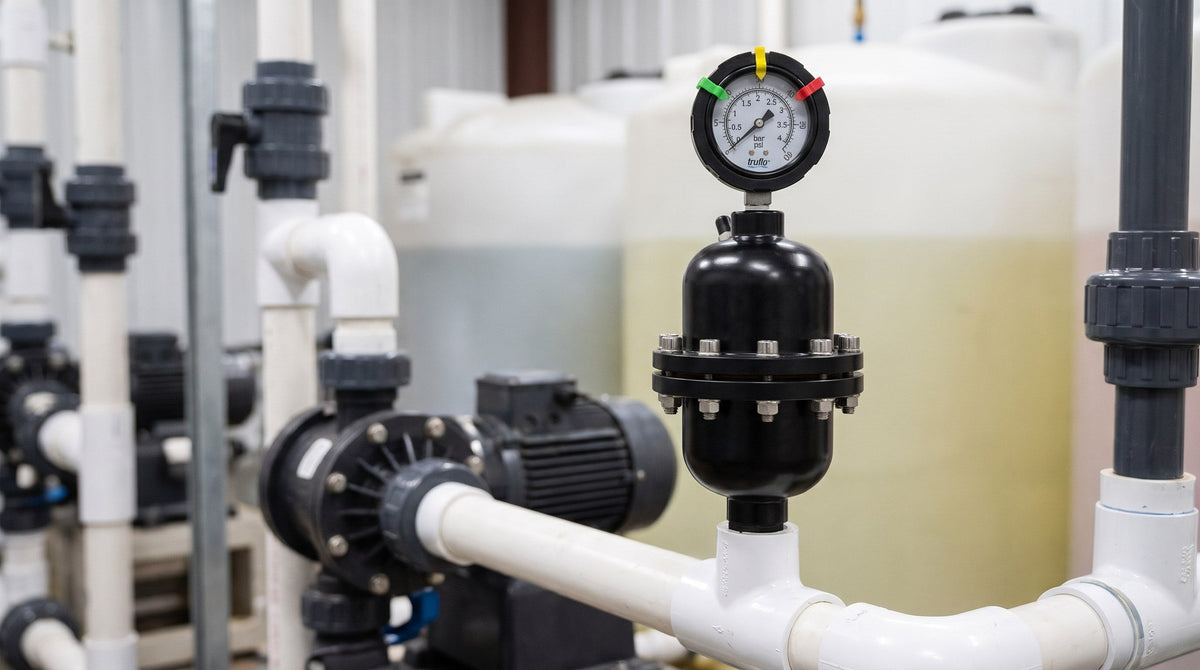
A pulsation dampener smooths the pressure spikes that a diaphragm or metering pump sends down its discharge line. The right choice depends on three things: whether the dampener needs a gas pre-charge or adapts by itself, the wetted material for your chemical, and the connection size. This guide compares the Icon Process Controls PulsePro dampeners ERE carries and the back pressure valves that are often fitted beside them.
In this guide
- What does a pulsation dampener do?
- Do you need a pulsation dampener on a diaphragm pump?
- Which type of dampener fits your line?
- How is a dampener different from a back pressure valve?
- How do you choose a pulsation dampener, step by step?
- Frequently Asked Questions
What Does a Pulsation Dampener Do?
A pulsation dampener stores a small volume of liquid during each pump stroke and gives it back between strokes, which flattens the pressure and flow swings in the discharge line. Positive displacement pumps such as diaphragm and metering pumps deliver in pulses, so the line sees repeated pressure peaks and, in long runs, water hammer.
Left alone, those pulses make pressure gauges flutter, shake pipe supports and loosen fittings, and they can upset a downstream flow meter or injection point. A dampener sits close to the pump discharge, on a tee, and takes up the pulse before it travels.
Do You Need a Pulsation Dampener on a Diaphragm Pump?
You need one when the pulses cause a visible problem: a gauge you cannot read, a flow meter that reads unsteadily, noisy or vibrating piping, or a long or rigid discharge line. A short, flexible line to a single injection point may run without one. Pump manufacturers publish their own guidance, so check the pump data sheet first.
If the pulses affect a pressure gauge reading, see our pressure gauge guide for liquid-filled and guarded options. If they affect a 4-20 mA signal, read the 4-20 mA pressure transmitter guide.
Which Type of Dampener Fits Your Line?
Pick the type by how you want to set it up. The Icon PulsePro family covers three approaches, from a self-adapting plastic unit to a gas-filled stainless steel one.
| Model | Principle | Body / connection | Notes from the product record |
|---|---|---|---|
| PulsePro all-plastic | Self-adapting; no pre-charging or tuning | All plastic; 3/4" NPT or 1-1/2" flange | Reduces pulsations by up to 90%; long-lasting heavy-duty diaphragm |
| PulsePro PV | Pre-charged, field adjustable | PVC, true-union; 1/2" (21 cu in) to 1-1/4" (122 cu in) | Reduces pulsations by up to 95%; includes an OBS pressure gauge |
| PulsePro PF | Gas-filled, direct-acting, pre-charged and adjustable | GFPP, PVDF or 316 SS; 1/2" (21 cu in) to 1-1/2" (488 cu in) | PTFE diaphragm; reduces pulsations by over 95%; includes an OBS-GO gauge |
Use the all-plastic unit where nobody will adjust a pre-charge and the fluid suits plastic. Use the PV where you want to tune the pre-charge against a gauge on a PVC line. Use the PF for aggressive chemicals that need a PTFE diaphragm or a PVDF or stainless steel body.
How Is a Dampener Different From a Back Pressure Valve?
A pulsation dampener absorbs pulses; a back pressure valve holds a minimum pressure in the line, or opens to relieve over-pressure. They solve different problems and many dosing skids use both.
- Icon BRP: installed downstream of a metering pump it maintains back pressure; in a tee branch it works as a relief valve. Teflon-bonded EPDM diaphragm, 5 to 150 psi range, PVC, CPVC, PP or PVDF bodies, true-union.
- Icon BRP3: the 316 stainless steel version, 5 to 150 psi (a 10-235 psi model is available), with an optional sanitary connection.
Back pressure also keeps a metering pump from over-feeding when the injection point is at low pressure. For the chemical itself, see our guides to chemical pot feeders and industrial RO, where dosing lines are common.
How Do You Choose a Pulsation Dampener, Step by Step?
- Identify the pump. Note the model, flow per stroke and strokes per minute; these set how much volume the dampener must absorb.
- Note the discharge pressure. A gas-filled unit is pre-charged against operating pressure; confirm the range with the manufacturer.
- Match the wetted material to the fluid. Check chemical compatibility of PVC, GFPP, PVDF, 316 SS and the PTFE or EPDM diaphragm against the safety data sheet.
- Pick the connection. NPT, flange or true-union, and the pipe size on your discharge line.
- Decide on adjustment. Self-adapting if no one will tune it; pre-charged and adjustable if you want to fine-tune against the gauge.
- Add the back pressure valve if the line needs it.
Chemical feed lines carry hazardous liquids, so confirm labels and safety data sheets under WHMIS before commissioning, and review general chemical safety guidance from CCOHS. The product records do not give a sizing formula or a pre-charge setting, so send us the pump and fluid details and we will confirm sizing with the manufacturer.
Browse the full range in the Pressure Gauges & Transmitters collection.
Need help with a pulsation dampener?
ERE Inc. has been Canada's environmental equipment specialist for 30+ years. Send us your pump model, discharge pressure and fluid and we will recommend the dampener and back pressure valve.
→ Request a Quote | 1-888-287-EREC | Browse Pressure Gauges & Transmitters | sales@ereinc.com
Frequently Asked Questions
What is a pulsation dampener?
A pulsation dampener is a small accumulator fitted on a pump discharge line that absorbs the pressure peaks of a diaphragm or metering pump and releases the liquid between strokes, giving a steadier flow.
Do I need a pre-charged dampener or a self-adapting one?
Choose a self-adapting unit, such as the PulsePro all-plastic, when no one will adjust a pre-charge. Choose a pre-charged, adjustable unit, such as the PulsePro PV or PF, when you want to tune it against the supplied gauge.
What is the difference between a pulsation dampener and a back pressure valve?
A dampener smooths pulses. A back pressure valve holds a minimum line pressure or relieves over-pressure. Dosing lines often need both.
How much can a dampener reduce pulsation?
Icon states up to 90% for the all-plastic PulsePro, up to 95% for the PulsePro PV and over 95% for the PulsePro PF. Actual results depend on the pump, line and installation.
Which body material should I choose?
Match it to the chemical. The PulsePro PV is PVC; the PulsePro PF comes in GFPP, PVDF or 316 stainless steel with a PTFE diaphragm. Check compatibility against the safety data sheet.
Related articles
- Pressure gauge guide
- 4-20 mA pressure transmitter buyer's guide
- Chemical pot feeders
- Industrial reverse osmosis guide
Lire en français : Amortisseurs de pulsations : guide de choix pour pompes doseuses et à membrane au Canada