
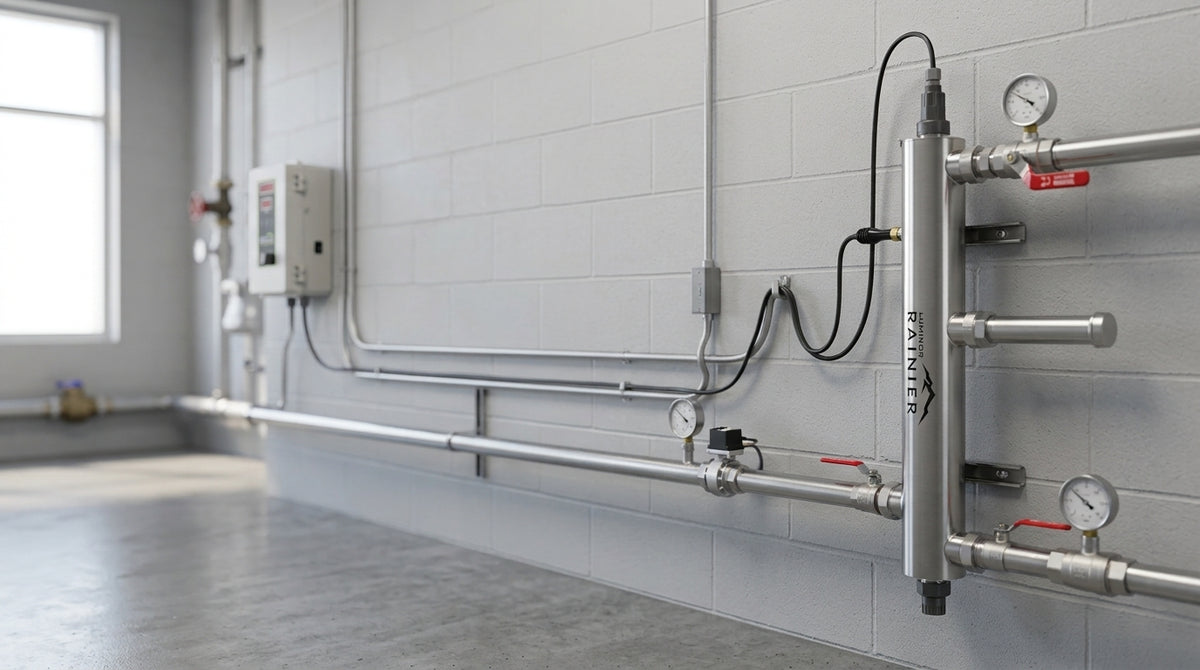
UV disinfection neutralizes bacteria, viruses, and protozoa by damaging their DNA with 254nm ultraviolet light — no chemicals, no disinfection byproducts, no taste or odour change. It works well in commercial and light industrial systems, but only if three things are right: UV dose, water clarity (UVT), and pre-filtration. Get any one wrong and the system passes water that looks treated but isn't.
What Is UV Water Disinfection and How Does It Work?
A UV disinfection system passes water through a chamber containing one or more UV lamps that emit light at roughly 254 nanometres — the wavelength that damages the DNA and RNA of bacteria, viruses, and protozoa (including chlorine-resistant organisms like Cryptosporidium and Giardia) so they can no longer reproduce or infect. The water itself is never heated, chemically dosed, or altered — UV disinfection adds no taste, odour, or disinfection byproducts, which is why it's become the standard secondary or standalone disinfection method for commercial buildings, food and beverage processing, pharmaceutical water, and municipal systems.
Commercial UV systems built on this principle — like the Luminor RAINIER series ERE stocks — use amalgam UV lamps housed inside a 316L stainless steel pressure vessel, rated for continuous operation with a 12,000-hour lamp life. Because UV disinfection is a physical process, not a chemical reaction, its effectiveness depends entirely on how much UV light actually reaches every organism in the water stream — which is where dose and water clarity come in. The U.S. EPA Ultraviolet Disinfection Guidance Manual is the standard technical reference for dose validation and UV reactor design in drinking water treatment, and its dose/UVT relationship applies directly to commercial and industrial systems as well.
How Do You Size a Commercial UV Disinfection System?
Sizing a UV system means matching your peak flow rate to a model rated to deliver the required dose at your water's actual UV transmittance — not just picking a unit rated for your pipe size.
- Establish your peak design flow rate (GPM your system must treat at maximum demand, not average daily flow).
- Test your source water's UVT (UV transmittance, %) — a lab or field UVT meter reading. Most municipal and well water without iron or heavy organics runs 90–98% UVT; water with colour, iron, or high organics can drop to 50–75% or lower.
- Match flow rate and UVT to a rated model — a system rated for 95% UVT will under-deliver dose on 60% UVT water, even if the flow rate looks right on the spec sheet. Low-UVT water needs a system specifically rated for it, or pre-filtration to raise UVT before the water reaches the UV chamber.
- Confirm port size, maximum operating pressure, and temperature range match your piping and application — hot water loops and high-TOC applications use different chamber designs than standard cold-water disinfection (see model comparison below).
Undersizing on UVT is the most common commercial UV sizing mistake — a system that looks adequately sized on flow rate alone can still under-dose if the water is cloudier or has more dissolved organics than assumed.
Does UV Disinfection Work Without Pre-Filtration?
No — UV disinfection is a polishing step, not a pre-treatment step. It requires reasonably clear water to work as rated, because both turbidity (suspended solids) and low UVT (dissolved colour, iron, organics) block UV light before it reaches the organisms suspended in the water. Iron in particular is a double problem: it lowers UVT and can coat the quartz sleeve around the lamp, progressively cutting UV output until the sleeve is cleaned or replaced. Health Canada's Guidelines for Canadian Drinking Water Quality set turbidity limits ahead of any disinfection step specifically because particulates shield microorganisms from UV light and chemical disinfectants alike.
For most commercial installations, ERE recommends sediment or cartridge filtration ahead of the UV chamber to control turbidity — see our filter cartridge selection guide for cartridge types and micron ratings. If the source water carries iron or hydrogen sulfide, that needs to be removed upstream with an oxidizing media like Filox before it reaches the UV chamber — running iron-bearing water through a UV system without pre-treatment will foul the quartz sleeve and drop effective dose over weeks, not years.
Which Luminor RAINIER Model Fits Your Application?
Luminor's RAINIER 6.0 platform ships as four application-specific variants sharing the same 316L stainless steel, ASME-rated chamber design, each rated for a different water condition or use case, plus VIQUA's VP950 as a simpler high-flow option:
| Model | Rated Dose / UVT | Flow Range | Best For |
|---|---|---|---|
| RAINIER 6.0 (Standard) | 30 mJ/cm² @ 95% UVT | 35–215 GPM | General commercial/light industrial disinfection on clear water |
| RAINIER-50 6.0 (Low UVT) | 30 mJ/cm² @ 50% UVT | 14–51 GPM | Cloudy, coloured, or high-organic water that can't be pre-filtered to standard UVT |
| RAINIER-HW 6.0 (Hot Water) | 30 mJ/cm² @ 75% UVT | 22–95 GPM | Hot water loops and Legionella/biofilm control up to 65°C (149°F) |
| RAINIER-TOC 6.0 (TOC Reduction) | 150 mJ/cm² @ 95% UVT | 7–35 GPM | Pharmaceutical and lab-grade pure water requiring total organic carbon reduction |
| VIQUA VP950 (High Flow) | 16–40 mJ/cm² (dose-dependent) | up to 60 GPM | Simpler single-model commercial/municipal disinfection at high flow |
All four RAINIER variants share the bayonet-style lamp connector for tool-free lamp changes, integral LED monitoring display (lamp life, running hours, lamp-failure alarm), and optional 4-20mA output with remote-on and dry-contact capability for building automation integration. The difference between models is the rated dose and UVT the chamber is designed to deliver reliably — picking the wrong variant for your water condition is the single biggest cause of underperforming commercial UV installations.
What Does ERE Supply for Commercial UV Disinfection?
ERE Inc. has distributed environmental and water treatment equipment across Canada for 30+ years. ERE stocks the full Luminor RAINIER 6.0 commercial line — standard, low-UVT, hot water, and TOC-reduction variants — plus the VIQUA VP950 high-flow system for straightforward high-volume applications.
UV disinfection is one piece of a full water treatment train — see ERE's industrial water filtration systems guide for how UV fits alongside filtration and reverse osmosis in a complete system, or browse the full water treatment collection. Send ERE your flow rate and source water UVT for a sized recommendation.
Need a UV disinfection system sized for your facility?
ERE Inc. sizes commercial UV systems based on your actual flow rate and source water UVT — not a generic spec sheet match. Send us your numbers and we'll recommend the right model.
→ Request a Quote | 1-888-287-EREC | Browse Water Treatment Systems | sales@ereinc.com
Frequently Asked Questions
What's the difference between UV dose and UV transmittance (UVT)?
UV dose (measured in mJ/cm²) is the amount of UV energy a system is designed to deliver at a given flow rate. UVT (UV transmittance, %) is a property of the water itself — how much of that UV light actually passes through it rather than being absorbed by colour, iron, or dissolved organics. A system rated for 95% UVT will under-dose water that only transmits 60%, even at the correct flow rate.
Does UV disinfection remove chlorine, iron, or hardness from water?
No. UV disinfection only inactivates microorganisms — it does not remove chlorine, dissolved metals, hardness, or particulates. Those require separate treatment: activated carbon for chlorine and organics, an oxidizing media like Filox for iron, or ion exchange/reverse osmosis for hardness and dissolved solids.
Do commercial UV systems need routine maintenance?
Yes — UV lamps have a rated service life (12,000 hours for ERE's Luminor systems) and need periodic replacement regardless of visible output, since UV intensity decays before the lamp visibly fails. The quartz sleeve around the lamp also needs periodic cleaning or replacement if source water carries iron or scale-forming minerals, since sleeve fouling reduces the dose reaching the water.
Can a UV system replace chlorination entirely?
In many commercial applications, yes — UV disinfection is used as the primary or sole disinfection method where a chemical residual isn't required downstream. In distribution systems that require a maintained chlorine residual for regulatory or biofilm-control reasons, UV is typically installed alongside chlorination as a supplemental barrier rather than a full replacement.
What flow rate can a commercial UV system handle?
It depends on the model and the required dose. ERE's Luminor RAINIER standard-disinfection line covers 35–215 GPM across six chamber sizes; the VIQUA VP950 handles up to 60 GPM in a single model. Higher-dose applications like TOC reduction run at proportionally lower flow rates for the same chamber size, since more UV exposure time per gallon is required.
Related articles
- Industrial Water Filtration Systems: Types, Applications & Selection Guide for Canada
- Industrial Reverse Osmosis Water Treatment: Guide for Canada
- Filox Filtration Media: Iron, H₂S & Manganese Removal Guide for Canada
- Industrial Filter Cartridges: How to Choose the Right Type and Micron Rating
Lire cet article en français.