
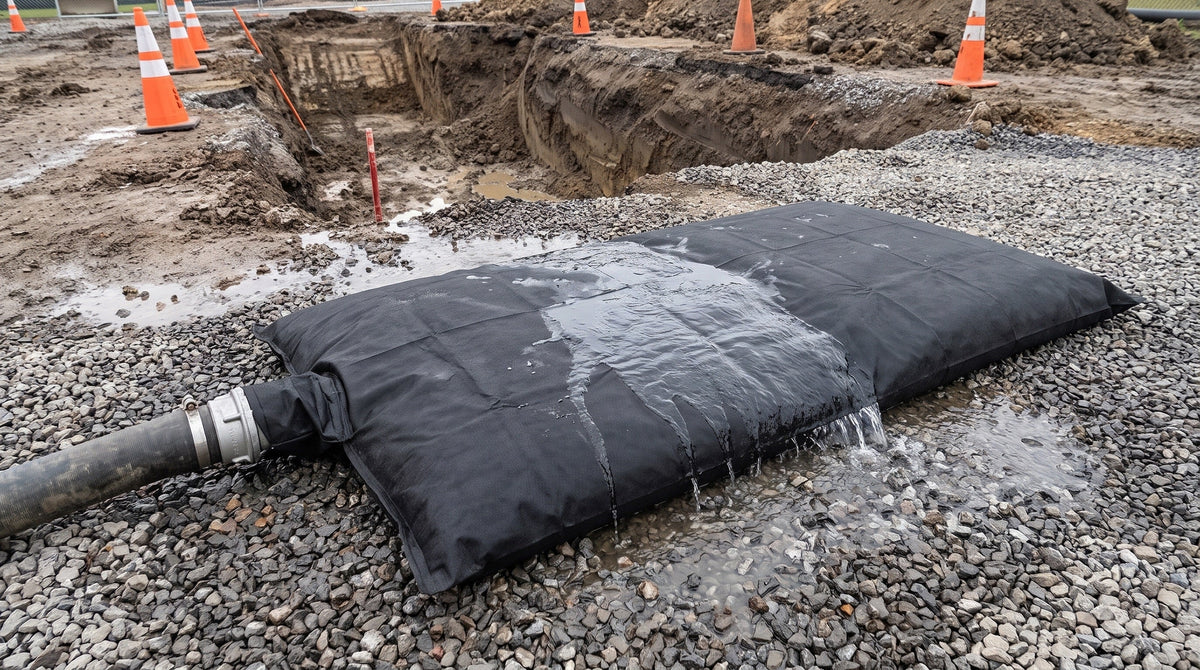
"Dewatering bag" names two different products. A site silt bag is a pump-in geotextile sack that strains sediment out of construction water. A sludge bag system, such as the TEKNOBAG DRAIMAD, is a polymer-dosed machine that turns thin plant sludge into a handleable cake. Pick by what you are pumping, not by the word on the search results.
What is a dewatering bag?
A dewatering bag is a sack of geotextile fabric that holds solids back while water drains through its walls. Sellers use the term for two jobs that share only the fabric: straining silt out of pumped site water, and dewatering sludge that has first been mixed with a flocculant.
| Question | Site silt bag | Sludge bag system |
|---|---|---|
| What goes in | Pumped excavation, trench or storm water carrying silt and sand | Wastewater or effluent plant sludge, about 1% dry solids |
| Conditioning | None | Polyelectrolyte (polymer) dosed and mixed in line |
| Equipment | The bag and your pump | Control panel, polymer tank, stirrer and pump, sludge pump, static mixer, reaction tank, stainless frame |
| Typical user | Contractors, municipalities, dredging and trenching jobs | Small and mid-size treatment plants, industrial effluent |
| ERE range | Silt bags | Sludge dewatering |
How does a pump-in site silt bag work?
You connect the discharge hose to the bag's inlet sleeve, pump into it, and the water seeps through the fabric while silt stays inside. When the bag is full you stop, let it drain and dispose of the cake. There is nothing to dose and nothing to power except the pump.
The Sampson Construction Silt Bag is a nonwoven polypropylene bag, black, one side heat-treated, rated 50 micron. It is made in Canada and is listed in four sizes: 3 x 4 ft, 6 x 6 ft, 10 x 15 ft and 15 x 15 ft. The product record does not state a flow rate, so ask ERE for the rated flow of the size you want before you match it to a pump.
What size silt bag do you need?
Size for the space you can lay it out in, then check flow. A 3 x 4 ft bag has 12 sq ft of fabric on one face, and a 15 x 15 ft bag has 225 sq ft, almost 19 times more (our arithmetic from the listed sizes, not a rated capacity). Larger fabric area drains faster for the same solids load, which is why a small bag clogs first on a muddy trench pump.
What does a 50 micron rating mean for a silt bag?
A 50 micron rating describes the size of opening in the fabric: solids much larger than 50 microns are held, finer particles pass. Fine clay and colloidal silt can stay in suspension and leave with the water, so the bag does not guarantee a clear discharge.
If your permit sets a turbidity or total suspended solids limit, plan the layout so the bag discharges onto a stable vegetated or gravelled area, and sample the discharge. The same micron logic applies to industrial filter bags, covered in our guide to filter bag micron ratings. For pressure-fed process water, see the industrial filter bag selection guide instead; a silt bag is a gravity-drained site tool.
How does a polymer sludge bag system differ?
It adds chemistry and a controlled fill cycle. The TEKNOBAG DRAIMAD dewaters sludge from water and effluent purification plants. Sludge is conditioned with polyelectrolyte, mixed, and fed to filtration sacks made from water-repellent material and mounted on a stainless steel frame that distributes the sludge evenly. A programmable control panel runs the sequence.
The product record states 15 to 30% dry solids after a few hours of operation, and 50 to 95% dry solids once the sacks are removed and stored in the open for about two months. The sack material lets the contents dehydrate but keeps rainwater out. One machine treats up to 20 m³ per day of sludge at 1% dry solids.
| Package (listed variant) | Sacks | Capacity at 1% DS |
|---|---|---|
| TE02-PACK | 2 | 0.5 to 1.5 m³/day |
| TE03-PACK | 3 | 1.5 to 2.5 m³/day |
| TE03-PACK-P (pressurized) | 3 | 2.4 to 6.25 m³/day |
| TE06-PACK | 6 | 5.5 to 9 m³/day |
| TE06-PACK-P (pressurized) | 6 | 8.3 to 14 m³/day |
| TE12BCAVPK (pressurized) | 12 | 11.2 to 20 m³/day |
How much cake will it produce?
Work it from dry solids, which do not change. One cubic metre of sludge at 1% dry solids carries roughly 10 kg of solids if you take its density as water's. At the top rating of 20 m³ per day that is about 200 kg of dry solids a day. At 15% dry solids that is about 1,330 kg of wet cake; at 30%, about 670 kg; after storage at 50%, about 400 kg. These are our numbers from the record's percentages, not a guarantee, because the record says the result depends on the type of sludge. Sludge conditioning is the variable: a jar test on your own sludge is the honest way to set expectations.
The polymer side matters as much as the bags. The POLYDILUTION TE-CMP series is Teknofanghi's polyelectrolyte preparation and dosing unit, with 300, 500 or 1000 L tanks, listed as pairing with the DRAIMAD for small plants.
When do you need a thickener or belt press instead of bags?
When the volume is too high for batch sacks, or the sludge is too thin to condition economically. A thickener raises the solids before dewatering, so you handle less water downstream.
- The SCRUDRAIN drum thickener takes sludge from 0.5 to 3% dry solids up to 5 to 15%, at 10 to 60 m³/h per unit depending on the sludge, with a stated capture rate up to 98%. Thickening from 1% to 10% cuts the volume to roughly a tenth (our arithmetic).
- The MONOBELT belt filter press combines a pre-thickener and a sludge press, in belt widths of 600 to 2000 mm and flows of 1 to 140 m³/h. The record lists cake of 18 to 30% dry solids and capture up to 98%.
As a rule of thumb from these ranges, a bag system suits flows in the single or low double digits of cubic metres per day, while the press range starts at 1 m³/h. That boundary is ours; ERE sizes it with you from sludge type and hours of operation.
How do you choose between them?
- Name the material. Silty water points to a silt bag. Biological or chemical sludge points to a conditioned system.
- Get the solids. For sludge, measure percent dry solids and daily volume. Everything else follows from those two numbers.
- Check the footprint. A silt bag needs a flat, protected discharge area. A bag system needs a pad, power and a polymer supply.
- Confirm the discharge limit. Know what the permit allows to leave, and where the filtrate goes.
- Plan the cake. Disposal route and cost decide whether a wetter or drier cake is worth the equipment.
Sampling the sludge first helps. Our guides to the Sludge Judge and sludge gun and to sediment grab samplers cover how to take a representative sample.
What do Canadian rules say about discharging dewatering water?
Under the federal Fisheries Act, section 36(3), no person may deposit a deleterious substance of any type in water frequented by fish, or in any place where it may enter such water. The Act's definition in section 34 covers water that contains a substance in a quantity or concentration that degrades fish habitat, so sediment-laden discharge can fall under it. Provincial and municipal permits add their own limits, so confirm yours before the job starts.
In the United States, the EPA construction stormwater programme lists turbidity benchmark monitoring for dewatering, a useful reference if you work across the border.
Need help with dewatering?
ERE Inc. has been Canada's environmental equipment specialist for 30+ years. Tell us the material, volume and discharge limit and we will match the bag or the system.
→ Request a Quote | 1-888-287-EREC | Browse Silt Bags | sales@ereinc.com
Frequently Asked Questions
What is the difference between a dewatering bag and a silt bag?
The terms overlap. A silt bag is the pump-in geotextile sack used on construction sites. "Dewatering bag" also covers conditioned sludge sacks used at treatment plants. Check whether the product needs polymer and a control panel.
Can a dewatering bag clean contaminated water?
No. A bag holds back particles. Dissolved metals, hydrocarbons and chemicals pass through, so contaminated water needs treatment or an oil-absorbing media before discharge.
What micron rating should a silt bag have?
The Sampson silt bag is rated 50 micron. Finer silt can pass, so choose by your discharge limit and the soil, and sample the discharge.
How much dry solids does a sludge bag system reach?
The TEKNOBAG DRAIMAD record states 15 to 30% dry solids after a few hours and 50 to 95% after about two months of storage, depending on the sludge.
How many sacks do I need for 10 m³ of sludge per day?
At 1% dry solids, 10 m³ per day falls inside the pressurized 6-sack package (8.3 to 14 m³/day); the standard 6-sack package tops out at 9. Confirm with ERE using your sludge data.
Do I need a permit to discharge dewatering water?
Usually, yes, or at least compliance with provincial and municipal limits. The Fisheries Act also prohibits depositing deleterious substances where they can reach fish-bearing water.
Related articles
- Filter Bag Micron Ratings: How to Choose the Right Filtration Level
- Industrial Filter Bags: Complete Selection Guide
- Sludge Blanket Monitoring: Sludge Judge vs Sludge Gun
- Ekman Dredge vs Snapper vs Swing Sampler
Lire en français : Sacs de déshydratation : sacs à limon de chantier ou systèmes de boues à polymère au Canada