
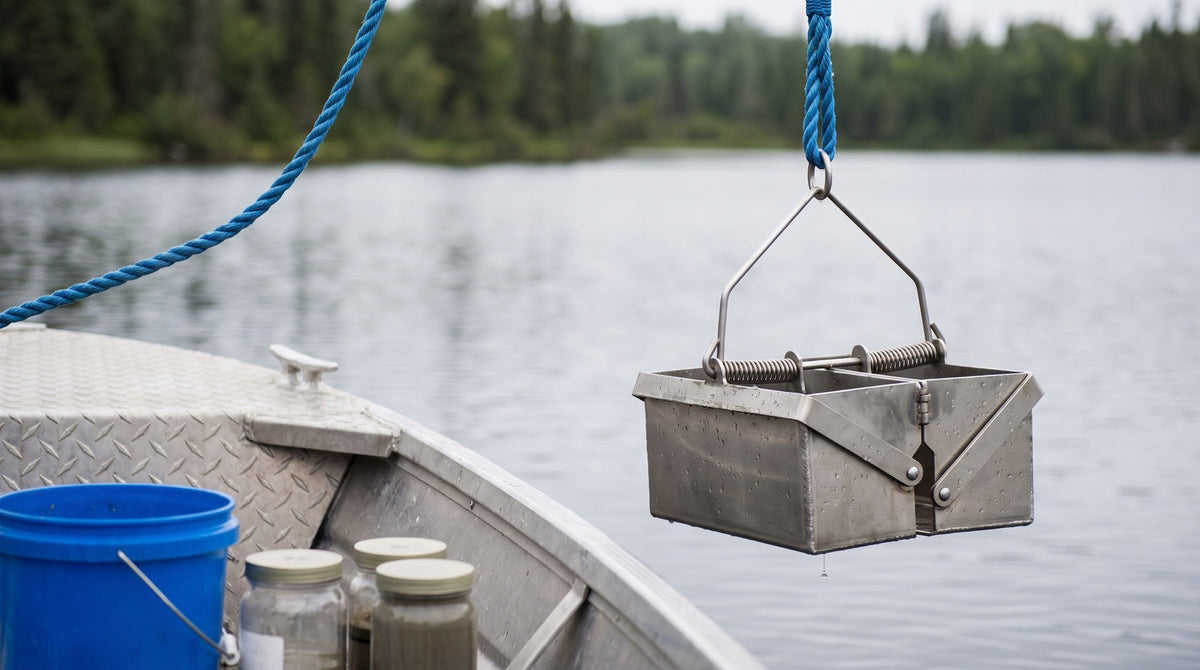
An Ekman dredge is the right choice for soft, fine-grained bottoms in calm lakes and ponds — but it's the wrong tool for a flowing stream, a sewer, or a narrow well. Which of the five sediment grab samplers ERE stocks you need depends on two things: what the bottom is made of, and whether the water is standing still or moving.
What Is an Ekman Dredge and When Do You Need One?
An Ekman dredge is a spring-loaded, box-shaped grab sampler that closes its jaws via a messenger weight dropped down the deployment line. It's built for soft, fine-grained aquatic bottoms — lake beds, pond sediment, slow-moving river reaches, lagoons — where the goal is an undisturbed sample of mud, silt, or organic ooze for benthic ecology work, sediment chemistry, or pollution assessment.
ERE's Ekman Dredge Spring-Loaded is all stainless steel and ships complete with the messenger, 100 ft of nylon rope, and a carrying case — everything needed to deploy from a boat, dock, or bridge without sourcing separate hardware.
What an Ekman Dredge Isn't Good For
Two conditions defeat an Ekman dredge: flowing water and coarse or rocky bottoms. Current pushes the open dredge sideways during descent and washes fine material out of the jaws before they close. Gravel, cobble, or debris on the bottom prevents the spring-loaded jaws from sealing, and the sample leaks out on retrieval. If either condition describes your site, one of the tools below is the better fit.
Which Sampler Fits a Flowing Stream Instead of a Calm Lake?
A Swing Sampler is purpose-built for exactly this case: collecting a sample from a horizontal flowing stream, such as a sewer line, storm drain, or shallow moving channel, where an Ekman dredge's vertical drop-and-close mechanism doesn't work against lateral flow. For rivers, wells, and tanks — sites with some depth and structure but not necessarily strong lateral current — ERE's Snapper is designed to take sediment and sludge samples where a full Ekman deployment is impractical.
| Sampler | Best Environment | Sample Type |
|---|---|---|
| Ekman Dredge Spring-Loaded | Calm lakes, ponds, slow rivers — soft bottom | Mud, silt, organic ooze |
| Snapper | Rivers, wells, tanks | Sediment and sludge |
| Swing Sampler | Horizontal flowing streams, sewers | Sediment and sludge from moving water |
| Sand / Silt Dredge | Most bottom surface types | Sand, silt |
| 15 lb & 25 lb Bottom Dredge | Most bottom surface types, weighted for depth/current | Sand, silt, heavier sediment |
Does the Bottom Material Change Which Dredge You Should Buy?
Yes — an Ekman dredge's spring-loaded jaws are sized and tensioned for fine, unconsolidated material, not sand or compacted silt. ERE's Sand / Silt Dredge and 15 lb & 25 lb Bottom Dredge are built to sample most bottom surface types, including coarser sand and silt an Ekman dredge's jaws won't seal against. The added weight on the 15 lb and 25 lb Bottom Dredge also helps the sampler reach and seat properly in deeper water or where mild current would otherwise drift a lighter unit off target during descent.
What About Tank or Well Sampling Specifically?
For confined spaces like storage tanks, sumps, or narrow-diameter wells where a full-size dredge won't fit or deploy cleanly, a hand-operated tool built for the confined geometry is the more practical option. Nasco's Sludge Nabber is designed for exactly this — a compact, hand-deployed sludge and sediment sampler for tanks, sumps, and other tight-access sites where lowering a full dredge assembly isn't practical.
How Do You Deploy an Ekman Dredge for a Bottom Sample?
- Select the right dredge for your target sediment. Confirm the site has calm water and a soft, fine bottom — an Ekman dredge is the wrong tool if either condition isn't met (see above).
- Cock the dredge open and attach the messenger line. Set the spring-loaded jaws to the open position and confirm the messenger weight is threaded and ready on the line.
- Lower the dredge slowly to the bottom. A controlled, steady descent lets the hinged top doors swing open and pass water through, reducing drag and avoiding a pressure wave that disturbs the surface sediment before the jaws close.
- Drop the messenger to trigger closure. Once the dredge is resting on the bottom, release the messenger down the line — it strikes the release mechanism and snaps the spring-loaded jaws shut around the sample.
- Retrieve at a steady, even pace. Pulling too quickly increases the risk of washout through the closed jaws, especially with fine or loosely consolidated material.
- Transfer the sample without disturbing stratification. Open the dredge over a sample container or tray and transfer the material directly, preserving any visible layering if the project's sampling plan calls for it.
Field protocols like the EPA's National Aquatic Resource Surveys benthic sampling methods follow this same lower–trigger–retrieve sequence, which is why an Ekman dredge remains a standard reference tool in North American benthic ecology work despite decades of newer sampler designs on the market.
For the full range of grab and sludge sampling equipment ERE stocks, see the Sludge & Sediment Sampling collection, including the Multi-Stage Sludge / Sediment Sampler Kit for projects that need to profile sediment at multiple depths in a single deployment.
Need help choosing a sediment grab sampler?
ERE Inc. has supplied environmental consultants across Canada for 30+ years — talk to a real engineer about matching a dredge or grab sampler to your site conditions.
→ Request a Quote | 1-888-287-EREC | Browse Sludge & Sediment Sampling | sales@ereinc.com
Frequently Asked Questions
What's the difference between an Ekman dredge and a Van Veen grab sampler?
Both are bottom-sediment grab samplers, but a Van Veen grab uses opposing hinged jaws that stay open under their own weight during descent and close when the cable goes slack, while an Ekman dredge holds its jaws open under spring tension and closes only when a messenger weight strikes the trigger. Van Veen grabs are generally used for slightly coarser or firmer bottoms and deeper water than an Ekman dredge is designed for.
Can I use a Snapper or Swing Sampler in place of an Ekman dredge?
Only if your site doesn't match an Ekman dredge's calm-water, soft-bottom requirement. A Snapper suits rivers, wells, and tanks; a Swing Sampler is built specifically for horizontal flowing streams like sewers. Neither substitutes for the other — match the tool to the water condition and access point, not the other way around.
What is a sludge nabber used for?
A sludge nabber, like the Nasco Sampling Sludge Nabber ERE stocks, is a compact hand-operated sampler for sludge and sediment in confined spaces — tanks, sumps, and narrow-access sites — where lowering a full-size dredge on a line isn't practical.
Does ERE sell or rent sediment grab samplers?
ERE sells the full range of sediment and sludge grab samplers covered in this guide. For rental availability on a specific model, request a quote and our team will confirm current stock and terms.
Related articles
- Water & Sediment Grab Samplers: Selection Guide for Canada
- How to Use a Sludge Judge Sampler: Tank & Lagoon Sludge Depth Protocol
- Sludge Blanket Monitoring: Sludge Judge vs. Sludge Gun Compared
- Environmental Sampling Equipment Guide for Canada
Lire en français : Drague Ekman contre Snapper : guide des échantillonneurs de sédiments