
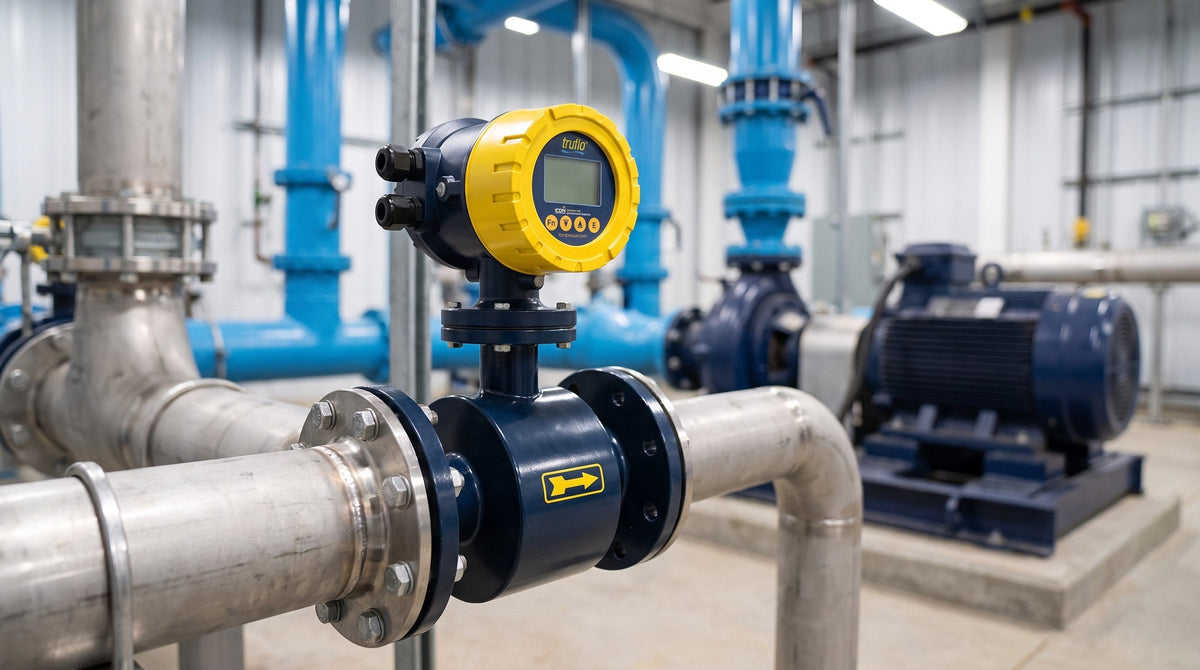
Choose a flow meter by the liquid first, then the pipe, then the output you need. A conductive liquid in a large line points to a magnetic meter, a clean or corrosive low flow points to a wetted ultrasonic or a mini turbine, a pipe you cannot cut points to a clamp-on ultrasonic, and a general water or chemical line points to a paddle wheel. ERE carries the Icon Process Controls range of ultrasonic, magnetic, paddle wheel, turbine, oval gear, thermal and variable-area flow meters, so you can match a technology and a part number to your line before you ask for a quote.
In this guide
- Which flow meter type fits which liquid and pipe?
- When should you choose an ultrasonic flow meter?
- When is a magnetic flow meter the right choice?
- Insertion or in-line paddle wheel: which one?
- When do turbine, oval gear, thermal and variable-area meters make sense?
- Do you need a flow meter or a flow switch?
- What about open channels and ditches?
- How do you get an accurate reading once it is installed?
- How do you choose a flow meter, step by step?
- Frequently Asked Questions
Which Flow Meter Type Fits Which Liquid and Pipe?
Match the technology to the liquid and the line, then pick the model. The table sorts the meters in the Flow Meters collection. Figures come from the product records; part numbers, materials, ranges and output options are confirmed on a quote.
| Technology | Models in the records | Best for | Sizes or flow listed | Accuracy listed |
|---|---|---|---|---|
| Clamp-on ultrasonic | UltraFlo 500, UltraFlo 500S | A pipe you cannot cut or shut down; PVC, PP, PVDF, PE, stainless and copper pipe | 500S is for 1/4 in to 1/2 in tubing | ±2.0% (UF500) |
| Wetted ultrasonic | UltraFlo 1000 PFA, 2000 HDPE, 4000 PSU, 5000 PE | Dosing, metering and pulsating flows in corrosive liquids | Low flow from 0.005 GPM (1000) and 0.006 GPM (5000) | See datasheet |
| Magnetic | MF1000 | Conductive liquids in larger lines, no pressure drop | 3/8 in to 20 in | ±0.5% of flow rate |
| Insertion paddle wheel | TI3 series (316 SS), TI series | Large pipes where cutting in a full meter body is costly | 1/2 in to 24 in pipe (TI3) | ±0.5% of full scale (TI3) |
| In-line paddle wheel | TK3 series (316 SS), TKW, TCB | Water, chemical feed and process lines in pipe or tubing sizes up to about 4 in | TKW 1/2 in to 4 in; TCB 1 in to 3 in | ±0.5% of full scale (TK3, TKW) |
| Mini turbine | ProPulse 2 | Ultra-low-flow dosing and metering | From 40 mL/min (0.01 GPM) | See datasheet |
| Oval gear | UltraFlo OGF | Viscous liquids: oils, syrups, chemicals, solvents, additives | 1/4, 3/8 and 1/2 in FNPT | See datasheet |
| Thermal | FTS | Flow sensing with no moving parts and a temperature function | See datasheet | See datasheet |
| Variable area (rotameter) | RotaFlo RFP | A quick visual reading with no power | 1/2 in to 2 in FNPT | ±4% of full scale |
The meter body material and the wetted parts are what your liquid sees. Read the Safety Data Sheet, which suppliers must provide under WHMIS, and check the manufacturer's chemical-resistance chart for the exact material before you specify anything.
When Should You Choose an Ultrasonic Flow Meter?
Choose ultrasonic when you want no moving parts, or when you cannot cut the pipe. Both situations are common in water treatment and chemical feed, and the Icon range covers each with a different design.
Clamp-on: measure from outside the pipe
The UltraFlo 500 measures liquid flow from the outside of the pipe, so the line stays intact and in service. The record lists PVC, PP, PVDF, PE, stainless steel and copper pipe, an accuracy of ±2.0%, a large OLED display of flow rate and total, and an optional pulse output. For small tubing, the UltraFlo 500S covers 1/4 in to 1/2 in tubing. Clamp-on is the right tool for a temporary check, a retrofit on a live line or a pipe where a flow tube would be hard to install. The trade-off is accuracy: a clamp-on listed at ±2.0% is not the meter to pick for a custody or billing measurement.
Wetted ultrasonic: corrosive, low and pulsating flow
The UltraFlo 1000, 2000, 4000 and 5000 put the liquid through a full-port tube with no moving parts. They are listed for dosing, metering and pulsating flows, which is where a paddle wheel or turbine tends to struggle. The wetted material changes by model: PFA Teflon on the 1000 with a remote display, HDPE on the 2000, and polyethylene on the 5000. The 1000 and 5000 list flows from 0.005 GPM and 0.006 GPM, the 2000 and 5000 list an empty-pipe alarm, and outputs include 4-20 mA with a pulse relay on the 1000, 2000 and 5000 and RS-485 on the 1000 and 5000. Pick the material against your chemical, not the other way round.
When Is a Magnetic Flow Meter the Right Choice?
A magnetic meter is the right choice for a conductive liquid in a line where you cannot accept a pressure drop. The Icon MF1000 has a full-port design with no pressure drop, sizes from 3/8 in to 20 in, PTFE as the standard liner, a choice of electrode and liner materials, and an accuracy of ±0.5% of flow rate. Outputs include 4-20 mA, pulse, RS485 and HART, and the integrated display shows flow and total.
The limit is the liquid. A magnetic meter reads the voltage a conductive liquid generates as it moves through a magnetic field, so it needs a minimum conductivity. Oils and most solvents are poor candidates, and very pure water is borderline. The MF1000 record does not list a minimum conductivity, so send us the liquid and we confirm it with the manufacturer before you order.
Insertion or In-Line Paddle Wheel: Which One?
Choose insertion for a big pipe, in-line for a small one. Both give you a flow rate and total from a paddle wheel, and the Icon records list ±0.5% of full scale on the TI3, TK3 and TKW families.
- Insertion (TI3 / TI): the TI3M is a 316 stainless steel meter for pipes from 1/2 in to 24 in. It installs through a tee, saddle or weld-on fitting, so one sensor can serve many pipe sizes. Variants add a dual LED display, pulse, 4-20 mA and RS485 outputs, or batching and relay outputs, and the TI3B is battery powered with a resettable total. The records note a lifetime warranty on the paddle wheel assembly.
- In-line (TK3 / TK / TKW / TCB): the TK3M is a 316 stainless steel body with a rotatable LED display and NPT, flanged or sanitary connections. The TKW is a blind unit with an LED flow indicator in PVC, PP or PVDF from 1/2 in to 4 in, and the TCB is a battery-operated PVC meter for 1 in to 3 in lines.
Paddle wheels have a moving part. They suit clean to lightly contaminated water and chemical lines, but a paddle in a stringy, fibrous or heavily particulate liquid can foul. The records do not list a particulate limit, so tell us what is in the line.
When Do Turbine, Oval Gear, Thermal and Variable-Area Meters Make Sense?
They make sense when your problem is a very low flow, a viscous liquid, a no-moving-parts sensor or a simple visual check, rather than a general water line.
- Mini turbine: the ProPulse 2 is listed for ultra-low flows from 40 mL/min (0.01 GPM), in PP, PVDF or PFA bodies, with NPN or PNP pulse, 4-20 mA and RS485 outputs.
- Oval gear: the UltraFlo OGF measures viscous liquids such as oils, syrups, chemicals, solvents and additives by positive displacement, with a PPS (Ryton) housing and 1/4 in to 1/2 in FNPT connections.
- Thermal: the FTS has no moving parts, an LCD display and a temperature function, with 4-20 mA, NPN/PNP or IO-Link output.
- Variable area: the RotaFlo RFP is a rotameter with a dual GPM and LPM scale, an acrylic body and stainless steel flow components, at ±4% of full scale. It needs no power, which is why it still turns up on chemical feed skids.
Do You Need a Flow Meter or a Flow Switch?
A flow meter tells you how much is flowing; a flow switch only tells you whether flow is there. If the job is pump protection or a no-flow alarm, a switch is simpler and cheaper to wire. The UFS is an all-plastic flow switch with a Ryton body for 1/2 in to 16 in pipe, used for pump protection and flow or no-flow detection with a normally open relay contact. The FES is an all-plastic paddle flow switch in the same collection. If you also need a number for a log or a PLC, step up to a meter with a 4-20 mA output; our 4-20 mA transmitter buyer's guide covers scaling and loop wiring that apply to flow signals too.
What About Open Channels and Ditches?
None of the meters above are for open channels. For a ditch, stream or partly full channel you need a velocity-area method and a current meter, which is a different instrument and a different guide. See Open Channel Flow Meter: Velocity-Area Method with a Swoffer Current Meter and the Swoffer Model 2100 and 3000 Series.
How Do You Get an Accurate Reading Once It Is Installed?
Run the meter on a full pipe with a stable flow profile, and verify it against something you trust. Most flow meters, magnetic and paddle wheel included, lose accuracy when the pipe is partly full, when air is entrained in the liquid, or when the sensor sits right after a valve, elbow or pump discharge. The manufacturer's datasheet gives the straight-run length it expects on each side of the meter; follow it, because the records here do not list it.
- Mount the meter where the pipe stays full, such as a rising run or the low point of a loop.
- Keep valves, pumps and elbows upstream of the meter outside the datasheet's straight-run distance.
- Choose a display and enclosure for the room: check the NEMA type or IP code against NEMA and the IEC 60529 ingress-protection (IP) code, since the product records do not list one.
- Verify against a known volume, such as a timed fill of a calibrated tank, at commissioning and after any repair. Our instrument calibration services guide explains how to plan recurring verification.
If the meter's reading will feed a pressure, level or control loop, it helps to read the matching guides on the pressure gauge and float switch side of the same process.
How Do You Choose a Flow Meter, Step by Step?
- Name the liquid. Chemistry, concentration, temperature, viscosity and whether it conducts decide the wetted material and the technology.
- Give the pipe. Size, material, whether it is full, and whether you can cut it. This separates clamp-on, insertion and in-line.
- State the flow range. Minimum, normal and maximum. A very low flow points to a wetted ultrasonic or a mini turbine.
- Pick the output. Local display only, pulse for a totalizer, or 4-20 mA, RS485 or HART for a controller.
- Check for solids and air. Fibrous or particulate liquids and entrained air favour ultrasonic or magnetic over a moving paddle.
- Confirm the accuracy basis. Percent of flow rate and percent of full scale are different. Compare like with like.
- Plan the installation. Straight run, full pipe, enclosure rating and access for the display.
- Send the details. Quote by liquid, pipe, range and output and we confirm the model, part number and availability.
Need a flow meter for a water, chemical or process line?
Send us the liquid, pipe size and material, flow range and output you need and we will confirm the model, part number and availability.
Frequently Asked Questions
What are the main types of flow meter?
The main types for liquid lines are ultrasonic (clamp-on or wetted), magnetic, paddle wheel (insertion or in-line), turbine, oval gear, thermal and variable area. Each suits a different liquid, pipe size and flow range.
What is the difference between an ultrasonic and a magnetic flow meter?
An ultrasonic meter measures flow with sound waves and works on a wide range of liquids. A magnetic meter reads the voltage a conductive liquid generates in a magnetic field, so it needs a conductive liquid but has a full-port design with no pressure drop.
Can I measure flow without cutting the pipe?
Yes. A clamp-on ultrasonic meter such as the UltraFlo 500 measures from outside the pipe, and an insertion paddle wheel installs through a tee, saddle or weld-on fitting rather than a full meter body.
Which flow meter is best for low-flow chemical dosing?
Wetted ultrasonic meters (UltraFlo 1000 and 5000, listed from 0.005 and 0.006 GPM) and the ProPulse 2 mini turbine (from 40 mL/min) are the Icon models listed for dosing and metering at low flow.
Do you quote flow meters across Canada?
Yes. Send the liquid, pipe size, flow range and output through the quote form and we confirm availability and bulk terms for delivery across Canada.
Related articles
- Open Channel Flow Meter: Velocity-Area Method with a Swoffer Current Meter
- 4-20 mA Pressure Transmitter Buyer's Guide for Canada
- Float Switch Guide: Choose by Float Type, Wetted Material and Contact
Lire en français : Débitmètre : guide de choix ultrasonique, magnétique, à roue à aubes ou à turbine pour les procédés au Canada