
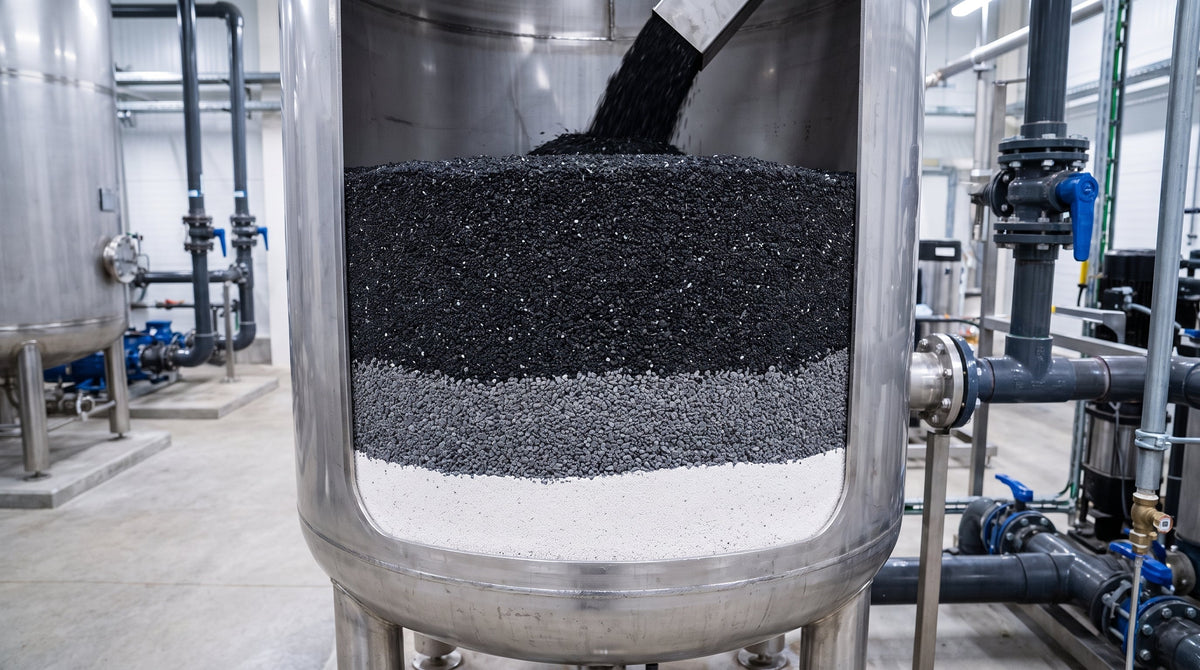
Manganese greensand, Birm, and KDF-85 all remove dissolved iron, manganese, and hydrogen sulfide from water — but they use different chemistry, need different regeneration, and fit different water conditions. Anthracite and silica sand don't remove dissolved contaminants at all; they trap suspended solids as the top and mid layers of a multi-media bed. Choosing wrong means a system that fouls early, needs more chemical than it should, or doesn't hit its target water quality.
What Removes Iron, Manganese and Hydrogen Sulfide From Water?
Three catalytic media handle dissolved iron, manganese and hydrogen sulfide: manganese greensand, Birm, and KDF 85. All three work the same basic way — they oxidize dissolved (soluble) contaminants into solid particles that the media bed then filters out and periodic backwashing flushes away. Where they differ is regeneration chemistry, operating pH and temperature range, and what else they can remove alongside iron and manganese.
ERE also stocks Filox™, a fourth catalytic option covered in its own Filox media guide — Filox needs no chemical regeneration at all and runs a higher service flow rate than greensand, making it a fourth point of comparison for facilities weighing operating cost against media price. Our Water Filtration Media Types guide covers the full media category, including activated carbon and activated alumina for contaminants outside this iron/manganese/H2S group.
How Does Manganese Greensand Filter Media Work?
Watts® Greensand Plus is a black, nodular media with a silica-sand core and a manganese-dioxide-coated catalytic surface. It oxidizes dissolved iron, manganese, hydrogen sulfide, arsenic and radium into solid particles the bed then filters and backwashes away — the widest contaminant range of the four catalytic media ERE stocks.
Greensand Plus runs in two modes: Continuous Regeneration (CR), where chlorine or another strong oxidant is fed upstream to keep the media catalytically active at all times, or Intermittent Regeneration (IR), using a periodic potassium permanganate soak. Typical capacity is 700–1,200 grains of oxidized iron and manganese per ft² of bed area, with a service flow rate of 2–12 gpm/ft² and an effective operating pH of 6.2–8.5 (water below pH 6.2 needs pre-adjustment). It carries WQA Gold Seal certification to NSF/ANSI/CAN 61 for material safety.
Because Greensand Plus needs an active oxidant feed, it fits facilities that already run chlorination or another oxidation step upstream — the media adds almost no incremental chemical-handling burden in that case. Where potassium permanganate is used for intermittent regeneration, it's a WHMIS-classified oxidizer and should be handled and stored according to its safety data sheet; see CCOHS's WHMIS/GHS guidance for classification and storage requirements for oxidizing chemicals on site.
How Is Birm Different From Manganese Greensand?
Watts® Birm removes dissolved iron and manganese without any chemical regeneration at all — it's an insoluble catalyst that accelerates the reaction between naturally dissolved oxygen and ferrous iron, and it isn't consumed in the process. That makes it simpler to operate than greensand: no oxidant feed, no permanganate storage, just periodic backwashing.
The tradeoff is narrower operating limits. Birm needs dissolved oxygen at a minimum of 15% of the combined iron-plus-manganese content, alkalinity greater than twice the combined sulfate and chloride concentration, free chlorine below 0.5 ppm, and hydrogen sulfide, oil and polyphosphates removed upstream — low-DO water needs pre-aeration and low-pH water needs correction before the Birm bed. Effective size is 0.48 mm, service flow rate 3.5–5 gpm/ft², operating pH 6.8–9.0, maximum water temperature 100°F (38°C). Birm does not remove hydrogen sulfide or arsenic — where H2S is present alongside iron and manganese, greensand or KDF 85 is the better fit.
What Does KDF Media Remove That Greensand and Birm Don't?
KDF Filtration Media is a high-purity copper-zinc alloy that drives a redox (reduction-oxidation) reaction without any chemical addition, and it comes in two grades built for different jobs. KDF 55 targets free chlorine reduction — a role greensand and Birm don't perform — for point-of-entry municipal water treatment. KDF 85 targets ferrous iron and hydrogen sulfide in groundwater, closer to a Birm/greensand substitute, and both grades also control scale and microbial growth on the media bed itself.
KDF's headline advantage is service flow rate: roughly 15 gpm/ft², about three times a conventional media bed, which allows a more compact tank for the same throughput. Operating range is pH 6.5–8.5 for drinking water, influent temperature 1.7–100°C (35–212°F), and a maximum contaminant concentration of 5 ppm for chlorine, iron, or H2S individually. KDF is frequently installed as a pretreatment stage ahead of granular activated carbon or an RO system — see our activated carbon media guide for how the two stages work together — because controlling chlorine and scale upstream extends the carbon bed's service life.
Why Do Multi-Media Beds Need Anthracite and Silica Sand?
Anthracite and silica sand don't touch dissolved iron, manganese or hydrogen sulfide — they're mechanical filtration media that trap suspended solids, floc and turbidity by physical straining, and they're what most greensand, Birm and KDF systems sit on top of or alongside rather than run alone.
Watts® Anthracite is crushed, select coal graded to AWWA Standard B100-01. Because it's lower density than sand (specific gravity ~1.6 vs. ~2.7), it hydraulically classifies above sand or greensand during backwash and forms the top layer in a multi-media bed, where its angular grain shape drives sediment deeper into the bed for longer filter runs and lower head loss than sand alone. Effective size runs 0.6–2.0 mm across its #1, #1½ and #2 grades, with a service flow rate of 5 gpm/ft² or higher.
Graded Filter Sand (High-Silica) — also stocked in a ready-to-ship NSF-certified 0.45–0.55 mm bagged grade — is washed, kiln-dried and screened silica sand meeting AWWA Standard B100-96. It's the workhorse mid-layer or standalone media for straightforward sediment and turbidity removal: effective size 0.45–0.55 mm, uniformity coefficient 1.6 or less, specific gravity 2.65–2.75. In a classic three-layer bed, anthracite sits on top, filter sand in the middle, and garnet (where used) at the bottom for final polishing.
Manganese Greensand vs. Birm vs. KDF vs. Anthracite vs. Silica Sand
| Media | What It Removes | Regeneration | Effective Size | Service Flow Rate |
|---|---|---|---|---|
| Manganese Greensand Plus | Iron, manganese, H2S, arsenic, radium | Chlorine/oxidant feed (CR) or periodic KMnO4 (IR) | 0.30–0.35 mm | 2–12 gpm/ft² |
| Birm | Iron, manganese only | None — backwash only | 0.48 mm | 3.5–5 gpm/ft² |
| KDF 55 / KDF 85 | Chlorine (55); iron & H2S (85); scale/microbial control | None — redox alloy, backwash only | — | ~15 gpm/ft² |
| Anthracite | Suspended solids, floc, turbidity (top layer) | None — backwash only | 0.6–2.0 mm | 5+ gpm/ft² |
| Silica Sand | Suspended solids, sediment, turbidity (mid layer) | None — backwash only | 0.45–0.55 mm | 1.5–5 gpm/ft² |
How Do You Choose the Right Filtration Media for Your Water?
Media selection comes down to what's actually dissolved in the water, what regeneration you're willing to operate, and whether you need mechanical filtration ahead of or alongside the catalytic stage. Work through it in this order:
- Test the water first. Confirm iron, manganese, hydrogen sulfide, pH, dissolved oxygen and alkalinity before specifying media — Health Canada's Guidelines for Canadian Drinking Water Quality set the aesthetic and health-based reference values most municipal and well-water testing is measured against.
- Decide if you can run an oxidant feed. If chlorination is already in place, greensand's CR mode adds little burden. If you want zero chemical handling, Birm or KDF 85 are the simpler operating models.
- Check for hydrogen sulfide. Birm doesn't remove H2S — if it's present, move to greensand, KDF 85, or Filox.
- Confirm dissolved oxygen and alkalinity meet Birm's minimums if Birm is the leading candidate — low-DO or low-alkalinity water needs pre-aeration or pH correction first, or a different media entirely.
- Add mechanical filtration where turbidity or solids loading is a factor. Anthracite and silica sand layer above or alongside the catalytic media rather than replacing it.
For the full range of filtration media ERE stocks — including Filox, activated carbon, and activated alumina for contaminants outside this group — see the Filtration Media collection.
Not sure which media fits your water chemistry?
ERE Inc. has been Canada's environmental equipment specialist for 30+ years — send us a water analysis and we'll size the right media and vessel for your application.
→ Request a Quote | 1-888-287-EREC | Browse Filtration Media | sales@ereinc.com
Frequently Asked Questions
Can you mix manganese greensand with Birm or KDF in the same vessel?
Generally no — greensand, Birm and KDF each need their own bed depth, service flow rate and backwash rate to perform correctly, and mixing catalytic media in one vessel usually degrades all of them. Where a facility needs more than one contaminant group handled, the media go in separate vessels in series, or one media (like Filox or greensand) is chosen specifically for its wider single-media contaminant range.
How long does manganese greensand media last?
Properly operated Greensand Plus in continuous-regeneration mode can run for many years — the manganese-dioxide coating is continuously refreshed by the oxidant feed rather than consumed. Intermittent-regeneration systems and media run outside its pH/temperature range wear faster; media life is a function of water chemistry and regeneration discipline, not a fixed calendar date.
Do anthracite and silica sand need chemical regeneration?
No. Both are purely mechanical filtration media — they trap suspended solids and turbidity by physical straining, not chemical oxidation, and are restored by backwashing alone.
What's the difference between Birm and Filox?
Both remove iron and manganese without chemical regeneration, but Filox also removes hydrogen sulfide (Birm doesn't) and runs a higher service flow rate. See our Filox media guide for full specs.
Related articles
- Water Filtration Media Types: Applications & Selection Guide
- Filox Filtration Media: Iron, H2S & Manganese Removal Guide
- Activated Carbon Filtration Media: GAC & Catalytic Carbon Guide
- Industrial Water Filtration Systems: Selection Guide
Lire en français : Glauconite Manganésée, Birm et KDF : Comment Comparer les Médias Filtrants