
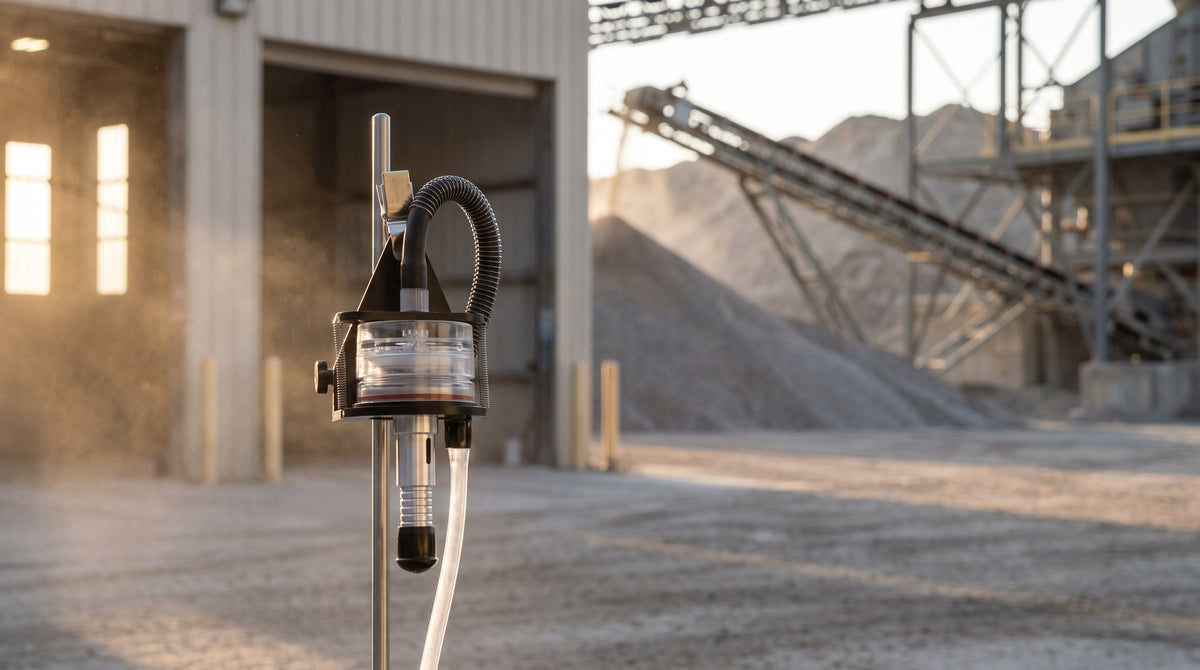
A respirable dust cyclone is a small size-selective separator that clips onto a personal sampling pump: air is drawn through it, the coarse dust is thrown into a grit pot, and the respirable fraction, defined by a 4 µm median cut point, carries on to a filter that a lab weighs or analyzes for crystalline silica. Choosing one comes down to three linked decisions: the cyclone (nylon, static-conductive nylon or aluminum), the flow rate it is specified for (1.7 L/min for the 10 mm nylon designs and 2.5 L/min for aluminum in NIOSH methods 0600 and 7500), and the sample time that flow rate implies. This guide works through each with the arithmetic, and shows where the three cyclone designs ERE lists fit: the Sensidyne "Dorr-Oliver" 10 mm nylon cyclone, the Zefon® 10 mm static conductive nylon cyclone and the Zefon® aluminum cyclone.
In this guide
- What is a respirable dust cyclone, and what does it actually do?
- Which cyclone do you need: nylon, conductive nylon or aluminum?
- What flow rate and sample volume should you use?
- Why does static charge matter?
- How do you assemble, calibrate and run a cyclone?
- What makes a cyclone sample unreliable?
- What else do you need besides the cyclone?
What Is a Respirable Dust Cyclone, and What Does It Actually Do?
A respirable dust cyclone is a size-selective pre-separator. Air enters and swirls, larger particles are thrown outward into a grit pot, and only the fraction that can reach the deep lung follows the airflow to the filter. NIOSH defines the dust that Method 0600 measures as an aerosol collected by a sampler with a 4 µm median cut point.
It always works as part of a sampling train of cyclone, filter cassette and pump. Both NIOSH methods name a 5 µm PVC membrane filter; ERE's product pages list 37 mm three-piece cassettes for the 10 mm nylon cyclones and 25 mm or 37 mm ones for the aluminum cyclone. Method 0600 (respirable particulates not otherwise regulated) is gravimetric, so the lab weighs the filter. Method 7500 measures crystalline silica by X-ray diffraction on the same kind of sample.
NIOSH methods are US methods, so confirm which reference your Canadian lab, jurisdiction or client actually uses. CCOHS notes that in many but not all Canadian jurisdictions the exposure limits are similar to the ACGIH TLVs, and that legislation varies by jurisdiction. In Quebec, the IRSST's Guide d'échantillonnage des contaminants de l'air en milieu de travail (8th edition, version 8.2, updated December 2025, in French) covers sampling strategy, sampling instruments and techniques, and sampling and analysis by substance. Whichever reference applies, your lab's method sheet has the final word on the cyclone and the flow.
Which Cyclone Do You Need: Nylon, Conductive Nylon or Aluminum?
Match the cyclone to the flow rate your method or lab specifies: the 10 mm nylon designs run at 1.7 L/min and the aluminum cyclone at 2.5 L/min. Within that choice, prefer a conductive construction where static charge is a concern (see below). The three designs ERE lists:
| Cyclone | Material | Flow rate and cut point | Cassette | NIOSH methods on the product page | Part numbers ERE lists |
|---|---|---|---|---|---|
| Sensidyne "Dorr-Oliver" 10 mm nylon cyclone | Nylon (conductive construction not stated in the listing) | 1.7 L/min for a 4.0 µm cut point (ISO/ACGIH/CEN); 2 L/min for 3.5 µm in other applications | 37 mm three-piece | 0600; 7500, 7501, 7601, 7602 | GIL-800061 cyclone; GIL-7013376 calibration jar; GIL-200159 grit pot; GIL-801124 vortex finder |
| Zefon® 10 mm static conductive nylon cyclone | Static-conductive nylon | 1.7 L/min for a 4.0 µm cut point (ISO/ACGIH/CEN); 2 L/min for 3.5 µm in other applications | 37 mm three-piece | 0600; 7500, 7501, 7601, 7602 | ZE-ZA0080 cyclone; ZE-ZA0081 with cassette/cyclone holder; ZE-ZA0063 (1 L) and ZE-ZA0085 (2 L) calibration jars; ZE-ZA0061 holder; ZE-ZA0082 grit pots (25/pack) |
| Zefon® aluminum cyclone for respirable dust | Aluminum (static conductive) | 2.5 L/min for a 4 µm cut point | 25 mm or 37 mm three-piece | 0600 and 7500 | ZE-ZA0060 (37 mm); ZE-ZA0075 (25 mm); ZE-ZA0062 and ZE-ZA0076 (with holder); ZE-ZA0066 grit pots (25/pack); ZE-ZA0067 O-rings (5/pack); ZE-ZA0011 (calibration adapter) |
Two things the table does not show. First, weight: Zefon lists 3.6 oz for the complete conductive-nylon assembly including cassette and holder and 1.1 oz (30 g) for the aluminum cyclone alone, so the two figures are not like for like. Second, interchangeability: Zefon states that its aluminum cyclone is fully interchangeable with the SKC aluminum cyclone, and that its calibration adapter fits both brands' 25 mm and 37 mm aluminum cyclones, so existing holders and calibration hardware can carry over.
The NIOSH methods also list a Higgins-Dewell cyclone at 2.2 L/min. It is not among the three designs above; if your lab specifies one, tell us and we will confirm what can be sourced. You can browse every cyclone and impactor in the Impactors & Cyclones collection.
What Flow Rate and Sample Volume Should You Use?
Use the flow the method assigns to your cyclone, and let the mass you need set the time. Both NIOSH methods specify 1.7 L/min ± 5% for the nylon cyclone and 2.5 L/min for the aluminum cyclone, and 0600 asks for a pump whose pulsation stays within ± 20% of the mean flow.
| Method | Flow rate | Sample volume | Mass range per sample | Working range |
|---|---|---|---|---|
| NIOSH 0600 (respirable particulates, gravimetric) | 1.7 L/min ± 5% (nylon); 2.5 L/min ± 5% (aluminum) | 20 L minimum (at 5 mg/m³) to 400 L maximum; sample 45 min to 8 h; do not exceed 2 mg on the filter | 0.1 to 2 mg (estimated LOD 0.03 mg) | 0.5 to 10 mg/m³ for a 200 L sample |
| NIOSH 7500 (crystalline silica, XRD) | 1.7 L/min ± 5% (nylon); 2.5 L/min (aluminum) | 400 to 1,000 L; do not exceed 2 mg on the filter | 0.02 to 2 mg SiO₂ (estimated LOD 0.005 mg) | 0.025 to 2.5 mg/m³ for an 800 L sample |
Sample volume is flow multiplied by time, so three worked examples show what the flow rate does to the sample:
- Full shift, nylon cyclone. 1.7 L/min × 480 min = 816 L, inside the 400 to 1,000 L window of method 7500. The 400 L minimum arrives at about 3 h 55 min and the 1,000 L maximum at about 9 h 48 min.
- Full shift, aluminum cyclone. 2.5 L/min × 480 min = 1,200 L, above the 1,000 L maximum; 1,000 L is reached at 400 min (6 h 40 min). Agree with your lab how to cover the shift, for example with two consecutive samples.
- Sampling at the silica TLV. CCOHS lists the ACGIH TLV-TWA for silica, quartz at 0.025 mg/m³ (respirable, A2). The bottom of the 7500 range, 0.02 mg, needs 0.02 ÷ 0.025 = 0.8 m³ (800 L) at that concentration: about 471 minutes (7 h 51 min) at 1.7 L/min, but 320 minutes (5 h 20 min) at 2.5 L/min. An 8-hour nylon sample (816 L) collects 0.0204 mg, only just inside the range.
The last example is arithmetic from the methods' own numbers, not a NIOSH recommendation. It shows why the higher-flow aluminum cyclone reaches a quantifiable mass sooner at low concentrations, where your method or lab accepts it. The same arithmetic explains 0600's 20 L minimum: 20 L at 5 mg/m³ is 0.1 mg, the bottom of its mass range.
Read your limit from your jurisdiction, not from a method header. NIOSH 7500 (Issue 4, 2003) prints an ACGIH figure of 0.1 mg/m³ for respirable quartz, while CCOHS now lists 0.025 mg/m³ from the 2025 TLVs. Canadian limits vary by jurisdiction, so treat 0.025 mg/m³ here as a worked-example figure.
Why Does Static Charge Matter, and Which Cyclones Are Conductive?
Static charge on the dust and on the cyclone body biases the result, which is why NIOSH recommends conductive samplers. Method 0600 reports electrostatic biases as large as −50% (Briant and Moss) and states that cyclones made with graphite-filled nylon eliminate the problem. It also recommends conductive filter cassettes.
ERE's Zefon listings describe the 10 mm nylon cyclone as static conductive and the aluminum cyclone as static conductive, eliminating interference. The Sensidyne Dorr-Oliver listing does not state a conductive construction, so if your lab or program specifies one, choose a Zefon cyclone or confirm the construction with us before you order.
How Do You Assemble, Calibrate and Run a Cyclone?
Inspect, assemble, calibrate with the cyclone in line, sample upright, then cap and blank. The steps below follow NIOSH 0600 and 7500; your lab's method sheet takes precedence.
- Confirm the cyclone, flow rate and filter with your lab. Ask which method the lab will run and which cyclone, flow rate and filter it specifies. Then use one sampler and one flow rate for the whole application, because NIOSH 7500 warns that mixing sampler types or flow rates introduces bias.
- Inspect and clean the cyclone. Remove the grit cap and look inside. NIOSH 0600 says to discard a cyclone whose interior is visibly scored, because its separation characteristics may be altered, and to clean the interior to prevent reentrainment of large particles.
- Assemble the sampler head. Fit the cyclone to the 5 µm PVC membrane filter in its three-piece cassette and holder, and check that the cyclone and filter holder are aligned so air cannot leak around the filter.
- Calibrate the pump with a representative cyclone in line. Nylon and aluminum cyclones are calibrated inside a large vessel with inlet and outlet ports: the calibrator, for example a bubble meter, connects to the inlet, the cyclone outlet connects to the port inside the vessel, and the vessel outlet connects to the pump. A calibration jar does this for the nylon and aluminum cyclones, and Zefon's calibration adapter fits over an aluminum cyclone and connects 1/4 inch I.D. tubing so the flow is measured as close to the cyclone inlet as possible.
- Sample upright for the planned time. Never let the assembly be inverted: NIOSH says turning the cyclone beyond horizontal can deposit oversized material from the cyclone body onto the filter. Method 0600 allows 45 minutes to 8 hours and says not to exceed 2 mg of dust on the filter. Record the flow rate and the start and stop times.
- Cap, blank and ship. Plug the cassette openings and ship. Both NIOSH methods list shipment as routine and call for 2 to 10 field blanks per set, and method 0600 also suggests 2 to 4 replicate samples per batch for quality assurance.
Method 0600 adds that, even if the flow shifts by a known amount between calibration and use, nominal flow rates are used in the concentration calculation because of a self-correction feature of the cyclones. That is a reason to record the calibration, not to skip it.
What Makes a Cyclone Sample Unreliable?
Most bad cyclone samples come from a short list of handling and equipment faults, each of them named in the NIOSH methods:
- Inversion. Oversized particles over 10 µm have been found on cyclone filters in some cases, and NIOSH links them to inverting the cyclone assembly.
- A scored or dirty cyclone body. Scoring can alter the separation characteristics, and a dirty interior can re-entrain large particles.
- Heavy loading, fibers or wet dust. NIOSH 0600 lists heavy dust loadings, fibers and water-saturated dusts as interferences with the cyclone's size-selective properties, and caps the load at 2 mg on the filter.
- Static charge. Electrostatic bias as large as −50%, as above.
- A pulsating pump. Method 0600 reports negative bias as large as −0.22 with pulsating flow, and a bias magnitude under 0.02 for pumps whose instantaneous flow stays within 20% of the mean. See our air sampling pump buyer's guide for what to look for.
- Mixed samplers or flow rates. NIOSH 7500 advises a single sampler and flow rate for a given application to eliminate bias between sampler types.
What Else Do You Need Besides the Cyclone?
The cyclone is one part of the sampling train. You also need a pump that holds the specified flow (buy one, or rent one for a short project), the filter and cassette your lab specifies, a way to calibrate (a calibration jar, or the adapter for the aluminum cyclone), and spare grit pots and O-rings. Spore-trap and fibre-count cassettes are a different family; see our cassette comparison. If you are sampling vapours rather than dust, the tubes in our sorbent tube guide are the right tool.
The product pages carry the instruction sheets, including the Dorr-Oliver silica sampling kit instructions, the Zefon nylon cyclone operating instructions and an aluminum cyclone spec sheet. Send us the method, the lab and whether the sample is personal or area, and we will match the cyclone, holder, calibration hardware and pump from the Air Sampling collection.
Need help choosing a respirable dust cyclone?
ERE Inc. has been Canada's environmental equipment specialist for 30+ years. Tell us the method, the lab and the sample duration, and we will match the cyclone, holder, calibration hardware and pump.
→ Request a Quote | 1-888-287-EREC | Browse Air Sampling | sales@ereinc.com
Frequently Asked Questions
What does a 4 µm cut point mean?
The cut point is the particle size a cyclone collects with 50% efficiency. NIOSH Method 0600 defines respirable dust as an aerosol collected by a sampler with a 4 µm median cut point, and ERE's product listings for the Zefon and Sensidyne cyclones state that their collection efficiency curves meet the ACGIH/ISO/CEN respirable convention at the specified flow: 1.7 L/min for the 10 mm nylon cyclones and 2.5 L/min for the aluminum cyclone.
Can I run a cyclone at a different flow rate?
Only if the method or regulator you follow says so, because the cut point depends on the flow. Zefon lists its nylon cyclone at 4.0 µm at 1.7 L/min and 3.5 µm at 2 L/min for other applications. NIOSH 7500 advises using a single sampler and flow rate for a given application to avoid bias, and notes that US coal mine dust sampling uses the Dorr-Oliver cyclone at 2.0 L/min with a 1.38 conversion factor.
What kind of pump does a respirable dust cyclone need?
One that holds the specified flow steadily: NIOSH 0600 calls for 1.7 L/min ± 5% for the nylon cyclone and 2.5 L/min ± 5% for the aluminum cyclone, with pulsation within ± 20% of the mean flow. Calibrate it with a representative cyclone in line before every sample.
Can I clean and reuse a cyclone?
Yes, with care. NIOSH 0600 says to inspect the interior before use, clean it to prevent reentrainment of large particles, and discard a cyclone whose interior is visibly scored, because scoring can alter its dust separation characteristics. Replacement grit pots, and O-rings for the aluminum cyclone, are listed on the product pages.
Related articles
- Air Sampling Pumps: Buyer's Guide for Environmental & Occupational Hygiene Professionals in Canada
- Air Sampling Pump Rental in Canada: What to Rent, When to Buy
- Air Sampling Cassette Types Compared: Air-O-Cell vs. Allergenco-D vs. Micro5 vs. PCM
- Sorbent Tubes for Air Sampling: How to Choose the Sorbent, Tube Size and Flow Rate in Canada
Lire en français : Cyclones pour poussière respirable : comment choisir entre nylon et aluminium et régler le débit au Canada