
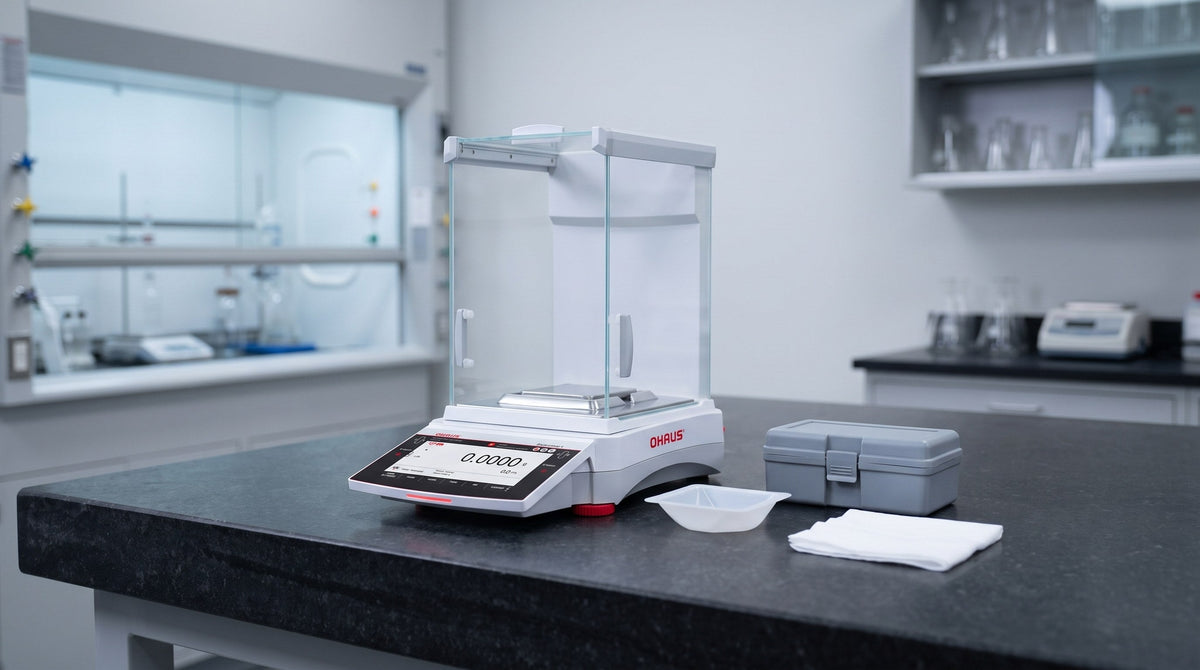
A laboratory balance is a precision weighing instrument, and what separates one type from the next is readability, the smallest step its display shows: 0.01 mg on a semi-micro balance, 0.1 mg on an analytical balance, and 1 mg to 1 g on a precision balance. The right one follows from two facts you already know: the smallest sample you will weigh and how closely that mass must be known. This guide turns them into arithmetic using the repeatability rule in USP <41>, shows which Ohaus families ERE lists at each level, and covers placement, calibration and when a balance needs Measurement Canada approval.
In this guide
- What is a laboratory balance, and what types are there?
- How do you match readability to your smallest sample?
- Which type do you need?
- Which features matter besides readability?
- Where should you put a balance, and how do you keep it accurate?
- Do you need a balance approved for trade in Canada?
- How do you choose a laboratory balance, step by step?
What Is a Laboratory Balance, and What Types Are There?
A laboratory balance measures mass to a stated readability, and balances are grouped by that readability: semi-micro, analytical, precision and portable. The table shows the ranges in the Ohaus product records ERE lists in its Scales & Balances collection.
| Type | Readability | Capacity (ERE Ohaus listings) | Ohaus families ERE lists |
|---|---|---|---|
| Semi-micro | 0.01 mg (0.1 mg on dual-range models) | 82–220 g | Pioneer® Semi-Micro · Explorer™ Semi-Micro EXR · Explorer Plus™ Semi-Micro EXP · Adventurer™ Semi-Micro |
| Analytical | 0.1 mg | 62–320 g | Pioneer® Analytical · Adventurer® Analytical · PR Series Analytical · Explorer™ Analytical EXR · Explorer Plus™ Analytical EXP |
| Precision | 1 mg to 1 g | 160–12,200 g | Pioneer® Precision · Adventurer™ Precision · PR Series Precision · Explorer™ Precision EXR · Explorer Plus™ Precision EXP |
| High capacity | 0.1 g | 12,000–65,000 g | Adventurer™ Precision High Capacity · Pioneer™ Precision High Capacity · Explorer Plus™ High Capacity EXP |
| Portable | 1 mg to 1 g | 120–22,000 g | Scout™ SPX · Scout® STX · Navigator™ · Compass™ CX · Compass™ CR · PS Series |
Two footnotes on the table. Models with a D in the model number, such as EXR125D, list two capacities and two readabilities (82 g / 120 g and 0.01 mg / 0.1 mg for that one). And the Scales & Balances collection also holds mechanical triple-beam, spring and school balances that need no power. For bench, counting and floor scales built for industrial weighing, see the Industrial Scales collection and our industrial scale buyer's guide.
How Do You Match Readability to Your Smallest Sample?
Multiply the readability by 820. USP <41> (the chapter text is public) passes a balance when two times the standard deviation of repeated weighings, divided by the smallest net weight you plan to use, does not exceed 0.10%. If the standard deviation comes out below 0.41 d, where d is the scale interval (the readability), you use 0.41 d instead. Setting the standard deviation at that floor gives a best-case minimum weight of 2 × 0.41 d ÷ 0.001 = 820 d.
| Readability (d) | Typical type | Best-case minimum weight (820 d) | With a safety factor of 2 |
|---|---|---|---|
| 0.01 mg | Semi-micro | 8.2 mg | 16.4 mg |
| 0.1 mg | Analytical | 82 mg | 164 mg |
| 1 mg | Precision, portable | 820 mg | 1.64 g |
| 0.01 g | Precision, portable | 8.2 g | 16.4 g |
| 0.1 g | Precision, high capacity, portable | 82 g | 164 g |
| 1 g | Precision, portable | 820 g | 1,640 g |
The last column applies the safety factor of 2 that the USP FAQ calls typically efficient for stable laboratory conditions with trained operators. Two examples of the arithmetic (ours, applied to USP's rule, not a USP table):
- A 50 mg reference-standard aliquot. A 0.1 mg analytical balance cannot meet the 0.10% limit below 82 mg, so 50 mg fails even in the best case. A 0.01 mg semi-micro balance has an 8.2 mg floor (16.4 mg with the margin), so 50 mg clears it about three times over.
- A 5 g soil or sludge aliquot. A 0.01 g balance has an 8.2 g floor, so 5 g fails. A 1 mg balance has a 0.82 g floor (1.64 g with the margin), so 5 g clears it about three times over.
Three limits on that number. First, 820 d is the best case: in a drafty room the measured standard deviation is larger, and the minimum weight rises with it. USP's FAQ adds that the calculated minimum weight can change over time, and that the smallest net weight is the user's own threshold, which should sit above it. Second, it applies to the net weight only: the tare vessel, or weighing paper, does not count toward it. Third, USP <41> is mandatory where a procedure says a substance must be "accurately weighed", and USP's FAQ says that the application decides whether it applies, not whether the balance is analytical or precision. For other uses the chapter says repeatability and accuracy should be commensurate with the requirements of the use. If your method tolerates 1% instead of 0.10%, the same formula gives 82 d.
Which Type Do You Need: Semi-Micro, Analytical, Precision, High-Capacity or Portable?
Pick the coarsest readability that still clears your minimum weight with margin, then the capacity that covers your heaviest load, sample plus container. Capacity barely moves the minimum weight, because USP notes that the standard deviation stays nearly constant across the lower measurement range.
- Semi-micro (0.01 mg, 82–220 g). Milligram-scale samples and standards. This is the finest readability among the Ohaus balances ERE lists online.
- Analytical (0.1 mg, 62–320 g). Routine analytical weighing where the smallest net sample is comfortably above the 82 mg floor.
- Precision (1 mg to 1 g, 160–12,200 g). Often called top-loading balances, these suit larger samples and heavier containers. The 1 mg models cover 220 to 1,200 g; the 0.01 g and 0.1 g models cover the heavier loads.
- High capacity (0.1 g, 12,000–65,000 g). Large sample containers, heavy items and bulk material where a tenth of a gram is enough.
- Portable (1 mg to 1 g, 120–22,000 g). Field, vehicle or shared-bench use. Battery life varies widely on the product records: the Compass™ CX lists 1,001 hours on disposable batteries and the Scout® STX lists 6 hours, so read the line before you buy for field use.
Weighing dust filters
If you sample airborne dust (see our respirable dust cyclone guide and air sampling cassette guide), check the method before you assume a balance will do. NIOSH 0600 names a balance with 0.001 mg sensitivity, NIST Class S-1.1 or ASTM Class 1 weights, and an environmental chamber or room for the balance, for example at 20 °C ± 1 °C and 50% ± 5% relative humidity, and it quotes a precision under 10 µg with a 0.001 mg balance against under 70 µg with a 0.01 mg one. The finest readability among the Ohaus balances ERE lists online is 0.01 mg, so ask us before ordering for filter weighing rather than assuming a semi-micro balance meets the method as written.
Which Features Matter Besides Readability?
Check the internal calibration option, the draft shield, the pan size, the connectivity and, on portable models, the battery life. All of them are on the product records, and they differ from model to model inside one family.
- Internal calibration. The records list AutoCal™ (automatic), InCal™ (semi-automatic) or none. In the PR analytical family, for example, the PR224 lists InCal and the PR224/E lists none, while the Explorer EXR224 lists AutoCal. USP's FAQ notes that built-in weights are not metrologically traceable, and that when they are used daily the sensitivity test with an external weight can be run less often (its example is weekly or monthly, set by risk assessment).
- Draft shield. The analytical records list a draft shield, and so do the Explorer, Explorer Plus and Adventurer semi-micro records. On the PR, Adventurer and Explorer precision records, the 1 mg models list one and the 0.01 g and coarser models do not.
- Pan size. The analytical records list a 90 mm (3.5 in) pan and the semi-micro records an 80 mm (3.15 in) pan; the 1 mg models in the PR, Adventurer and Explorer precision records list 4.7 to 5.1 in (120 to 130 mm) pans. Match it to your weighing boats and containers.
- Connectivity and data. The PR Series Analytical record lists one RS232 port and links data sheets and manuals in English and French. Check the data sheet for the exact model before you assume USB or Ethernet.
Where Should You Put a Balance, and How Do You Keep It Accurate?
Put it on a stable surface away from ventilation, vibration and heat sources, and away from doors and high-traffic areas such as hallways, then keep it levelled, adjusted and checked. Those are the factors USP's FAQ lists when a balance is moved: after a relocation, control the levelling, adjust with the built-in weights, run the performance checks and, if the conditions changed, calibrate.
- Performance checks. USP requires periodic sensitivity and repeatability checks between calibrations, with the frequency set by the laboratory from a risk analysis or by a regulator that prescribes one. It does not require them daily.
- Accuracy test. USP <41> passes a balance whose reading is within 0.10% of a suitable test weight, one between 5% and 100% of the balance's capacity whose own maximum permissible error is no more than one-third of the test limit. The chapter points to ASTM E617 and OIML R 111 for test weights.
- Repeatability test. USP's FAQ says a load of a few percent of capacity, around 5%, is enough, because the standard deviation is nearly constant in the lower range. The test involves 10 measurements.
- Calibration. A full calibration includes repeatability, eccentricity and error-of-indication tests and yields a measurement uncertainty. USP names EURAMET cg-18 and ASTM E898. For a 220 g balance the FAQ's example test points are 0, 50, 100, 150 and 220 g.
Do You Need a Balance Approved for Trade in Canada?
Only if the weighing is trade. Measurement Canada's bulletin GEN-41 says devices used in trade require type approval and inspection, and devices not used in trade do not. Trade means selling, purchasing, exchanging or providing something on the basis of measure.
GEN-41 draws the line on what the weighing is used for. Determining the quantity of an individually measured commodity, or an adjustment to that quantity, is trade. Weighing samples before and after cleaning or drying to adjust the amount bought, which the bulletin calls dockage, is deemed trade. Determining the quality or grade of a product is not, and a measurement that only affects the price and not the amount is a quality measurement. A laboratory that assays quality is on one side of that line and a laboratory that sets a moisture adjustment on a purchased load is on the other. Where the number you need is the moisture fraction itself, a moisture analyzer weighs the sample while it dries it.
Some ERE records list a "Readability (Certified)" value, for example the PR523N and the AX223N/E at 0.01 g. Whether a given model carries Measurement Canada approval for your use is confirmed against its approval, not inferred from the model suffix, so ask us to confirm before you order for trade use. For industrial scales, the Measurement Canada interval and minimum-load rules are worked through in our industrial scale buyer's guide.
How Do You Choose a Laboratory Balance, Step by Step?
Work from the sample to the balance: smallest net weight and tolerance, then readability, capacity, features, regulatory context and placement.
- Write down your smallest net sample and your tolerance. Note the lightest amount you will weigh (net of the container) and how closely its mass must be known. USP chapter 41 uses 0.10% for accurately weighed substances; your own method may use a different figure.
- Calculate the minimum weight you need. At a 0.10% tolerance the best-case minimum weight is 820 times the readability, and USP's FAQ says a safety factor of 2 is typically effective in stable conditions with trained operators. Pick the coarsest readability whose figure, doubled, is still below your smallest sample.
- Choose the capacity. Take the heaviest load you will place on the pan, including the container. Capacity has little effect on the minimum weight, because USP notes the standard deviation stays nearly constant across the lower measurement range.
- Choose the features. Check the internal calibration option (AutoCal, InCal or none), the draft shield, the pan size, the connectivity and, for a portable model, the battery life listed on the product record.
- Decide whether the weighing is trade and whether your method names a balance. Weighing that sets the quantity sold falls under Measurement Canada's trade rules. A method such as NIOSH 0600 can also name the balance readability and the room conditions.
- Plan placement, test weights and performance checks. Put the balance away from vents, vibration, heat, doors and hallways, and use test weights that meet ASTM E617 or OIML R 111. Set the check frequency from your own risk analysis.
Send us the smallest net sample, the tolerance or method, the heaviest load, whether the weighing is trade, and where the balance will sit, and we will match a model from the Scales & Balances collection.
Need help choosing a laboratory balance?
ERE Inc. has been Canada's environmental equipment specialist for 30+ years. Tell us your smallest sample, tolerance and capacity, and we will match the Ohaus balance, features and calibration approach.
→ Request a Quote | 1-888-287-EREC | Browse Scales & Balances | sales@ereinc.com
Frequently Asked Questions
What is the difference between an analytical balance and a precision balance?
Readability. In ERE's Ohaus listings, semi-micro balances read to 0.01 mg (82 to 220 g) and analytical balances to 0.1 mg (62 to 320 g), while precision balances read from 1 mg to 1 g at capacities from 160 g to 12,200 g. On the PR, Adventurer and Explorer precision records, the 1 mg models list a draft shield and the 0.01 g and coarser models do not.
What is minimum weight on a laboratory balance?
It is the smallest net sample you can weigh and still meet a repeatability limit. USP chapter 41 sets that limit at 0.10%: two times the standard deviation of repeated weighings, divided by the smallest net weight. It also replaces any standard deviation below 0.41 times the scale interval with 0.41 times the scale interval, so the best-case minimum weight is 820 times the readability.
How often should a laboratory balance be calibrated?
USP says there is no requirement for a daily repeatability test: the laboratory sets the frequency of performance checks from a risk analysis, and a regulatory requirement that prescribes a frequency supersedes it. Calibration itself covers repeatability, eccentricity and error-of-indication tests, and USP names EURAMET cg-18 and ASTM E898 as the standard procedures.
Can I add weighing paper to reach the minimum weight?
No. USP states that the minimum weight requirement does not include the weight of the tare vessel. The net quantity, the difference between the reading before and after the material is added, is what must meet it.
Related articles
- Respirable Dust Cyclones: How to Choose Between Nylon and Aluminum and Set the Flow Rate in Canada
- Air Sampling Cassette Types Compared: Air-O-Cell vs. Allergenco-D vs. Micro5 vs. PCM
- pH Meters: How to Choose a Pocket, Portable or Bench Meter for Water Testing in Canada
Lire en français : Balances de laboratoire : comment choisir entre modèles analytiques, semi-micro, de précision et portables au Canada