
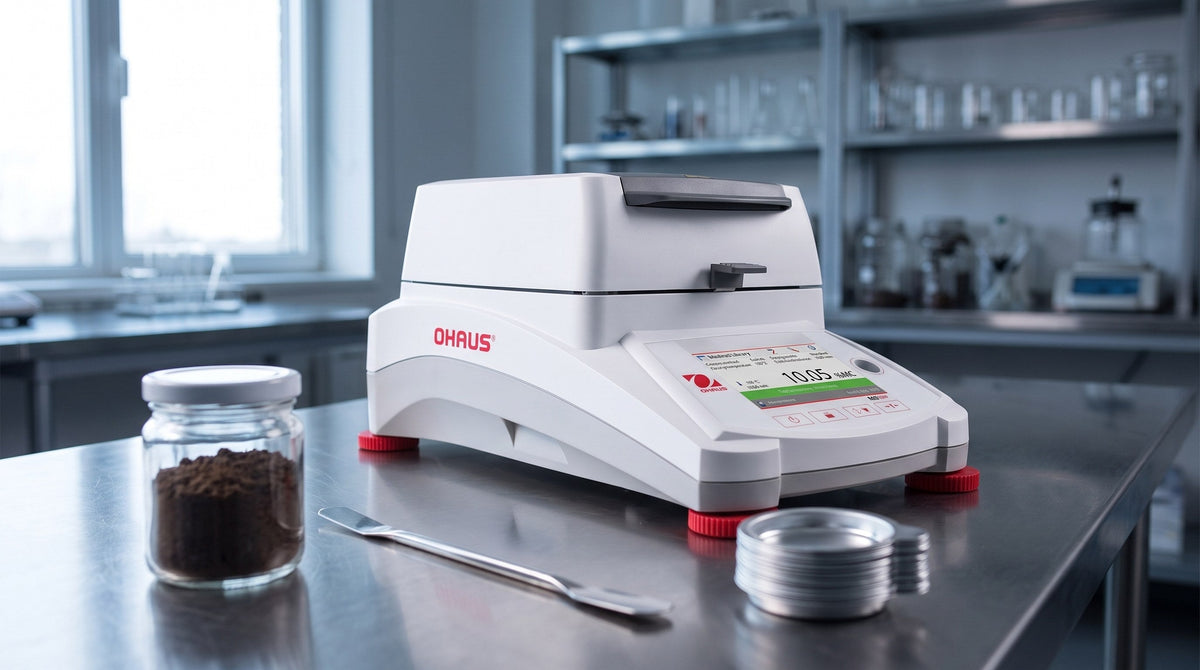
A moisture analyzer weighs a sample, heats it and reports the weight it loses as moisture, so the accuracy you get depends less on the headline readability than on how much sample you load, what the sample does when it is heated and whether the result has to match an oven method. This guide works through those three questions and applies them to the five Ohaus analyzers in ERE's Moisture Analyzers collection: the MB23, MB32, MB62, MB92 and MB120.
In this guide
- What Does a Moisture Analyzer Actually Measure?
- How Does Sample Size Change the Accuracy of a Moisture Analyzer?
- Which Ohaus Moisture Analyzer Fits Your Work?
- Will a Moisture Analyzer Give the Same Result as an Oven?
- How Should You Prepare the Sample and Set the Temperature?
- Which Accessories Does a Moisture Analyzer Need?
- How Do You Choose a Moisture Analyzer, Step by Step?
- Frequently asked questions
What Does a Moisture Analyzer Actually Measure?
A moisture analyzer measures the weight a sample loses when it is heated and reports that loss as a percentage of the starting weight. That is loss on drying (LOD): a weight difference, not a direct measurement of water.
USP General Chapter <731> Loss on Drying defines the result as the amount of “volatile matter of any kind” driven off under the specified conditions, and sends you to Water Determination <921> for substances that appear to contain water as their only volatile constituent. In practice a solvent, a light hydrocarbon or a decomposing organic in the pan is counted as moisture, so an analyzer is only as specific as your sample is simple.
Inside the instrument, a built-in balance weighs the sample, a heater dries it while the balance keeps weighing, and a shut-off criterion ends the run. Ohaus's MB32 manual describes the calculation as the ratio between the wet and dry weights, which is why adjusting the balance is optional for a correct result: the measurement is relative.
Infrared or Halogen: Does the Heater Matter?
ERE's five analyzers use two heater families. The MB23 has an infrared element with no glass; the MB32, MB62 and MB92 use carbon-fibre infrared heating; the MB120 uses a halogen lamp. Ohaus says the carbon-fibre elements give faster analysis, better energy efficiency and uniform heating (MB Series brochure), and that the MB120's halogen system dries samples “in a fraction of the time” of a traditional oven loss-on-drying measurement (MB120 datasheet).
Those are manufacturer statements, and neither document publishes a like-for-like drying-time test between the two heaters. The differences you can check are the temperature ceiling (160 °C on the MB23, 180 °C on the MB32, 200 °C on the MB62 and MB92, 230 °C on the MB120) and the interface around the heater, covered below.
How Does Sample Size Change the Accuracy of a Moisture Analyzer?
Directly. The result is a weight loss divided by the sample weight, so the same balance step is a larger share of a small sample. The MB32 manual states it plainly: “The repeatability always becomes worse with decreasing sample weight.” The MB120 manual says the same. For the balance side of the story (readability, minimum weight, placement), see our laboratory balance guide.
What Does One Balance Count Mean at Each Sample Weight?
One count of the built-in balance is a fixed weight, so as a percentage of the sample it is the readability divided by the sample weight. This is our arithmetic, not an Ohaus specification, and it is a floor: no result can be finer than this.
| Balance readability | 0.5 g | 1 g | 3 g | 5 g | 10 g | 20 g |
|---|---|---|---|---|---|---|
| 0.001 g (MB32, MB62, MB92, MB120) | 0.2% | 0.1% | 0.033% | 0.02% | 0.01% | 0.005% |
| 0.01 g (MB23) | 2% | 1% | 0.33% | 0.2% | 0.1% | 0.05% |
The two readability figures on each datasheet are the same statement made at a 10 g sample. The MB32, MB62, MB92 and MB120 list 0.01% / 0.001 g, and 0.001 g ÷ 10 g is 0.01%; the MB23 lists 0.1% / 0.01 g for the same reason. Load 3 g instead and the 1 mg models resolve about 0.033%, not 0.01%.
What Repeatability Does Ohaus Publish?
Repeatability is coarser than resolution because it includes heating, weighing and sample scatter. The MB23, MB32, MB62 and MB92 datasheets quote it at two sample weights.
| Model | 3 g sample | 10 g sample | Worse at 3 g by |
|---|---|---|---|
| MB23 | 0.3% | 0.2% | 1.5× |
| MB32 | 0.15% | 0.02% | 7.5× |
| MB62 | 0.10% | 0.018% | 5.6× |
| MB92 | 0.08% | 0.015% | 5.3× |
Going from 10 g down to 3 g degrades the published repeatability 5.3 to 7.5 times on the MB32, MB62 and MB92, and 1.5 times on the MB23. The MB23's 0.2% at 10 g is also coarser than the 3 g figure of the MB32, MB62 or MB92 (0.15%, 0.10%, 0.08%), which is the price of a 10 mg balance.
The MB120 datasheet lists no repeatability, but its manual publishes a table across five sample weights.
| Sample weight | Published repeatability | Implied weight loss (our arithmetic) |
|---|---|---|
| 0.5 g | ±0.6% | ±3 mg |
| 1 g | ±0.3% | ±3 mg |
| 2 g | ±0.15% | ±3 mg |
| 5 g | ±0.06% | ±3 mg |
| 10 g | ±0.03% | ±3 mg |
Multiply each percentage by its sample weight and every row gives the same answer: 0.6% × 0.5 g = 0.3% × 1 g = 0.15% × 2 g = 0.06% × 5 g = 0.03% × 10 g = 3 mg. Ohaus's published repeatability for the MB120 is therefore a constant ±3 mg of weight loss, three counts of its 1 mg balance, expressed against the sample. That gives a planning rule for that model, ±(0.3 ÷ sample weight in g)%, which is our reading of the table and not an Ohaus specification. Ohaus's own worked example reaches the same place: to hold repeatability better than ±0.15%, at least 2 g is required.
Two limits apply. Ohaus states that its tables assume an ideal, homogeneous sample whose moisture separates completely without decomposition, such as moist sand, and that scatter in a real measurement series can be larger. And larger samples dry more slowly, so Ohaus advises choosing the lowest sample weight that still meets your accuracy requirement.
Range limits also apply. The MB32, MB62 and MB92 records list a 0.5 g minimum start weight and a recommended moisture content of 0.5% to 100%, and the MB32 manual says a drying run will not start below the minimum weight. The MB23 datasheet gives 3 g to 20 g as the typical sample and 0.5 g as the minimum. A material at 0.2% moisture sits outside what those three models recommend.
Which Ohaus Moisture Analyzer Fits Your Work?
Choose by how many different materials you dry and what record you must keep, because the four 1 mg models read the same 0.01%. The MB23 and MB32 suit one or two routine methods, the MB62 gives each material its own method, and the MB92 and MB120 add controlled access, longer memory and richer data handling.
| Model | Heater | Capacity | Balance / moisture readability | Temperature range | Drying programs |
|---|---|---|---|---|---|
| MB23 | Infrared, no glass | 110 g | 0.01 g / 0.1% | 50–160 °C (5 °C steps) | Timer 1–99 min |
| MB32 | Carbon-fibre infrared | 90 g | 0.001 g / 0.01% | 40–180 °C (1 °C steps) | Standard, Fast |
| MB62 | Carbon-fibre infrared | 90 g | 0.001 g / 0.01% | 40–200 °C (1 °C steps) | Standard, Fast, Ramp, Step |
| MB92 | Carbon-fibre infrared | 90 g | 0.001 g / 0.01% | 40–200 °C (1 °C steps) | Standard, Fast, Ramp, Step |
| MB120 | Halogen | 120 g | 0.001 g / 0.01% | 40–230 °C (1 °C steps) | Standard, Fast, Ramp, Step |
| Model | Methods / results stored | Display | Data handling and access | Ports |
|---|---|---|---|---|
| MB23 | Not listed | Backlit LCD | Shows % moisture, % solids or weight | Bidirectional RS-232 |
| MB32 | 2 / 1 | 4 in LCD with second line | 3 automatic shut-off criteria, plus timed and manual | RS-232, USB device |
| MB62 | 20 / 100 | 5 in LCD with second line; multicolour status light | 5 automatic criteria, plus timed and manual; 10 sample IDs | RS-232, USB device |
| MB92 | 20 / 200 | 4.3 in capacitive touchscreen; live drying curve; status light | 5 automatic criteria, plus timed, manual and free; free-defined sample name, sample ID and batch ID; password protection | RS-232, USB host, USB device |
| MB120 | 100 / 1,000 | 4.3 in colour touchscreen | SmartGuide method creation; user management; results exported by USB stick | RS232, USB host, USB device |
- MB23. The entry point. The datasheet points it at textiles, wastewater, ceramics and food work that needs infrared heating and readings to 0.1%. It lists no method library, so plan on setting temperature and time for each material.
- MB32. Routine testing with one or two saved methods, on a redesigned housing with carbon-fibre heating and an upgraded load cell, according to Ohaus.
- MB62. A method per material: 20 methods, 100 results stored with a sample ID, four drying programs and a status light.
- MB92. Adds a capacitive touchscreen, a live drying curve, 200 results, free-defined sample and batch IDs and password protection. Ohaus positions it for both the laboratory and the production floor.
- MB120. The flagship: halogen heating to 230 °C, SmartGuide (it analyses the sample and creates a method), 100 methods, 1,000 results, export by USB stick and user management.
On records, the MB92 datasheet cites password protection and the MB120 datasheet says user management “aids compliance”; neither claims 21 CFR Part 11 compliance. If your quality system needs audited electronic records, ask ERE to confirm before you order. On the Canadian side, the MB23 datasheet lists CSA/UL approval and the other four list a CSA compliance mark; the MB32, MB62, MB92 and MB120 run on 120 VAC.
Will a Moisture Analyzer Give the Same Result as an Oven?
Not automatically. An analyzer and an oven both measure loss on drying, but they differ in temperature profile, sample geometry, end point and, for soil work, the basis on which the result is reported. Where a standard method governs, correlate the analyzer against it on your own material before you rely on it.
Are %MC and %RG the Same Number?
No. The MB120 manual defines the three display modes from the start weight and the dry weight: %MC = (start − dry) ÷ start × 100, %DC = dry ÷ start × 100, and %RG = (start − dry) ÷ dry × 100. %MC is the wet basis and cannot pass 100%; %RG divides by the dry weight and can, which is why the moisture range on the MB32, MB62 and MB92 records runs to 1,000% in regain mode.
ASTM D2216-19 defines the water content of soil and rock as the mass of water divided by the solid mass, expressed as a percentage. That is %RG, not %MC. If your report follows D2216, select %RG on the display or convert: %RG = %MC ÷ (100 − %MC) × 100 (our arithmetic from the two definitions).
| %MC (wet basis) | %DC (dry content) | %RG (dry basis, regain) |
|---|---|---|
| 5% | 95% | 5.3% |
| 10% | 90% | 11.1% |
| 20% | 80% | 25% |
| 30% | 70% | 42.9% |
| 50% | 50% | 100% |
For sludge cake or biosolids reported as percent solids, %DC is the figure to read.
What Do ASTM D2216 and D4959 Say About Soils?
D2216 is the oven reference. Its standard drying temperature is 110 ± 5 °C, it notes that proper drying takes several hours, and Method A (result to the nearest 1%) is the referee method in a dispute; Method B reports to 0.1%. It also flags materials where oven drying misleads: some organic soils decompose at 110 °C, gypsum loses hydrated water (drying at 60 °C may be preferable, and the result then differs from the standard one), and soluble salts in marine sediments are counted as solids. Its safety clause says the method should not be used on contaminated soils unless adequate health and safety precautions are exercised.
ASTM D4959-24 covers faster direct-heat drying as a substitute “when more rapid results are desired” and less accurate results are acceptable, with D2216 as the referee when accuracy is questioned. It warns that overheating gives a water content higher than D2216 would, describes building a correction factor from several comparisons with D2216 that is reconfirmed on a regular basis, says the method is not appropriate when small variations could decide acceptance or rejection, and says it is not appropriate for specimens known to contain flammable organics or contaminants.
Our reading: neither standard names a moisture analyzer, and D4959-24 describes heat applied to the container rather than directly to the soil, while an infrared or halogen element irradiates the specimen. Treat the analyzer as its own method and prove it the way D4959 proves direct heating: run paired specimens of your own soils through the analyzer and through D2216, derive the correction, and re-check it on a schedule. Ohaus's manual recommends the same habit, comparing results with the reference method and adjusting the drying temperature to compensate for small deviations. If a client, regulator or accredited laboratory has specified D2216, keep to it. For collecting the specimen in the first place, see our soil sampling equipment guide.
How Should You Prepare the Sample and Set the Temperature?
Spread a thin, even layer, choose the lowest temperature that dries the sample without decomposing it, and keep the start weight consistent from run to run.
- Surface area. The MB32 manual advises a glass-fibre filter for pasty, fat-containing and liquid samples: it spreads the sample over a wide area, and Ohaus says it shortens drying time by a factor of 2 to 3 for liquids. Crusting or pasty materials can be mixed with quartz sand in a higher-walled pan.
- Temperature. Per the MB120 manual, choose a temperature at which the sample neither decomposes nor changes chemically; a temperature that is too low prolongs the run. Estimate the moisture content, find the decomposition temperature by experiment and compare with the reference method. Some samples release different amounts of moisture at different temperatures.
- Adjustment. Weight adjustment is optional for a correct result because the measurement is relative, but Ohaus says to do it where a quality system (GLP, GMP, ISO 9001) requires it or if you suspect the unit has been abused. Temperature adjustment needs a temperature calibration kit; the MB32, MB62 and MB92 records list adjustment points at 100 °C and 160 °C and an external 50 g weight.
- Solvents and fuels. Ohaus's manual warns that adding solvents can create flammable or even explosive mixtures, calls for extremely small samples and says a careful risk analysis must be performed in cases of doubt. The same logic applies to a sample that already carries solvent or fuel.
Which Accessories Does a Moisture Analyzer Need?
Start with aluminum pans, glass-fibre filters for liquids and pastes, and a temperature calibration kit; add a printer or a computer link if results must be filed.
ERE's OHAUS Moisture Analyzer Accessories product lists four genuine Ohaus parts: the temperature calibration kit for the MB series (OH-11113857), the pan handler for the MB32, MB62 and MB92 (OH-30954234), the pan holder for the MB23 (OH-80252476) and a set of 200 glass-fibre filters (OH-80850087). The Ohaus datasheets also list aluminum pans (sets of 50 or 80), reusable pans in 7 mm and 14 mm heights, a sample cage, an in-use cover, the SF40A impact printer, RS232-USB and RS232-Ethernet interface kits (MB23), and a protective glass kit and carrying case (MB32, MB62, MB92). Ask ERE for anything that is not on the online product.
How Do You Choose a Moisture Analyzer, Step by Step?
Work from the reference method to the model: method, tolerance, sample behaviour, model and accessories.
- Name the reference method. If a client, regulator or accredited laboratory specifies an oven method (ASTM D2216 for soil), plan a correlation study on your own material; otherwise define the loss-on-drying conditions you will hold constant.
- Set the tolerance and work out the sample weight. Keep one balance count and the published repeatability inside your tolerance: to resolve 0.1% on a 1 mg balance you need at least 1 g, and on the MB120 a repeatability better than ±0.15% needs at least 2 g.
- Check what the sample does when heated. Look for solvent, fuel, flammable organics, salts, gypsum or anything that decomposes. If the sample is contaminated or flammable, complete a hazard review first, then choose the temperature by experiment.
- Pick the model by methods and records. One or two routine methods point to the MB23 or MB32, a method per material to the MB62, and batch IDs, password protection or user management to the MB92 or MB120. Choose the halogen MB120 if you need up to 230 °C.
- Add accessories, then correlate and re-check. Order pans, glass-fibre filters and a temperature calibration kit, run paired specimens against your reference method, record the correction and re-check it on a schedule. Ask ERE to quote the model and accessories.
Need help choosing a moisture analyzer?
ERE Inc. has been Canada's environmental equipment specialist for 30+ years. Tell us the material, the sample weight you can spare and the reference method you must match, and we will recommend the Ohaus model, the accessories and a correlation plan.
→ Request a Quote | 1-888-287-EREC | Browse Moisture Analyzers | sales@ereinc.com
Frequently Asked Questions
What is the difference between a moisture analyzer and a moisture meter?
A moisture analyzer is a laboratory instrument that weighs a sample, heats it and calculates loss on drying, so it reports a weight-based result on a specimen you bring to the bench. A moisture meter reads moisture indirectly, with pins or a pinless sensor, on the material in place. ERE lists them in separate collections: moisture analyzers and moisture meters.
What is the difference between %MC, %DC and %RG?
%MC is the weight lost divided by the start weight, %DC is the dry weight divided by the start weight, and %RG (regain) is the weight lost divided by the dry weight. Only %RG can exceed 100%, which is why the range runs to 1,000% in regain mode. ASTM D2216 defines soil water content on the dry mass, so it matches %RG.
What sample size should I weigh out?
Enough that one balance count and the published repeatability fit your tolerance. On a 1 mg analyzer, 3 g resolves about 0.03% and 10 g about 0.01%. The MB120 manual lists ±0.15% at 2 g and ±0.03% at 10 g, and the MB32, MB62 and MB92 records list a 0.5 g minimum start weight. Ohaus advises the lowest weight that still meets your accuracy, because larger samples dry more slowly.
Can I use a moisture analyzer on hydrocarbon-impacted soil?
Do not assume so. ASTM D2216 says its oven method should not be used on contaminated soils without adequate health and safety precautions, ASTM D4959 says direct heating is not appropriate for specimens known to contain flammable organics or contaminants, and Ohaus warns of fire or explosion risk with solvents. Complete a hazard review first, and ask your laboratory or ERE which method suits the sample.
Related articles
- Laboratory Balances: How to Choose Between Analytical, Semi-Micro, Precision and Portable Models in Canada
- Soil Sampling Equipment in Canada: Augers, Core Samplers, and Split Spoons
- Phase II Environmental Site Assessment (ESA): Equipment Checklist for Canadian Consultants
Lire en français : Analyseurs d'humidité : comment choisir selon le poids de l'échantillon, le type de chauffage et la corrélation avec l'étuve au Canada