
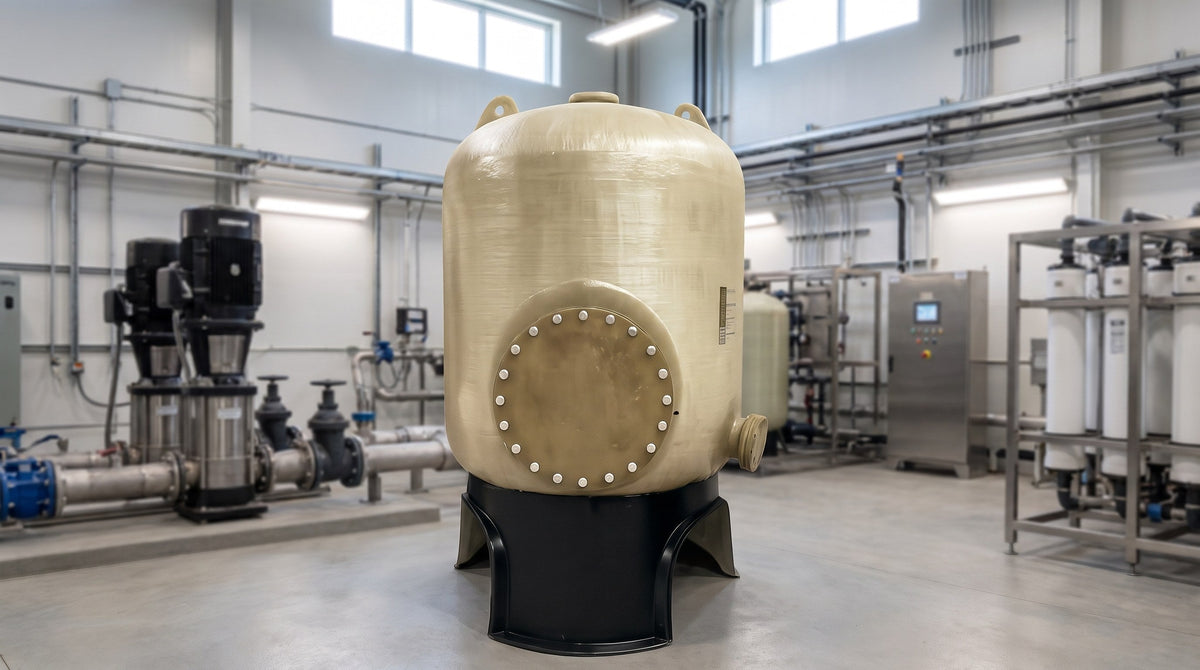
ERE stocks two FRP water treatment tanks — a 60″ and a 72″ filament-wound vessel — and the right one for your application comes down to two numbers on the manufacturer's own spec sheet: the outside diameter and the straight shell height. This guide works through what those two numbers mean for filtration area and capacity, which of ERE's five recommended applications fits each size, and what a Canadian buyer needs to check before ordering a pressure-rated vessel.
In this guide
- What Is an FRP Tank and Why Use One for Water Treatment?
- How Do the 60″ and 72″ Tanks Compare on Filtration Area and Capacity?
- Which Applications Fit Each Tank Size?
- What Standards Govern FRP Tank Construction and Installation in Canada?
- What Connections Does the Tank Have for Loading, Discharge and Access?
- How Do You Choose an FRP Tank, Step by Step?
- Frequently Asked Questions
What Is an FRP Tank and Why Use One for Water Treatment?
An FRP (fiber-reinforced plastic) tank is a cylindrical pressure vessel built by winding or molding glass fibers into a thermoset resin, instead of welding steel plate. For water treatment service the appeal is corrosion resistance: the resin shell doesn't rust or pit the way a steel vessel does when it's holding backwashing filter media, softener resin or acidic wastewater day after day.
ERE's two FRP tanks are filament-wound — the fiber is wound onto a rotating mandrel under tension, which is the higher-strength of the two common construction methods (the other being contact-molding, used for lighter-duty tanks). ASTM D3299 is the standard specification that covers both filament-wound and contact-molded glass-fiber-reinforced thermoset resin tanks for exactly this kind of corrosion-resistant, above-ground vertical service — it's the reference point to ask a vendor about when you're comparing FRP tanks from different manufacturers.
Both ERE tanks are made in Canada and ship as a single molded vessel with an integral FRP base and lifting lugs — there's no separate steel skirt or saddle to source.
How Do the 60″ and 72″ Tanks Compare on Filtration Area and Capacity?
The two models share almost the same overall footprint height but differ in diameter, and that trade-off is worth doing the arithmetic on before you pick one.
| Spec | ER-FRP6096 (60″) | ER-FRP7296 (72″) |
|---|---|---|
| Outside diameter | 60″ (1,500 mm) | 72″ (1,800 mm) |
| Overall height | ~96″ (~2,400 mm) | ~96″ (~2,400 mm) |
| Straight shell height | 41⅛″ (1,045 mm) | 33″ (839 mm) |
| Cross-sectional (filtration) area — our arithmetic | ~19.6 sq ft | ~28.3 sq ft |
| Approx. straight-shell volume — our arithmetic | ~503 US gal (~1,905 L) | ~582 US gal (~2,202 L) |
The area and volume figures are our own calculation from the diameter and straight shell height on ERE's spec sheet (a cylinder's cross-section is π × radius², and straight-shell volume is that area times the shell height) — they are not a published ERE or manufacturer number, and they exclude the domed heads at each end, which add some additional volume beyond what's shown here.
The result is not intuitive: going from 60″ to 72″ diameter buys you 44% more filtration area (28.3 vs. 19.6 sq ft), but only about 16% more straight-shell volume (582 vs. 503 gal), because the 72″ tank's shell is roughly 8″ shorter to hold the same ~96″ overall height. If your limiting factor is media surface loading rate (a filtration-area problem), the 72″ gives you more headroom per inch of diameter gained than its volume alone would suggest. If your limiting factor is contact time or total media volume, the gap between the two is smaller than the diameter difference implies.
Does a Taller Building Footprint Change Which Size You Need?
Both tanks hold to the same ~96″ overall height, so a switch between sizes doesn't change your ceiling clearance requirement — only your floor footprint (a 60″ vs. 72″ diameter circle) and your piping run to the side connections change.
Which Applications Fit Each Tank Size?
ERE's spec sheet recommends each size for a different set of duties, and the split lines up with the area-vs-volume trade-off above: lower-flow, deeper-bed applications on the 60″, and higher-throughput or pretreatment duty on the 72″.
What Is the 60″ Tank (ER-FRP6096) Recommended For?
- Multimedia filtration — general suspended-solids removal ahead of downstream processes. See ERE's industrial water filtration systems guide for how multimedia filtration fits into a full treatment train.
- Carbon adsorption — activated carbon for organics, chlorine or taste-and-odour removal.
- Iron and manganese removal — media-based oxidation/filtration. ERE's Greensand, Birm and KDF media comparison covers the media choices that go inside a vessel like this one.
- Softeners — ion-exchange resin service. See ERE's cation, anion and mixed-bed resin guide for resin selection.
What Is the 72″ Tank (ER-FRP7296) Recommended For?
- High-flow filtration — the larger cross-section handles more flow per vessel at the same media loading rate.
- Industrial pretreatment — ahead of process water or discharge treatment.
- RO pre-filters — protecting reverse-osmosis membranes from particulate fouling. See ERE's industrial RO water treatment guide for what pretreatment an RO system needs.
- Wastewater polishing — a final filtration step before discharge.
Both vessels are listed in ERE's water treatment systems collection alongside the media, resin and disinfection equipment that pairs with them.
What Standards Govern FRP Tank Construction and Installation in Canada?
Two separate questions apply here: how the tank itself is built, and whether it needs to be registered before it can be installed under pressure in a Canadian province.
What Standard Covers How the Tank Is Built?
ASTM D3299, Standard Specification for Filament-Wound Glass-Fiber-Reinforced Thermoset Resin Corrosion-Resistant Tanks, covers the resin system, laminate construction, and design requirements for cylindrical tanks like ERE's. It's the reference to ask any FRP tank vendor whether their vessel meets, and it's a fair basis for comparing tanks from different manufacturers on paper.
Does This Tank Need a CRN (Canadian Registration Number)?
If a vessel is pressure-rated and will operate above roughly 15 psig, most Canadian provinces require it to carry a Canadian Registration Number before it can be legally installed, under CSA B51, the Boiler, Pressure Vessel, and Pressure Piping Code. CRN registration is jurisdiction-specific — a vessel registered in one province is not automatically cleared to install in another. Before you specify either FRP tank for a project outside Quebec, confirm its pressure rating and CRN status with ERE; a low-pressure or atmospheric application (some multimedia filters and softener vessels run at municipal supply pressure without needing a separate pressure-vessel registration) may not trigger this requirement at all, but it's worth confirming rather than assuming either way.
What Connections Does the Tank Have for Loading, Discharge and Access?
Both the 60″ and 72″ tank share the same connection sizes, which simplifies switching sizes mid-project without redesigning your piping.
| Connection | Size | Type |
|---|---|---|
| Top & side manhole | 20″ (500 mm) | Bolted |
| Side discharge port | 6″ (150 mm) | Flanged |
| Top inlet connection | 3⅛″ (80 mm) | Flanged |
| Base & lifting lugs | — | Integral FRP |
The 20″ bolted manhole (both top and side) is sized for a technician to physically enter or reach into the vessel for media loading, inspection and media replacement — a meaningfully larger access point than the small hand-holes on some competing tank lines. The flanged 6″ discharge and 3⅛″ inlet connections bolt directly to standard flanged pipe on either side, so no field-welding or threaded adapters are needed at installation.
How Do You Choose an FRP Tank, Step by Step?
- Identify your primary duty. Match your application against ERE's recommended list — multimedia filtration, carbon adsorption, iron/manganese removal or softening points to the 60″; high-flow filtration, industrial pretreatment, RO pre-filtration or wastewater polishing points to the 72″.
- Decide whether filtration area or media volume is your limiting factor. If you need more surface loading capacity per vessel, the 72″'s 44% area advantage outweighs its smaller 16% volume advantage. If total contact time or media volume drives your design, size on the volume figures instead.
- Confirm your floor footprint and piping layout. Both tanks hold the same ~96″ overall height, so only the diameter (60″ vs. 72″) and the connection layout (20″ manhole, 6″ discharge, 3⅛″ inlet, both sizes) need to fit your mechanical room.
- Check the pressure rating and CRN status with ERE. If the vessel will run under pressure above roughly 15 psig, confirm CRN registration for your installation province before you commit to a purchase order.
- Request a quote. Both tanks are made in Canada; ask ERE for current lead time, freight dimensions and the media or resin to pair with the vessel.
Need help sizing an FRP water treatment tank?
ERE Inc. has been Canada's environmental equipment specialist for 30+ years. Tell us your flow rate, application and installation province, and we'll confirm the right size, media pairing and CRN requirements before you order.
→ Request a Quote | 1-888-287-EREC | Browse Water Treatment Systems | sales@ereinc.com
Frequently Asked Questions
What sizes does ERE's FRP water treatment tank come in?
Two: a 60″ outside diameter (ER-FRP6096) and a 72″ outside diameter (ER-FRP7296), both filament-wound and made in Canada, with roughly the same ~96″ overall height.
What's the real difference between the 60″ and 72″ tank?
The 72″ tank has about 44% more filtration cross-sectional area than the 60″, but only about 16% more straight-shell volume — its shell is shorter to keep the same overall height. ERE recommends the 60″ for multimedia filtration, carbon adsorption, iron/manganese removal and softeners, and the 72″ for high-flow filtration, industrial pretreatment, RO pre-filters and wastewater polishing.
Does an FRP tank need CRN registration in Canada?
If it's pressure-rated and operates above roughly 15 psig, most provinces require a Canadian Registration Number under CSA B51 before installation, and registration is specific to each province. Confirm the tank's pressure rating and CRN status with ERE before specifying it for a project outside Quebec.
What standard governs how the tank is constructed?
ASTM D3299 covers filament-wound and contact-molded glass-fiber-reinforced thermoset resin tanks for corrosion-resistant, above-ground vertical service — ERE's tanks are the filament-wound type this standard describes.
What connections does the tank have for loading and access?
Both sizes share a 20″ bolted manhole (top and side), a 6″ flanged side discharge port, a 3⅛″ flanged top inlet, and an integral FRP base with lifting lugs.
Related articles
- Industrial Water Filtration Systems: Types, Applications and Selection Guide for Canada
- Ion Exchange Resin for Industrial Water Treatment: Cation, Anion and Mixed Bed Compared
- Industrial Reverse Osmosis Water Treatment: How It Works and When to Use It
Lire en français : Réservoirs en FRP : comment choisir entre les modèles 60 po et 72 po pour le Canada