
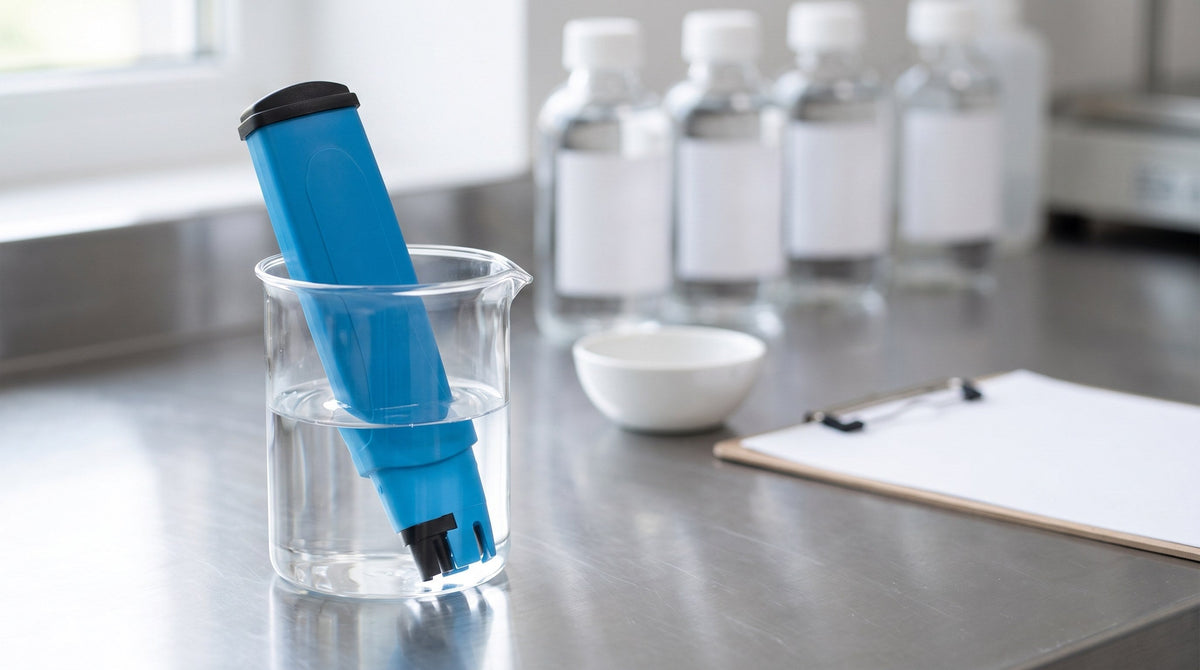
A TDS meter is a conductivity meter that multiplies its reading by a conversion factor and displays the result as total dissolved solids in mg/L (ppm). For buying, four things decide whether the number is any use: the measuring range, the conversion factor, the calibration standard and how the meter handles temperature. This guide compares the TDS testers and meters ERE carries, from pocket testers to a multiparameter meter and an online controller.
In this guide
- What a TDS meter measures
- The conversion factor
- What TDS reading matters
- Pocket, portable, multiparameter or online
- Low range or high range
- Calibrating a TDS meter
- Temperature compensation
- Taking a reliable reading
- Where TDS meters are used
- When a lab result is the better answer
What Does a TDS Meter Actually Measure?
A TDS meter measures the electrical conductivity of the water and converts it to an estimate of dissolved solids. Dissolved salts conduct current, so the more ions in the sample, the higher the conductivity and the higher the calculated TDS. The USGS National Field Manual says conductometric measurements are typically used to estimate the concentrations of total dissolved solids in natural waters, which is why it reports conductivity at 25 °C.
Health Canada's technical document on TDS makes the same point from the treatment side: it notes that standard method SM 2510 considers conductivity a surrogate measure of TDS that may be used for rapid quantification and process monitoring. The practical consequence is that a TDS meter tells you how much is dissolved, in total, not which ions make it up. Two samples with the same TDS can have very different chemistry.
What Is the TDS Conversion Factor, and Why Do Two Meters Read Differently?
The conversion factor is the number the meter multiplies conductivity by to get TDS, and two meters using different factors will report different TDS for the same water. Hanna's testers let you select a factor from 0.45 to 1.00 in the meter setup, and they allow direct calibration in ppm when the factor is 0.5 or 0.7.
Hanna's own standards show the size of the effect. Its 12.88 mS/cm conductivity standard is listed as 6.44 ppt at a factor of 0.5 and 9.02 ppt at 0.7, so the same solution reads about 40 percent higher at the higher factor (an ERE calculation from the manual's figures). That is why the factor belongs in your record beside every TDS value. If a client or a laboratory compares your reading with theirs, the factor is the first thing to reconcile.
What TDS Reading Matters in Drinking and Process Water?
For drinking water, the Canadian figure is 500 mg/L or less, and it is an aesthetic objective rather than a health limit. The Health Canada document states the objective as TDS ≤ 500 mg/L, intended to minimize complaints about taste, odour or excessive scaling, and says that because TDS is made up of numerous salts it is not possible to derive a meaningful health-based value. It adds that high TDS can lead to excessive scaling in pipes, heaters, boilers and appliances.
The U.S. EPA lists the same number: its secondary drinking water standards table gives 500 mg/L for TDS, with hardness, deposits, colored water, staining and salty taste as the noticeable effects above it. Neither source tells you that a lower reading is safe, only that it is less likely to cause those nuisance effects. Use a TDS meter to screen, trend and check treatment performance, and pair it with specific tests where a specific ion matters.
Which TDS Meter Format Fits the Job: Pocket Tester, Portable Meter, Multiparameter Meter or Online Controller?
Choose a pocket tester for spot checks, a portable meter when you also need pH and a longer probe cable, a multiparameter meter when TDS is one of several logged parameters, and an online controller when the reading has to run a process. The table lists the instruments ERE carries, with specifications from the manufacturers' manuals or ERE's product records.
| Instrument | Format | TDS range | Also reads | Notes |
|---|---|---|---|---|
| Hanna Dist 5 (HA-98311) and Dist 6 (HA-98312) | Pocket tester | 0 to 2000 ppm (Dist 5); 0.00 to 10.00 ppt (Dist 6) | EC, temperature | Floating waterproof casing; replaceable graphite probe; ±2 % of full scale; about 100 h battery |
| Hanna Combo (HA-98129, HA-98130) | Pocket tester | 0 to 2000 ppm (HA-98129); 0.00 to 10.00 ppt (HA-98130) | pH, EC, temperature | Same EC/TDS ranges and ±2 % of full scale as the Dist testers; adds pH on one device |
| Hanna HA-991300 and HA-991301 | Portable meter, separate probe | 0 to 2000 ppm (HA-991300); 0.00 to 10.00 ppt (HA-991301) | pH, EC, temperature | IP67 casing; HI12883 probe on a 1 m cable; about 600 h battery; ±2 % of full scale |
| Ohaus Starter 300C | Portable meter | 0.1 mg/L to 199.9 g/L | Conductivity, temperature | STCON3 four-pole probe specified for 70 µS/cm to 200 mS/cm on the kits that include it |
| Ohaus Starter 400M | IP67 multiparameter | 0.1 mg/L to 199.9 g/L | pH, conductivity, salinity, resistivity, temperature | 1,000-record memory; micro-USB; rechargeable battery |
| Hanna HI9829 | Multiparameter meter, submersible probe | 0 to 400,000 ppm (maximum depends on the TDS factor) | pH, ORP, DO, EC, turbidity, temperature (by model) | ±1 % of reading or ±1 ppm, whichever is greater; 44,000-sample logger; IP67 meter, IP68 probe |
| Hanna HA-710 | Online controller | 0 to 1000 ppm or 0 to 100 ppt | Conductivity (EC) | ON/OFF, PI or PID control; ±0.5 % of full scale; 1/2 DIN panel mount |
The Ohaus, HI9829 and HA-710 entries follow ERE's product records. Ask for the exact kit when you quote: the Ohaus ST300C-B is the meter alone, and the probe is not included.
Should You Buy the Low-Range or the High-Range Model?
Buy the low-range model (0 to 2000 ppm) for drinking water, groundwater and treated water, and the high-range model (0 to 10 ppt) only for brackish or process water. Hanna makes both ranges of each pocket and portable tester, and the choice matters because the accuracy specification is a percentage of full scale.
Hanna specifies ±2 percent of full scale for EC and TDS on the Dist, Combo and HA-991300/HA-991301 testers. If that is read against each range's full scale (an ERE calculation, not a manufacturer figure), the 2000 ppm models carry about ±40 ppm and the 10 ppt models about ±0.20 ppt, or ±200 ppm. On a 300 ppm sample that is roughly ±13 percent on a 2000 ppm model against ±67 percent on a 10 ppt model. It is also the reason not to take a 10 ppt tester to reverse osmosis permeate or drinking water, where the sample sits at the bottom of its range.
How Do You Calibrate a TDS Meter?
Calibrate with a standard close to your samples, then check the result against a second standard. Hanna's Dist 5 and Combo testers calibrate automatically at a single point, and the manuals list the standards each model recognizes: 1413 µS/cm or 1382 ppm (factor 0.5) or 1500 ppm (factor 0.7) for the low-range models, and 12,880 µS/cm, 6.44 ppt (factor 0.5) or 9.02 ppt (factor 0.7) for the high-range ones. The HA-991300 and HA-991301 manual notes that because EC and TDS are related, you do not have to calibrate in TDS at all.
- TDS standards: ERE stocks Hanna TDS calibration solutions in 800 ppm, 1382 ppm, 1500 ppm and 6.44 ppt, in 20 mL sachets and, for 1382 and 1500 ppm, 500 mL bottles. ERE's product record lists them as NIST-traceable, with a five-year unopened shelf life and a temperature reference chart on each package.
- Conductivity standards: Hanna conductivity calibration solutions are available at 84, 1413 and 12,880 µS/cm.
- Bracket your samples: the USGS says to choose standards that bracket the expected conductance of the samples, and to check the calibration against at least one further standard. A standard within ±3 percent of its certified value above 100 µS/cm is considered accurate and does not warrant recalibration.
- Low-conductivity caution: the USGS notes that standards below 200 µS/cm are susceptible to bias from dilution or contamination and are difficult to measure accurately. Rinse well, and expect more scatter at the bottom of the range.
- Fresh standards: use fresh solution and never one past its expiry date.
Hanna's schedule and the USGS advice pull in slightly different directions, and both are reasonable. Hanna says to recalibrate its pocket testers when the electrode is replaced, after aggressive samples and at least monthly. The USGS notes that conductance meters typically keep their calibration, so frequent recalibration is generally unnecessary. The way to reconcile them is to check against a standard often and recalibrate when the check fails or the schedule says so.
Does Temperature Change a TDS Reading?
Yes, and a good meter corrects for it automatically. The USGS states that electrical conductivity increases by 0.5 to 3 percent per degree Celsius and varies with the ionic species present, which is why results are reported at 25 °C. Hanna's testers apply automatic temperature compensation and let you set the coefficient β from 0.0 to 2.4 percent per °C.
Set β deliberately. The HA-991300 and HA-991301 manual says β should be set to 1.9 during calibration, and the coefficient you use for a sample should reflect the water you are measuring. Record the sample temperature and the β value beside the reading, particularly when comparing a cold monitoring well with a warm process stream.
How Do You Take a Reliable TDS Reading?
Calibrate, set the factor, rinse the probe, immerse and stir gently, and read only when the stability tag clears. A practical sequence:
- Calibrate near your samples. Calibrate on the range you will measure, using a standard close to the expected value. Hanna's Dist and Combo testers calibrate automatically at one point, in a standard their manual lists, such as 1413 µS/cm or 1382 ppm on the low-range models.
- Set the factor and temperature coefficient. Confirm the TDS conversion factor and the temperature coefficient (β) match your method, and note both. The Hanna testers let you change them in setup.
- Rinse and immerse. Rinse the probe with distilled or deionized water, then immerse it in the sample and stir gently.
- Wait for the stability tag. Take the reading only after the stability tag on the display has disappeared.
- Record the context. Write down the TDS value with the conversion factor, the sample temperature and the standard used at the last calibration.
- Rinse and store dry. Rinse the probe between samples, clean the electrode monthly with a lint-free cloth, and never store the probe in distilled or deionized water.
The rinse, cleaning and storage steps come from the Dist 5 and Dist 6 manual. Confirm the procedure your project's sampling plan requires before you rely on any of it.
Where Do Environmental and Industrial Teams Use TDS Meters?
The main uses are screening water quality, tracking a change over time and watching the performance of treatment equipment. That is the rapid-quantification and process-monitoring role Health Canada describes for conductivity as a TDS surrogate.
On the treatment side, conductivity or TDS is the usual way to compare feed water with product water on reverse osmosis and ion exchange equipment. See our guides to industrial reverse osmosis and ion exchange resin for how those systems are built, and use a low-range tester so the product-water reading is not lost in the instrument's error band. Where the reading has to control a process continuously, the HA-710 controller works from a conductivity or TDS probe and offers ON/OFF, PI and PID control against set points. For brackish or marine samples where salinity, not just TDS, is the reportable parameter, see our salinity meter guide.
When Is a Lab TDS Result the Better Answer?
A lab result is the better answer when the number will be reported, disputed or compared against a limit. A TDS meter gives an estimate calculated from conductivity, and its value depends on the conversion factor, the temperature coefficient and the calibration standard. In that case report the measured conductivity, name the factor, and ask your laboratory which method your regulator or client specifies. Our portable conductivity meter guide covers the conductivity side, including probe design and temperature compensation.
For a wider parameter set, see our water quality meter guide and the companion guides to pH meters and ORP meters. For our full range of field water-quality meters, probes and standards, see the Water Quality Instrumentation collection. Multi-brand supply means one quote can cover the meter, the probe and the standards.
Need help choosing a TDS meter?
ERE Inc. has been Canada's environmental equipment specialist for 30+ years. Tell us your sample range and workflow and we will match the meter, probe and calibration standards.
→ Request a Quote | 1-888-287-EREC | Browse Water Quality Instrumentation | sales@ereinc.com
Frequently Asked Questions
What TDS reading is acceptable in drinking water?
Health Canada's aesthetic objective for TDS is 500 mg/L or less. It is an aesthetic objective, not a health-based limit, because TDS is made up of numerous salts and Health Canada says a meaningful health-based value cannot be derived for it. The U.S. EPA lists the same 500 mg/L as a secondary drinking water standard. A reading under 500 mg/L does not tell you which salts are present.
Is a TDS meter the same as a conductivity meter?
It makes the same measurement. A TDS meter measures conductivity and multiplies it by a conversion factor to report mg/L (ppm). If you need a defensible, method-based number, report the conductivity and treat the TDS value as a convenience readout, recording the factor that produced it.
How often should a TDS meter be calibrated?
Hanna says its Dist 5 and Dist 6 testers should be recalibrated whenever the electrode is replaced, after testing aggressive samples and at least once a month. The USGS adds that you should check the calibration against at least one further standard that brackets your samples, and that a standard reading within ±3 percent of its certified value (above 100 µS/cm) does not warrant recalibration.
Which TDS conversion factor should I use?
Use the factor your method or laboratory specifies and record it with every reading. Hanna's testers let you select any factor from 0.45 to 1.00 and calibrate directly in ppm at 0.5 or 0.7. Because the factor multiplies the conductivity, the same sample reads about 40 percent higher at 0.7 than at 0.5.
Related articles
- Chlorine Meters: A Buyer's Guide for Canada
- Portable Conductivity Meters: How to Choose One for Field Water Monitoring in Canada
- pH Meters: How to Choose a Pocket, Portable or Bench Meter for Water Testing in Canada
- ORP Meters: How to Choose and Verify an Oxidation-Reduction Potential Meter for Water Testing in Canada
- Water Quality Meters for Environmental Work: A Buyer's Guide for Canada
- Industrial Reverse Osmosis Water Treatment: How It Works, When to Use It, and What Pre-Treatment You Need
Lire en français : Testeurs TDS : comment choisir un appareil, régler le facteur de conversion et l'étalonner au Canada