
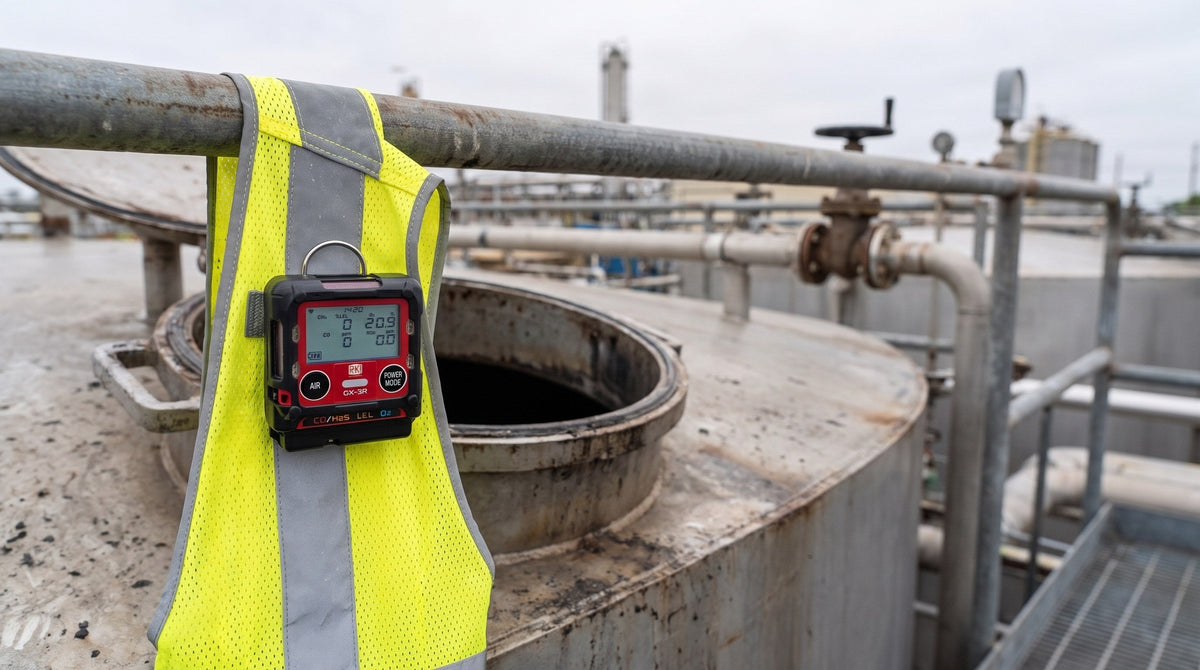
A combustible gas detector reads how close the air is to a flammable mixture, shown as a percentage of the lower explosive limit (%LEL). For work in tanks, sumps, pump rooms and hot-work areas you need a calibrated LEL instrument (a personal monitor, a sample-draw monitor or a fixed head), not a household leak sniffer. This guide sorts the combustible gas instruments ERE carries by the job they do and explains why a ppm leak checker and a %LEL monitor are not interchangeable.
In this guide
- What does a combustible gas detector actually measure?
- Which LEL sensor fits the job: catalytic, infrared or spectrometer?
- Personal, sample-draw or fixed: which form do you need?
- Do you need an LEL monitor or a leak checker?
- What do Canadian rules say about testing for flammable atmospheres?
- What catches buyers out with LEL instruments?
- How do you choose a combustible gas detector, step by step?
- Frequently Asked Questions
What Does a Combustible Gas Detector Actually Measure?
It measures the concentration of flammable gas or vapour as a percentage of the lower explosive limit, the lowest concentration in air that can ignite. At 0% LEL the air has none of the gas; at 100% LEL it is at the point where it can burn or explode. The scale is the same whatever the gas, which is why the reading is useful for a worker who does not know the chemistry.
The conversion depends on the gas. Methane's 100% LEL is 5% by volume: the calibration mixture for the RKI GX-3R is 2.5% methane and is labelled 50% LEL. That makes 10% LEL about 5,000 ppm of methane and 1% LEL about 500 ppm (our arithmetic from the record's calibration gas, not a manufacturer figure). Keep that scale in mind when you compare instruments: a detector that resolves 1% LEL cannot find a 20 ppm leak, and a 20 ppm leak checker is not telling you a space is safe to enter.
Which LEL Sensor Fits the Job: Catalytic, Infrared or Spectrometer?
Catalytic bead is the default for portable instruments, infrared suits oxygen-poor or heavily contaminated atmospheres, and the RKI MPS spectrometer sensor suits fixed heads that must read several gases on one calibration. Choose from the gases and the contaminants in your process, not from the price of the sensor.
| Sensor | How it works | Strength | Watch for |
|---|---|---|---|
| Catalytic bead | Burns the gas on a heated bead and measures the change | Reads most flammable gases, hydrogen included; compact. The GX-3R's sensor is rated 0 to 100% LEL, ±5% of reading or ±2% LEL, whichever is greater | Needs oxygen to read correctly; silicones and some other vapours can poison it. The GX-3R sensor carries two active filaments so the second takes over if the first is poisoned |
| Infrared | Measures absorption of infrared light by hydrocarbons | Works without oxygen and is not poisoned by silicones | Hydrocarbons only: it does not see hydrogen. Ask ERE which infrared option is offered on the platform you choose |
| RKI MPS LEL sensor | Identifies the gas it sees and applies the right LEL factor itself | Reads 14 combustible gases on a single methane calibration, hydrogen included; immune to H2S, silicone and HCFC poisons; annual field response checks; expected life over 10 years | For fixed heads: it is compatible with RKI M2A, S2 and Direct Connect, not a pocket monitor |
Personal, Sample-Draw or Fixed: Which Form Do You Need?
Use a personal monitor on the worker, a pumped monitor to test a space before and during entry, and a fixed head where the hazard is permanent. The form is set by how the gas reaches the sensor, and that decides whether you can test a space from outside it.
- Personal, diffusion: the RKI GX-3R reads LEL, O2, CO and H2S on a clip, with IP66/68 protection and a 3.52 oz (100 g) body. Gas reaches the sensor by diffusion as standard, with a hand aspirator or motorized pump optional. The GX-3R Pro adds Bluetooth and a toxic-gas channel. The record lists its approvals as ATEX with CSA pending in the description and CSA in the specification summary, so confirm the approval you need at order.
- Personal with a pump: the Dräger X-am 2800 carries one CatEx SR catalytic Ex sensor (set for methane, propane, hydrogen, nonane and more) and up to three XXS toxic or oxygen sensors; with the Dräger X-am Pump it handles clearance measurement before entry. It is approved for cCSAus Class I Div 1.
- Sample-draw: the RKI GX-Force pulls a sample at 0.5 L/min nominal from up to 100 ft away through a hose, so you can test a tank or manway from outside. It is intrinsically safe to Class I Div 1 Groups A B C D, with a Leak Check mode that reads combustibles in the ppm range.
- Fixed: for spaces that stay hazardous, the LEL element goes on an explosion-proof head feeding a controller. See our fixed gas detector guide; a sample-draw option is the Model 1017 explosion-proof sample-draw LEL sensor.
For a first-time buyer comparing the personal options, our portable gas detector guide covers channel counts and kits. A short-term job may be better rented: see gas detector rental in Canada.
Do You Need an LEL Monitor or a Leak Checker?
If the question is "is this space safe to enter or work in", you need an LEL monitor. If the question is "where is the leak", you need a leak checker. They answer different questions, and buying one for the other's job is the usual mistake.
Handheld leak checkers use a sensitive element and a probe to locate a source. The RKI SP-230 uses a hot-wire semiconductor (MOS) sensor and an internal pump, reads 50 gases and shows 0.1 ppm on a bar with 0.3 ppm of phosphine applied (Type SC covers toxic, combustible and refrigerant gases including methane and hydrogen). The Ion Science Panther uses a micro thermal conductivity detector for helium, hydrogen and refrigerants. For landfill surface scans, the QED SEM5000 is built for methane emissions monitoring at wellheads and penetrations; see our landfill gas monitoring guide.
None of these replaces a %LEL monitor for entry clearance. A 20 ppm methane reading on a leak checker is 0.04% LEL on the arithmetic above; it says a joint is weeping, not that a tank is clear.
What Do Canadian Rules Say About Testing for Flammable Atmospheres?
Provincial confined-space rules require testing before entry and, in many cases, continuous monitoring where a flammable atmosphere may develop; the details vary by province, so read your own regulation. The Canadian Centre for Occupational Health and Safety (CCOHS) summarizes them in its confined space atmospheric hazards page. For example, it reports that in British Columbia pre-entry testing is completed no more than 20 minutes before entry and continuous monitoring is required if a flammable or explosive atmosphere of more than 20% of the lower explosive limit may develop, and that in Manitoba a hazardous confined space needs continuous monitoring of the atmosphere.
The general program, from hazard assessment to rescue, is in the CCOHS confined spaces overview. We cover what each province expects of the instrument in our confined space gas monitoring guide. Alarm set points are configurable; set them to your written procedure and confirm the factory defaults at order.
What Catches Buyers Out With LEL Instruments?
Four things: a poisoned or oxygen-starved catalytic sensor reading low, the wrong calibration gas for the gas you actually meet, no bump test before the shift, and a household unit used for an industrial job.
- Poisoning and oxygen: a catalytic sensor that has been exposed to silicones can read low without any fault alarm, and catalytic sensors need oxygen to burn the gas, so an inert or oxygen-deficient atmosphere is a reason to consider infrared.
- Calibration gas: an instrument calibrated on methane reads other gases with a correction factor. If your hazard is hydrogen or a solvent vapour, ask for the factor or calibrate to the gas you meet. The MPS sensor removes this step for the 14 gases it covers.
- Bump test and calibration: a functional bump test before each use and periodic calibration are what make the reading defensible. Our bump test vs calibration guide and calibration schedule guide set out the difference.
- The wrong class of instrument: consumer plug-in units and pen-style sniffers are not intrinsically safe or approved for hazardous locations and do not give a calibrated %LEL reading. For a Class I Div 1 location, check the approval on the data sheet, as in the X-am 2800 and GX-Force records above.
How Do You Choose a Combustible Gas Detector, Step by Step?
- Name the gas. Methane and propane are covered by a standard catalytic sensor; hydrogen and solvent vapours may need a correction factor or another sensor.
- Name the question. Entry clearance or personal protection points to a %LEL monitor; finding a leak points to a leak checker.
- Check the atmosphere. Silicones or low oxygen point away from plain catalytic; a permanent hazard points to a fixed head.
- Choose the sampling. Diffusion for the wearer; a pump or hose when someone must test from outside the space.
- Confirm the area approval. Match the Class and Division on the data sheet to your location.
- Plan the upkeep. Calibration gas, bump-test station, cycle and records.
- Get a quote on the configured unit. Sensor mix, alarms and accessories are set at order.
Need help choosing a combustible gas detector?
ERE Inc. has been Canada's environmental equipment specialist for 30+ years. Tell us the gas, the space and the approval you need, and we will configure the instrument, the calibration gas and the bump-test kit.
→ Request a Quote | 1-888-287-EREC | Browse Portable Gas Detectors | sales@ereinc.com
Frequently Asked Questions
What does LEL mean on a gas detector?
LEL is the lower explosive limit, the lowest concentration of a flammable gas in air that can ignite. The detector shows the reading as a percentage of that limit, so 0% is none and 100% is the point where the mixture can burn.
What is the difference between a combustible gas detector and a gas leak detector?
A combustible gas detector (LEL monitor) tells you how close the air is to a flammable mixture, to protect people. A gas leak detector locates a leak source at low concentration. Use the first for entry and hot work, the second to trace a leak.
How many ppm is 10% LEL?
It depends on the gas. For methane, 100% LEL is 5% by volume, so 10% LEL is about 5,000 ppm. Other gases have different limits, so convert with the correct figure for your gas.
Can a catalytic LEL sensor be poisoned?
Yes. Silicones and some other vapours can reduce a catalytic sensor's response, and it needs oxygen to read correctly. Regular bump tests catch a loss of response, and infrared or MPS sensors avoid the weakness.
Is a household gas detector acceptable for confined spaces or hot work?
No. Household units are not calibrated to a %LEL scale and are not approved for hazardous locations. Use an industrial LEL instrument with the approval your location requires.
Which ERE products measure LEL?
The RKI GX-3R and GX-3R Pro, the RKI GX-Force sample-draw monitor and the Dräger X-am 2800 for personal and pumped monitoring, plus RKI fixed heads with the MPS LEL sensor. Request a quote for the configuration.
Related articles
- Portable Gas Detectors: Buyer's Guide for Canada
- Fixed Gas Detectors: A Buyer's Guide for Canada
- Confined Space Gas Monitoring Requirements in Canada
- H2S Gas Detectors: Personal, Fixed and Tube Options
- SF6 Leak Detector vs Area Monitor: Which Do You Need?
Lire en français : Détecteur de gaz combustibles : moniteurs LIE ou détecteurs de fuite pour les sites canadiens