
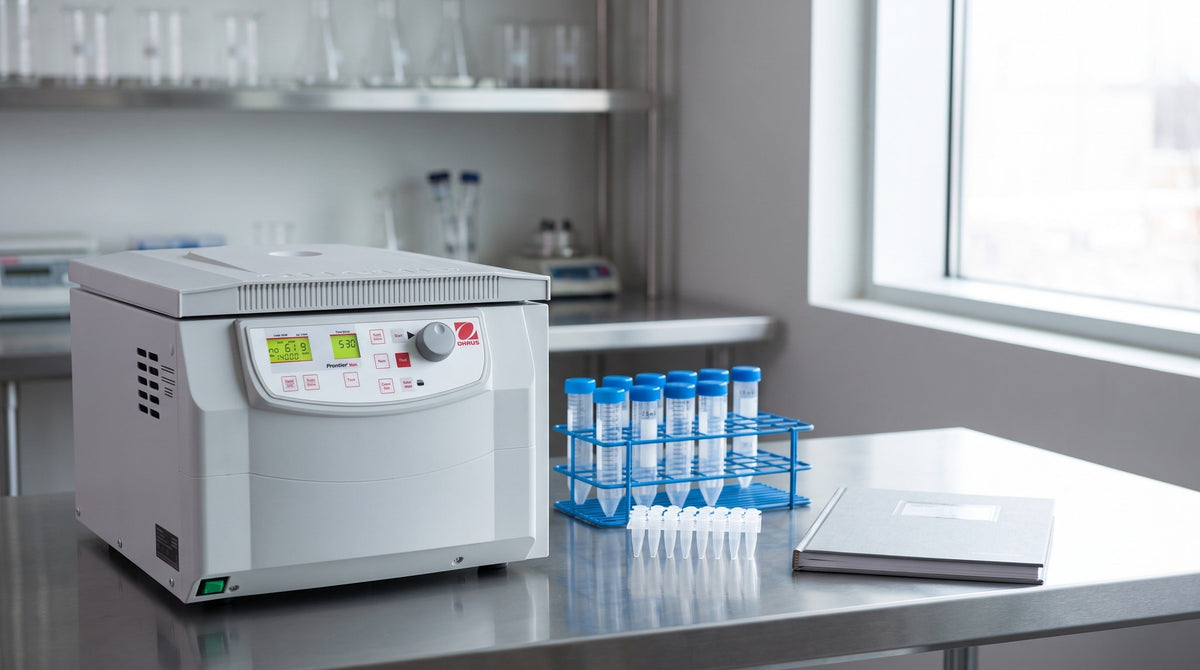
Choose a laboratory centrifuge by the tube you spin and the force the method needs in ×g, not by the rpm on the front panel. A mini or micro centrifuge handles 0.2-2 mL tubes at up to about 22,000 ×g; a multi centrifuge takes 15-50 mL tubes at 4,000-4,500 ×g; a multi pro unit reaches 18,000-24,000 ×g with buckets up to 4 × 750 mL. This guide sets out how ERE's OHAUS Frontier and Labnet Spectrafuge ranges split, how to convert rpm to ×g, and what to check before a rotor and a tube go together.
In this guide
- Which laboratory centrifuge do you need: mini, micro, multi or multi pro?
- Why compare centrifuges in ×g instead of rpm?
- How do you match the rotor to your tubes?
- Which tubes can you spin, and how fast?
- What balancing and biosafety rules apply?
- How do you choose a centrifuge, step by step?
- Frequently Asked Questions
Which Laboratory Centrifuge Do You Need: Mini, Micro, Multi or Multi Pro?
Start from the tube volume and the force. ERE lists two brands in the centrifuges collection: OHAUS Frontier 5000 series and Labnet Spectrafuge. The figures below are from the product records; voltage options and exact model availability are confirmed on a quote.
| Class | Model (record) | Speed | Max force | Capacity |
|---|---|---|---|---|
| Mini (quick spin-downs) | OHAUS Frontier 5306 | 0-6,000 rpm | 2,000 ×g | 8 × 1.5/2.0 mL, or 4 × 8-place PCR strips |
| Spectrafuge Mini | 6,000 rpm | 2,000 ×g | 6 × 1.5/2.0 mL or 2 × 0.2 mL strips | |
| Micro (DNA/RNA prep, ultrafiltration) | Frontier 5513 | 200-13,500 rpm | 17,317 ×g | 24 × 1.5/2.0 mL |
| Frontier 5515 | 200-15,200 rpm | 21,953 ×g | 44 × 1.5/2.0 mL or 12 × 5 mL | |
| Spectrafuge 24D | 500-13,300 rpm | 16,300 ×g | 24 × 1.5/2.0 mL | |
| Multi (general-purpose, low speed) | Frontier 5706 | 200-6,000 rpm | 4,427 ×g | 6 × 50 mL |
| Frontier 5707 + R05 | 200-6,800 rpm | 4,445 ×g | 8 × 15 mL | |
| Spectrafuge 6C | up to 6,500 rpm | 4,000 ×g | 6 × 15 mL | |
| Multi Pro (research, industrial, clinical) | Frontier 5714 | 200-14,000 rpm | 18,624 ×g | 4 × 100 mL |
| Frontier 5718 | 200-18,000 rpm | 23,542 ×g | 4 × 100 mL | |
| Frontier 5816 | 200-15,000 rpm | 21,379 ×g | 6 × 250 mL | |
| Frontier 5916 | 200-16,000 rpm | 24,325 ×g | 4 × 750 mL |
The Multi Pro record describes seven models from 0.2 mL to 4 × 750 mL with automatic rotor identification. The Frontier micro record also links a datasheet for the 5515R and the Multi Pro record one for the FC5830R, which are refrigerated models; ask us for availability if your samples must stay cool, because they are not in the part-number tables above. The Spectrafuge 24D is air-cooled, with an ambient operating range of 4-35 °C, and the record notes it may be used in a cold room for below-ambient work.
Why Compare Centrifuges in ×g Instead of rpm?
Because the force on a sample is set by speed and rotor radius together. The standard conversion is RCF (×g) = 1.118 × 10⁻⁵ × r (cm) × rpm2, where r is the distance from the rotation centre to the sample; Sigma-Aldrich publishes the same formula in its g-force calculator. Methods that cite a force, such as "spin at 10,000 ×g", must be run in ×g, and rpm alone cannot reproduce them on a different machine.
The product records show the effect directly. Back-calculating the implied radius from the listed rpm and ×g:
| Rotor or model | Speed | Listed force | Implied radius |
|---|---|---|---|
| OHAUS Frontier 5306 (mini) | 6,000 rpm | 2,000 ×g | about 5.0 cm |
| Rotor R-A8X2/6M (8 × 1.5/2.0 mL) | 6,000 rpm | 2,560 ×g | about 6.4 cm |
| Rotor R-A12X15/6M (12 × 15 mL) | 6,000 rpm | 4,427 ×g | about 11.0 cm |
| Frontier 5513 (micro) | 13,500 rpm | 17,317 ×g | about 8.5 cm |
Three machines at the same 6,000 rpm differ by more than a factor of two in force. When a protocol gives only rpm, ask for the rotor it was written for, or convert it with the radius of your own rotor. Force also scales with the square of speed, so a 10% speed error is roughly a 21% force error.
How Do You Match the Rotor to Your Tubes?
Pick the rotor style from the separation you want, then the cavity size from the tube. The OHAUS Frontier 5000 rotor range in the record covers angle, PCR and swing-out rotors:
- Angle rotors hold tubes at a fixed angle and reach the highest force. Examples from the record: R-A24X2/13M (24 × 1.5/2.0 mL, 17,317 ×g at 13,500 rpm), R-A12X5/14MS (12 × 5 mL, 19,978 ×g at 14,500 rpm), R-A6X50/6M (6 × 50 mL, 4,427 ×g at 6,000 rpm), and the high-speed R-A4X85/20MI (4 × 85 mL, 41,137 ×g at 20,000 rpm).
- Swing-out rotors let buckets swing horizontal, which suits larger volumes and microplates at lower force. Examples: R-S4X290/4MI (4 × 290 mL, 3,780 ×g at 4,500 rpm) and R-S4X100/5MIS (4 × 100 mL, 4,080 ×g at 5,000 rpm).
- PCR rotors take 0.2 mL strips: R-A4XPCR/6 (4 × 0.2 mL PCR8 strips, 2,260 ×g at 6,000 rpm) and R-A4XPCR/15M (15,342 ×g at 15,000 rpm).
Before you order, check three things: the rotor is listed for your centrifuge model (we confirm the pairing on the quote), the tube diameter column matches your tube (for example 12 mm for 1.5/2.0 mL and 29 mm or 31 mm for 50 mL, depending on the rotor), and the rotor's top speed is at or above what the method needs. The Frontier rotor record states the rotors withstand autoclave sterilization through to sub-zero temperatures.
Which Tubes Can You Spin, and How Fast?
The tube's own rating sets the limit, whatever the centrifuge can do. ERE lists Globe Scientific tubes in the centrifuges range, and the records give specific figures:
| Tube | Spin limit in the record | Other notes from the record |
|---|---|---|
| 15 mL clinical-grade polypropylene | 8,500 rpm | Autoclavable without cap; -40 °C to +80 °C; HDPE cap; the record lists use with the Spectrafuge 6C |
| 50 mL clinical-grade polypropylene | 8,500 rpm | Autoclavable without cap; -40 °C to +80 °C; HDPE cap |
| 15 mL acrylic | 5,000 rpm (6,160 ×g) | Record contrasts this with polystyrene at 1,700 rpm (3,000 ×g); RNase/DNase-free, non-pyrogenic, non-cytotoxic |
Note the unit difference: the polypropylene tubes are rated in rpm only, so you cannot compare 8,500 rpm with a rotor's ×g figure without the rotor radius. Treat the tube rating as a hard limit on speed and confirm the pairing with the manufacturer's data sheet, which the product pages link. For microtubes, ERE also lists 0.5, 1.5 and 2 mL polypropylene and polyethylene tubes in the same collection.
What Balancing and Biosafety Rules Apply?
Balance every load, use matched tubes and never exceed the rotor's maximum speed. OSHA's Laboratory Safety Quick Facts on centrifuges says unbalanced rotors can result in injury or death and that the majority of centrifuge accidents result from user error. Its steps include keeping bowls and tubes dry, inspecting tubes for cracks, avoiding overfilled tubes, seating the rotor on the drive shaft, closing the lid during operation and waiting for the rotor to stop before opening it. When centrifuging infectious materials, it advises waiting 10 minutes after the rotor stops before opening the lid.
For biological work in Canada, the Canadian Biosafety Standard, Third Edition requires, at containment level 2, that regulated materials which are primarily infectious or transmitted by inhalation be centrifuged in sealed safety cups or rotors unloaded by a mechanism that prevents their release (requirement 4.5.23). At containment level 3 and above, the sealed cups or rotors are unloaded in a biological safety cabinet or equivalent (4.5.24). The Frontier rotor record flags one listed rotor, R-A24X2/20MIB (24 × 1.5/2.0 mL, 38,007 ×g at 20,000 rpm), as aerosol-tight; the rest of the table lists the field as not applicable.
The Frontier 5306 mini adds a rotor imbalance sensor and two safety switches that stop the rotor if the lid opens, according to its record. These are backstops, not substitutes for balancing. Your biosafety officer decides what containment your work needs; ERE supplies the equipment, not the risk assessment.
How Do You Choose a Centrifuge, Step by Step?
- List the tubes. Note the volumes (0.2, 1.5/2.0, 5, 15, 50 mL or larger bottles) and how many you spin at once.
- Find the force in the method. Use ×g; if the protocol gives rpm, get the rotor it was written for.
- Pick the class. Mini for spin-downs, micro for microtubes at high force, multi for 15-50 mL at low force, multi pro for large volumes or high force with big buckets.
- Choose the rotor style. Angle for highest force, swing-out for large volumes and plates, PCR for strips.
- Check the tube rating. The tube's limit must be at or above the run speed.
- Decide on cooling and containment. Refrigerated models, sealed safety cups or aerosol-tight rotors if the samples need them.
- Confirm power and bench space. Voltage varies by model (for example the 5706 is listed at 230 V; the 5707 at 100-230 V), and the Spectrafuge 6C footprint is 8.25 × 9.5 in.
Send us the tube list, the force and any cooling or containment needs and we will match the model, rotor and tubes. The same labs often need a laboratory balance for loading, a magnetic stirrer for prep and a pH meter for buffers.
Need help choosing a laboratory centrifuge?
ERE Inc. has been Canada's environmental equipment specialist for 30+ years. Send us your tubes, target ×g and any cooling needs and we will match the model, rotor and tubes.
→ Request a Quote | 1-888-287-EREC | Browse Centrifuges | sales@ereinc.com
Frequently Asked Questions
What is the difference between a micro centrifuge and a mini centrifuge?
A mini centrifuge is for quick spin-downs at about 2,000 ×g, as in the OHAUS Frontier 5306 and Spectrafuge Mini. A micro centrifuge runs microtubes at up to roughly 17,000-22,000 ×g, as in the Frontier 5513 and 5515 and the Spectrafuge 24D.
How do I convert rpm to ×g?
Use RCF = 1.118 × 10^-5 × r × rpm^2, with r the rotor radius in centimetres. The radius is rotor-specific, so the same rpm gives different ×g in different rotors.
Can I use any 15 mL tube in a centrifuge?
No. Tubes have their own limits. ERE's records list 8,500 rpm for the clinical-grade polypropylene 15 mL tube and 5,000 rpm (6,160 ×g) for the acrylic one, against 1,700 rpm (3,000 ×g) for polystyrene.
Do I need a refrigerated centrifuge?
Only if the method requires cool samples through the run. The Spectrafuge 24D is air-cooled to keep samples near ambient, but for below-ambient work you need a refrigerated model or a cold room. Ask us about refrigerated Frontier variants.
How long should I wait before opening the lid after centrifuging infectious material?
OSHA's quick facts say to wait 10 minutes after the rotor comes to a complete stop. Follow your institution's biosafety procedure, which may be stricter.
Which centrifuge is best for 50 mL tubes?
A multi centrifuge such as the Frontier 5706 holds 6 × 50 mL at up to 4,427 ×g. For higher force or more tubes, the Frontier rotor range includes R-A10X50/10MI (10 × 50 mL, 16,022 ×g at 10,500 rpm); we confirm which model carries it.
Related articles
- Laboratory Balance Buyer's Guide for Canada
- Magnetic Stirrer Guide: Choose by Volume, Speed and Heat
- pH Meter Buyer's Guide for Canada
- Moisture Analyzer Buyer's Guide for Canada
Lire en français : Centrifugeuse de laboratoire : guide de choix par tube, force g et rotor au Canada