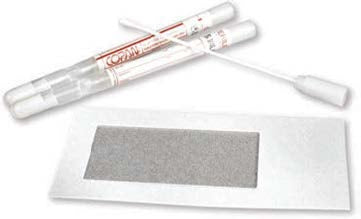
Air sampling draws a measured volume of air through a collection medium, so the lab can report a concentration. ERE carries the full train. Personal and area pumps come from Sensidyne Gilian, A.P. Buck and Zefon, including the intrinsically safe Buck Allin. Media include 25 mm MCE asbestos cassettes, pre-weighed gravimetric cassettes, Air-O-Cell, Allergenco-D and Micro5 spore-trap cassettes and sorbent tubes; respirable dust needs a Dorr-Oliver or aluminum cyclone. For live readings, the DustTrak II and Gilian Dustlight photometers; for flow, calibrators.
ERE rents and sells air sampling pumps, calibrated and tested before each rental. Tell us the contaminant and the method, and we will put the train together.
Air sampling FAQ
Personal or area pump?
A personal pump is worn in the breathing zone and runs at roughly 20 to 5,000 mL/min, for exposure monitoring. An area or high-volume pump samples a fixed location at higher flows, for clearance and IAQ work: the Gilian AirCon-2 runs 2 to 30 L/min. In flammable atmospheres, use an intrinsically safe pump such as the Buck Allin. See our air sampling pump guide.
Which media for asbestos, mold, dust or VOCs?
For asbestos and fibre counting, PCM/MCE preloaded filter cassettes; for mold and bioaerosols, spore-trap cassettes such as Air-O-Cell and Allergenco-D (15 L/min) or Micro5 (5 L/min); for particulate mass, pre-weighed gravimetric cassettes, behind a cyclone for respirable dust; and for VOCs and gases, sorbent tubes on a low-flow pump. Our cassette comparison explains each one.
Real-time monitor or filter sample?
Both. A photometer such as the DustTrak II gives a live trend, while a weighed filter gives the reference mass; NIOSH Method 0600 weighs respirable dust collected on a filter behind a 4 µm cyclone. Photometer readings can differ from the filter, so use them to find and track a source, and the filter to report. See DustTrak vs gravimetric sampling.
How accurate must the flow be?
NIOSH methods call for flow within ±5% before and after each sampling period, so calibrate the pump with the full sampling train in line, before and after every sample, using a calibrator traceable to a primary standard.