


RK-LC-860
Toray LC-860 High-Function Oxygen Analyzer
Range: 0.1 ppm-100 % O2 | Response T90: 30 s | Repeatability: ± 1 % FS
Price on quote · 4 business hours
Fixed gas detectors and complete detection systems for plants, wastewater and biogas facilities, battery rooms and indoor spaces: RKI sensor/transmitters, sample-draw units and Beacon controllers from 1 to 8 channels, plus Ion Science VOC, benzene and SF6 monitors.


Range: 0.1 ppm-100 % O2 | Response T90: 30 s | Repeatability: ± 1 % FS

Range: 0.001 ppm-100 % O2 | Sensor: Zirconia | Power: 24 VDC

Channels: 64 | Relays: 4 | Power: 12 to 35 VDC

Range: 0-10000 ppm O2 | Sensor: Zirconia | Warm-up: 5 min

Channels: 12 | Relays: 4 | Power: 12 to 35 VDC

Range: 0.1 ppm-100 % O2 | Sensor: Zirconia | Output: 4-20 mA / 0-10 V

Sample Points: 80 | Sampling Distance: 120 m | Tape Change: 180 days

Channels: 32 | Display: 7 in touchscreen | Alarm Levels: 3 per channel

Sensor: NDIR | Response T90: 60 s | Accuracy: ± 5 % FS

Tape Life: 1 month | Output: 4-20 mA | Accuracy: ± 20 %

Points (RS-485): 32 | Power: 24 VDC | Output: 4-20 mA

Response T90: 5 s | Range: 25-50 MJ/m³ | Protection: IP66/67

Output: 4-20 mA / HART | Power: 24 VDC | Protection: IP65/67

Sensor: PID | Power: 12 to 35 VDC | Temperature: -40 to +54 °C

Range: 0-100 % LEL | Gases: 14 | Sensor Life: 10+ years

Power: 115-220 VAC | Temperature: -40 to +70 °C | Enclosure: IP66

Output: 4-20 mA 2-wire | Power: 12 to 35 VDC | Temperature: -40 to +60 °C
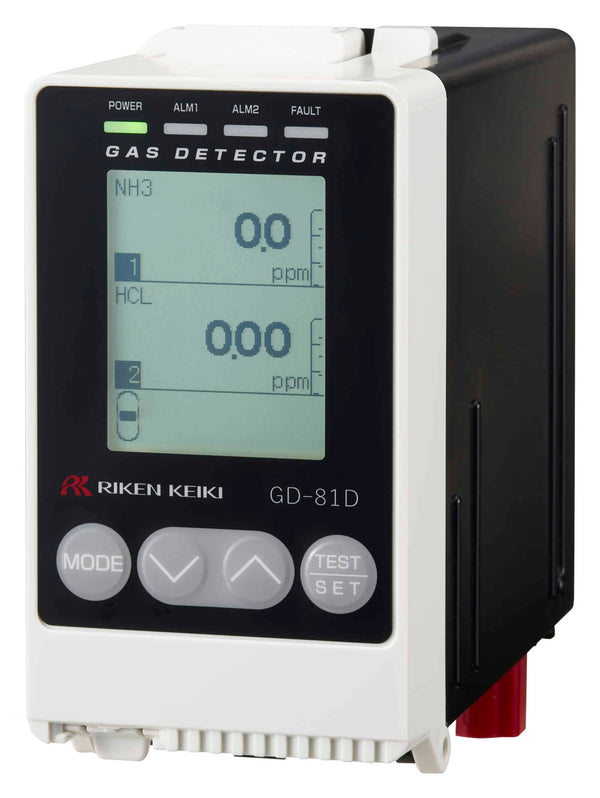
Flow: 0.5 L/min | Gases per Unit: Up to 2 | Power: 24 VDC

Range: 0-100 ppm H2S | Horn: 103 dB | Power: 12 VDC

Input: 4-20 mA | Power: 12 to 35 VDC | Radio: 900 MHz / 2.4 GHz

Switch Inputs: 2 | Battery: 3.6 V / 19 Ah | Radio: 900 MHz / 2.4 GHz

Channels: 255 | Radio: 900 MHz / 2.4 GHz | Power: 12 to 35 VDC

Battery Life: 16 hours | Detectors: 255 | Radio: 900 MHz / 2.4 GHz

Channels: 255 | Output: Modbus RS-232 / RS-485 | Analog Outputs: Up to 32 x 4-20 mA
A fixed gas detection system watches a location around the clock: sensors or transmitters at the hazard, wired to a controller that displays readings and drives alarms and relays. ERE supplies RKI Instruments sensor/transmitters for combustibles (LEL), oxygen, H2S, CO, CO2 and other toxic gases, including the explosion-proof S2 Series and M2A-XL, sample-draw units such as the GD-70D, and Beacon 110, 200, 410A and 800 controllers (1 to 8 channels). Stand-alone monitors cover single points: the OX-600 for oxygen deficiency, the EC-600 for carbon monoxide and the PS-2. For VOCs and benzene, Ion Science offers the Falco 2 PID detector and the Titan 2 benzene monitor.
Tell us the gases, the number of points and the area classification, and we will propose a system.
Three parts: a sensor or transmitter at each monitoring point, a controller that reads it continuously and holds the alarm setpoints, and outputs such as relays to horns, strobes or a building management system. RKI Beacon controllers accept direct-connect RKI sensors or any 4-20 mA transmitter, so you can mix sensor types on one panel. Our fixed gas detector buyer's guide walks through the choices.
A diffusion sensor is mounted where the gas may collect and reads the air that reaches it. A sample-draw unit uses a pump or an aspirator to pull air from a point where a sensor cannot sit, such as a duct or a vessel headspace: the RKI 35-3001 and Model 1017 draw samples from up to 100 ft away, and the air aspirator is built for extreme temperature, pressure and moisture.
Standard sensors cover combustible gases (LEL), oxygen, hydrogen sulfide and carbon monoxide, and several RKI transmitters add CO2 and other toxic gases. Application systems target specific hazards: the digester gas monitor for methane, CO2, O2 and H2S, the wastewater tri-sensor head for LEL, O2 and H2S, the Ion Science SF6 AreaCheck P2 for SF6 leaks, and the Toray LC-750 analyzer for low oxygen levels in clean inert gas.
Several RKI transmitters are explosion-proof for Class I, Division 1, Groups B, C and D, including the S2 Series, the M2A-XL, the Model 1017 and the wastewater tri-sensor head; the GD-K88Ai toxic gas transmitter is intrinsically safe. Ratings differ by model and sensor, so check the certification on the product page against your area classification.
Fixed sensors need periodic bump tests and calibration with certified calibration gas, at the interval set by the manufacturer and your site procedure. Some models make this easier: the M2A-XL can be zeroed and calibrated without opening the housing, and GD-70D plug-in sensors keep their calibration data, so they can be swapped in the field. ERE also repairs and calibrates fixed gas detection systems.