
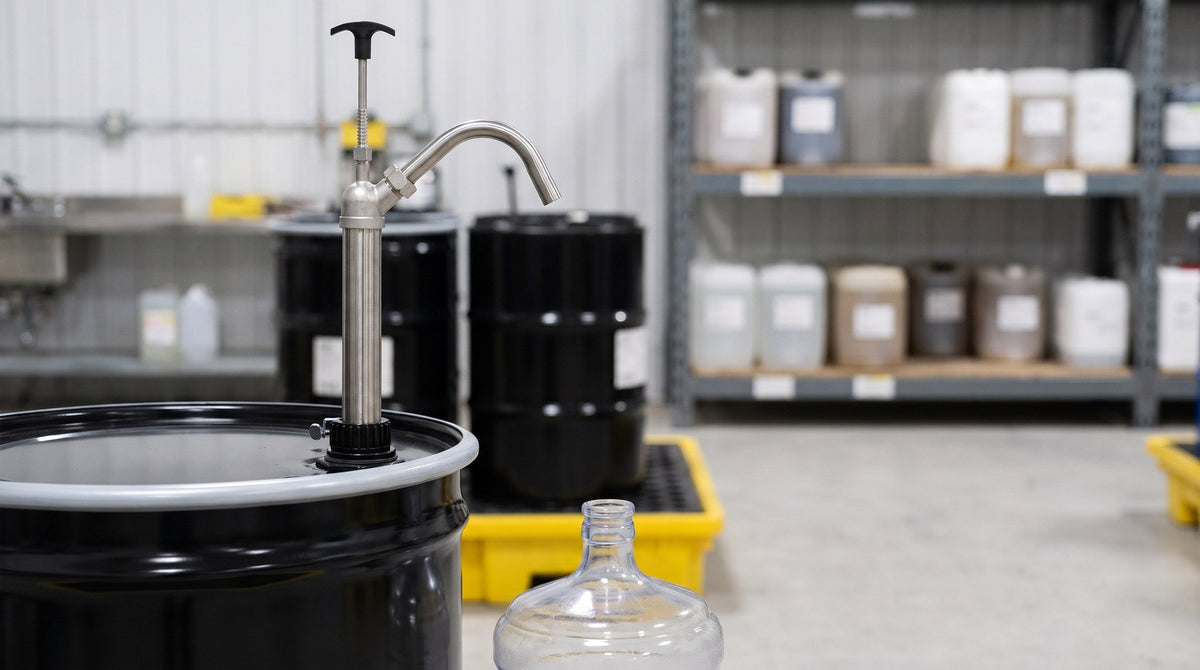
A drum pump is a hand-operated or powered pump that lifts liquid out of a 205 L (55 US gal) drum through the 2 in. bung opening, so you can transfer it without tipping or pouring. For chemicals the pump choice is a material decision first: the wetted parts have to survive the liquid. This guide shows how to match a manual drum pump to the liquid, what a pull-type pump actually delivers, and what ERE carries from KLETON.
In this guide
- What is a drum pump and how does a pull-type pump work?
- How do you match the pump material to the liquid?
- How much liquid does a manual drum pump move?
- What changes when the liquid is flammable?
- Is a drum pump the right tool for sampling?
- How do you choose a drum pump, step by step?
- What drum pumps does ERE carry?
- Frequently Asked Questions
What Is a Drum Pump and How Does a Pull-Type Pump Work?
A drum pump is a transfer pump built to sit in a standard drum bung. A pull-type manual model has a tube that reaches the bottom of the drum and a handle you pull up and push down; each stroke draws a set volume of liquid up the tube and out of the spout. No power supply is needed, which is why these pumps are common on remediation sites, in maintenance shops and in labs that decant drums into smaller containers.
Manual pumps suit occasional transfers of low- to medium-viscosity liquids. Powered pumps (electric or air-operated) are the usual step up when you empty drums daily, move thick liquids or need a steady flow. The material question below applies to both.
How Do You Match the Pump Material to the Liquid?
Read the liquid's SDS, then pick the pump whose wetted parts are listed as compatible. The CCOHS WHMIS safety data sheet fact sheet shows that Section 10 (stability and reactivity) lists incompatible materials and conditions to avoid, and Section 7 covers safe handling and storage. A pump is a material in contact with the liquid, so those sections are where you check it.
| Model | Body | Wetted components | What to check on the SDS |
|---|---|---|---|
| SC-DC117 | Polypropylene | Polyethylene, polypropylene and nylon | Compatibility with polyethylene, polypropylene and nylon |
| SC-DC118 | PVC | PVC, nylon and Viton® | Compatibility with PVC, nylon and Viton® seals |
| SC-DA529 | Stainless steel | 304 stainless steel, polyethylene and PTFE | Compatibility with 304 stainless steel, polyethylene and PTFE |
| SC-DB845 | Stainless steel | 304 and 316 stainless steel with PTFE | Compatibility with 304 and 316 stainless steel and PTFE; quote on request |
The table lists materials, not a compatibility guarantee. ERE's product record describes the range as for use with most mild acids, detergents, water and solvents. For anything stronger, check the liquid against the specific wetted materials, and ask us if the SDS is unclear.
How Much Liquid Does a Manual Drum Pump Move?
The KLETON pull-type pumps deliver 22 oz. per stroke. A 205 L (55 US gal) drum holds about 7,040 fl oz, so emptying one takes roughly 320 strokes. That is fine for filling a few carboys or a day tank, and slow for emptying whole drums, which is the point where a powered pump earns its cost.
Stroke volume is nominal. Viscous liquids, long tube runs and worn seals all reduce what actually comes out, so treat 22 oz. as a planning figure, not a guarantee.
What Changes When the Liquid Is Flammable?
Static electricity becomes a fire hazard. CCOHS explains that transferring a flammable liquid between metal containers can produce static sparks, so the dispensing and receiving containers are bonded together and one is grounded. Bonding and grounding connections must be bare metal to bare metal and checked regularly. CCOHS adds that the risk increases with container volume and the volatility of the liquid, and that liquids transferred into non-conductive containers can still build up a charge.
The ERE product record does not state a hazardous-location or flammable-liquid rating for these pumps. If the liquid is flammable, confirm the pump and the transfer setup against the SDS and your site's procedures before use. Where transfers happen over a containment pallet, our spill containment pallet guide covers sump capacity and drum handling, and the spill kit guide covers what to keep at the drum for drips.
Is a Drum Pump the Right Tool for Sampling?
Not usually. A drum pump pulls liquid from the bottom of the tube, so it moves the lower part of the drum first and mixes poorly with layers above. If the goal is a sample that represents the whole drum, including any layering, use a sampler designed for it. Our drum and tank liquid sampling guide compares the methods, and the coliwasa sampler guide covers the full-depth composite tube. Use the pump to transfer once you have characterized the contents.
How Do You Choose a Drum Pump, Step by Step?
- Identify the liquid and its hazards from the SDS. Note the incompatible materials, flash point and viscosity.
- Pick the wetted materials. Match polypropylene, PVC with Viton, or stainless steel with PTFE to the liquid.
- Check the drum and opening. Confirm a 55-gallon drum with a 2 in. bung.
- Check the transfer volume. At 22 oz. per stroke, decide whether manual pumping is practical or a powered pump is better.
- Plan the transfer setup. Add bonding and grounding for flammable liquids, a containment pallet and spill supplies.
What Drum Pumps Does ERE Carry?
ERE lists the KLETON pull-type drum pumps in four material combinations (SC-DC117, SC-DC118, SC-DA529 and SC-DB845), each fitting a 55-gallon drum through a 2 in. bung adapter at 22 oz. per stroke. Browse the full range on the drum pumps collection. Pricing and availability are quoted live, so request a quote with the liquid and the drum size and we will confirm the material match.
Need help choosing a drum pump?
ERE Inc. has supplied environmental and sampling equipment to Canadian consultants and industrial sites for 30+ years. Send us the liquid and the SDS and we will match the pump material.
→ Request a Quote | 1-888-287-EREC | Browse Drum Pumps | sales@ereinc.com
Frequently Asked Questions
What is a drum pump used for?
A drum pump transfers liquid out of a 55-gallon drum through the bung opening without tipping or pouring it. Manual pull-type models need no power and are used for water-based liquids, detergents, mild acids and solvents, depending on the materials.
How do I know which drum pump material to choose?
Read Section 10 (incompatible materials) and Section 7 (handling) of the liquid's SDS, then match the pump's wetted materials. Polypropylene, PVC with Viton and stainless steel with PTFE suit different liquids.
How many strokes does it take to empty a 55-gallon drum?
At 22 oz. per stroke, roughly 320 strokes for a full 205 L drum. Viscous liquids and worn seals reduce the delivered volume.
Can I use a manual drum pump for flammable liquids?
Only after checking the SDS and your site's procedures. CCOHS says flammable liquids transferred from drums need bonding and grounding to control static sparks, and ERE's product record gives no flammable-liquid rating for these pumps.
Is a drum pump a good way to take a sample?
No. It draws from the bottom and does not represent layered contents. Use a coliwasa or drum thief for a representative sample, then transfer with the pump.
Related articles
- Drum and Tank Liquid Sampling: Equipment and Methods in Canada
- Coliwasa Samplers: Types, Use and Selection
- Spill Containment Pallets: Sump Capacity, Hardcovers and Drum Handling
- Spill Kit Guide: Oil-Only, Universal and Hazmat Kits
Lire en français : Pompe à fût : comment choisir une pompe manuelle pour fûts de 55 gallons au Canada