
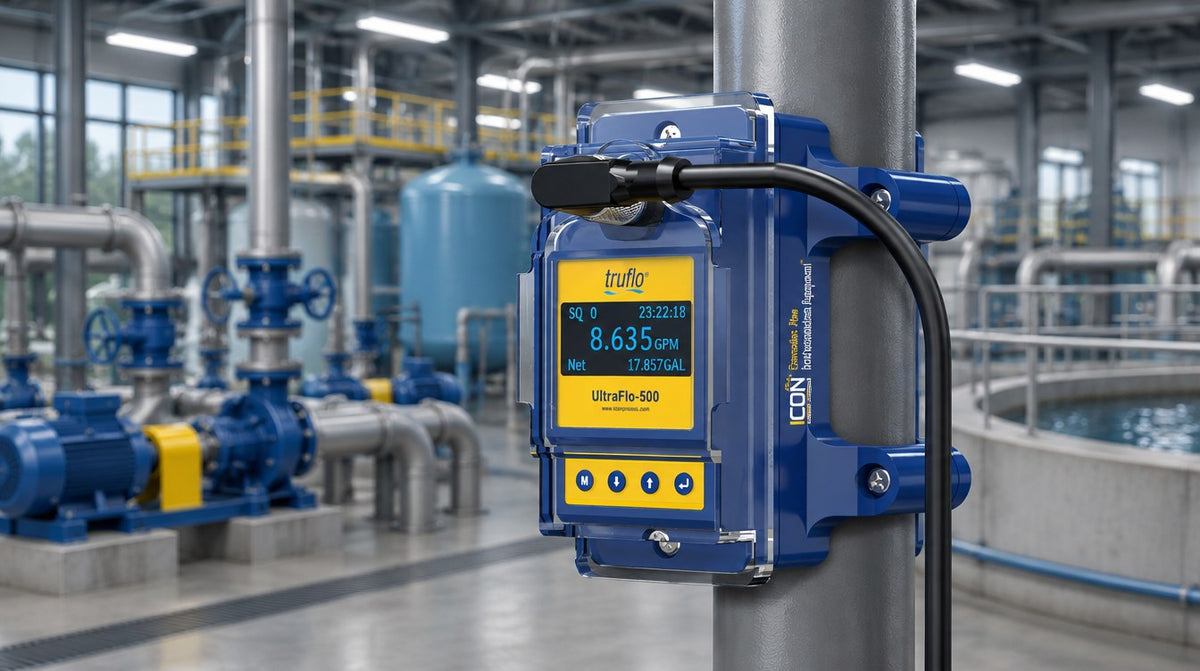
Choose an ultrasonic flow meter by where it touches the liquid. A clamp-on meter such as the Icon UltraFlo 500 reads flow from outside the pipe, so you do not cut the line. An inline meter such as the UltraFlo 1000, 2000, 4000 or 5000 has a flow tube with wetted parts in PFA, HDPE, polysulfone or polyethylene, and suits dosing, metering and pulsating flows. Neither type has moving parts to wear.
What is an ultrasonic flow meter?
An ultrasonic flow meter measures liquid flow with sound waves instead of a rotor or paddle, so nothing moves in the stream. About 590 searches a month in Canada are for "ultrasonic flow meter". The travel-time method used on pipe flows with clamp-on sensors is described by NIST's ultrasonic technology assessment. Confirm the measuring principle of any model on its datasheet. ERE lists six Icon Process Controls UltraFlo ultrasonic meters in the flow meters collection.
Which UltraFlo ultrasonic flow meter fits which job?
Pick the row that matches your pipe size and flow range. All figures below are from the product pages.
| Model | Type | Size | Flow range | Wetted material | Max pressure |
|---|---|---|---|---|---|
| UltraFlo 500 | Clamp-on | 1/4 to 12 in pipe | 0.3 to 15 ft/s | None (outside the pipe) | Not applicable |
| UltraFlo 500S | Clamp-on | 1/4 to 1/2 in tubing | See datasheet | None (outside the tube) | Not applicable |
| UltraFlo 1000 | Inline, remote display | 3/8 to 1 in | 0.005 to 31.7 GPM | PFA Teflon | 100 psi |
| UltraFlo 2000 | Inline | 2 in | 0.8 to 80 GPM | HDPE | 100 psi |
| UltraFlo 4000 | Inline, LCD or blind | 1/2 to 1-1/4 in | 0.08 to 63.4 GPM | Polysulfone (PSU) | 145 psi |
| UltraFlo 5000 | Inline, LCD or blind | 1/2 to 1 in | 0.005 to 6.3 GPM | Polyethylene (PE) | 100 psi |
When should you choose a clamp-on ultrasonic flow meter?
Choose clamp-on when you cannot or do not want to cut the line. The UltraFlo 500 measures from the outside of the pipe and works on PVC, PP, PVDF, PE, stainless steel and copper pipe. It is rated ±2.0% accuracy (0.5 to 5.0 m/s) with ±0.8% repeatability, a 500 ms response time and fluid temperatures of 14 to 122°F (-10 to 50°C). Viscosity must stay under 300 cSt. It runs on 24 VDC at 3 W, with a large OLED display of flow rate and total, a 4-20 mA output and an optional pulse output. The aluminum housing is IP54. The UltraFlo 500S is the small-tubing version for 1/4 to 1/2 in tubing.
When does an inline ultrasonic flow meter make more sense?
Choose inline when you need tighter accuracy, a very low flow, or a wetted material matched to a chemical. The four inline models are rated ±1.0% accuracy and use a full-port flow tube with no moving parts. Each has 4-20 mA output with a pulse relay and RS-485, and an empty pipe alarm on the 2000, 4000 and 5000. They are listed for dosing, metering and pulsating flows, such as chemical feed lines.
- UltraFlo 1000: all PFA Teflon wetted parts, flared tubing connections, remote display, -40 to 248°F (-40 to 120°C).
- UltraFlo 2000: HDPE wetted parts, 0.8 to 80 GPM on 2 in, IP67 / NEMA 4X enclosure, measures conductive and non-conductive liquids.
- UltraFlo 4000: polysulfone wetted parts, 145 psi, LCD or blind display, optional sanitary tri-clamp ends.
- UltraFlo 5000: polyethylene wetted parts, the lowest range of the family at 0.005 to 6.3 GPM, LCD or blind display.
Is an ultrasonic meter better than a paddle wheel or magnetic meter?
It is the better choice when you cannot accept moving parts or a cut pipe. Ultrasonic meters have no rotor to foul or wear, while paddle wheel and magnetic meters suit other applications. Our flow meter guide compares all four technologies. If you are measuring a river or channel instead of a pipe, use the open channel flow meter guide.
How do you choose an ultrasonic flow meter?
- Measure the pipe or tube. Use the outside diameter for clamp-on, the connection size for inline.
- Define the flow range. Include the lowest flow you must still read, not only the average.
- Check the liquid. Review the safety data sheet under WHMIS and match the wetted material (PFA, HDPE, PSU or PE) to the chemical, temperature and pressure.
- Pick the output. 4-20 mA to a PLC, pulse for totalizing, RS-485 for networks.
- Plan the install. Clamp-on needs a straight, full pipe of a supported material; inline means cutting into the line.
Browse the range in the flow meters collection.
Frequently asked questions
What does a clamp-on ultrasonic flow meter measure?
It measures liquid flow from outside the pipe. The UltraFlo 500 covers 1/4 to 12 in pipe in PVC, PP, PVDF, PE, stainless steel or copper at 0.3 to 15 ft/s.
How accurate are the UltraFlo ultrasonic meters?
The UltraFlo 500 is ±2.0% (0.5 to 5.0 m/s) and the inline UltraFlo 1000, 2000, 4000 and 5000 are ±1.0%.
Do ultrasonic flow meters have moving parts?
No. All six UltraFlo models have no moving parts, so there is no rotor or paddle to wear or foul.
Can I get a meter for corrosive chemicals?
Yes. The UltraFlo 1000 has all PFA Teflon wetted parts. Send us the chemical, concentration, temperature and pressure and we will confirm the wetted material.
Need help choosing an ultrasonic flow meter?
ERE Inc. has supplied environmental and process instruments from Montreal for 30+ years. Tell us the pipe size, the liquid and the flow range, and we will match the meter.
→ Request a Quote | 1-888-287-EREC | Browse Flow Meters | sales@ereinc.com
Lire en français : Débitmètres ultrasoniques : à pince ou en ligne, et choix au Canada