

Browse Categories
Air
Browse Air Filtration & Treatment
Need help?


Talk to a technical specialist.


Online
Real specialists · Mon–Fri 8:00–4:30 ET.
Department
Air Filtration & Treatment
Industrial air filtration and treatment from ERE: UltraSorber activated-carbon units and vessels for VOCs, odours and toxic gases, eight air-phase carbons, Sampson HVAC pleated filters including MERV 13, odour-removal filters and odour control products. Request a quote.


30 products

AirGuard 1250
Capacity: up to 12,500 CFM | Treats: VOCs & odors | Application: ambient air treatment
Price on quote · 4 business hours

90-024-55M
UltraSorber-ALCO™ Alcohol Air Treatment Units
Air Treatment System
Price on quote · 4 business hours

90-023-55M
UltraSorber-FORMA™, Formaldehyde Air Treatment Units
Air Treatment System
Price on quote · 4 business hours

90-022-55M
UltraSorber-MERC™ Mercury Air Treatment Units
General Specifications: | Media Weight: 325 lbs | Mesh Size: 4 x 10 | Max. Vapor Flow: 375 cfm
Price on quote · 4 business hours

90-021-55M
UltraSorber-FUME™ Fume Hood Air Treatment Units
Air Treatment System
Price on quote · 4 business hours

90-020-5P
UltraSorber-ODOR™ Sewage Odor Air Treatment Units
Air Treatment System
Price on quote · 4 business hours

90-019-55M
UltraSorber-CS™ Air Treatment Units
Air Treatment System
Price on quote · 4 business hours

90-018-55M
UltraSorber-BC™ Air Treatment Units
General Specifications: | Media Weight: 165 lbs | Mesh Size: 4 x 10 | Max. Vapor Flow: 200 cfm
Price on quote · 4 business hours

90-017-55M
UltraSorber-MIST™ Oil Mist Air Treatment Units
Air Treatment System
Price on quote · 4 business hours

90-016-55M
UltraSorber-CHLORO™ Chlorine Air Treatment Units
General Specifications: | Bulk Density (lbs/cf): 57-59 | Specific Surface, sq. ft/g: 431 | Mesh Size: 14 x 40
Price on quote · 4 business hours

90-015-55M
UltraSorber-AMMO™ Ammonia Air Treatment Units
General Specifications: | 6 x 8 mesh size | Max. Air Flow: 375 CFM | Flow Recommended: 250 CFM
Price on quote · 4 business hours

CARB-1071001-45G170
UltraVent™-OD
Max flow: up to 375 cfm | Motor: 1/2–1 hp, 115V/1/60 | Weight: 275–400 lbs | Recommended flow: 300–350 cfm
Price on quote · 4 business hours

UltraVent™ 450
UltraVent™ Air Filter
Odor removal: 99.5% | Carbon bed: 2.6” (66 mm) | Pre-filter: 20mm, 670 g/m² | Reversible twist-lock, no tools
Price on quote · 4 business hours

UltraSorber-Air™-500
UltraSorber-Air™-500
Max flow: 500 cfm | Carbon weight: 2,000 lbs | Capacity: 500 gal | Pressure drop: 19" wc
Price on quote · 4 business hours

CannaSorb
UltraSorber™ CannaSorb™
Air-phase activated carbon | Application: cannabis odor control
Price on quote · 4 business hours

VOC-Carb
UltraSorber™ Voc-Carb™
Air-phase activated carbon | Target: VOCs
Price on quote · 4 business hours

MER-Carb
UltraSorber™ MER-Carb™
Sulfur-impregnated air-phase activated carbon | Target: mercury vapor
Price on quote · 4 business hours
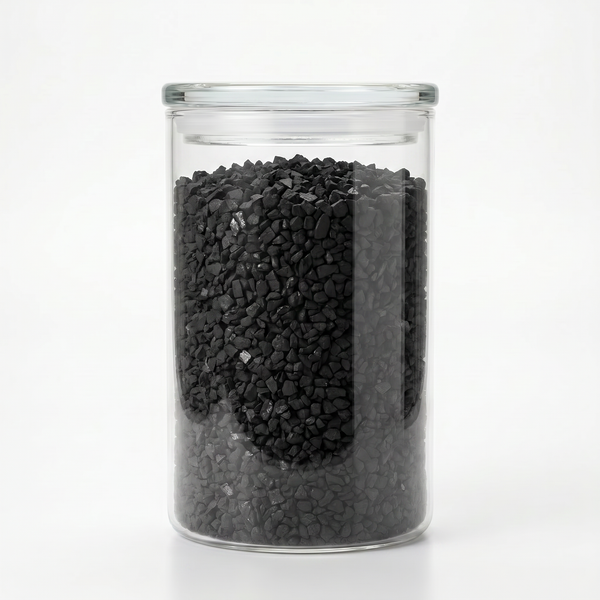

KOH-Carb
UltraSorber™ KOH-Carb™
KOH-impregnated air-phase activated carbon | Target: acid gases / H₂S
Price on quote · 4 business hours

AMMO-Carb
UltraSorber™ AMMO-Carb™
Air-phase activated carbon | Target: ammonia (NH₃)
Price on quote · 4 business hours

CNS-612
UltraSorber-CNS™
Coconut-shell activated carbon (air-phase) | 55 lb box
Price on quote · 4 business hours

BC-410
UltraSorber-BC™
Air-phase activated carbon | Application: air-emission contaminant / TOC removal
Price on quote · 4 business hours

Air problems fall into two groups. Particles are filtered: Sampson HVAC pleated filters, the MERV 13 Green Pleat and the Dafco Titan FP fit standard air handlers. Gases, vapours and odours are treated, mostly by adsorption on activated carbon: ERE builds air treatment systems, from drum-size UltraSorber units to UltraSorber-Air vessels of up to 5,000 cfm and the AirGuard 1250 for 12,500 CFM of ambient air, and supplies eight UltraSorber air-phase carbons, including impregnated grades for mercury, H2S and ammonia. For smells, there are carbon odour-removal filters and odour control products such as Odour Skunk™ and CannaSorber™.
Tell us what is in the air, the airflow and the site, and we will propose a filter, a unit or both.
Air filtration and treatment FAQ
Filter or treat?
Filters stop particles such as dust, pollen and mist; their MERV rating tells you how fine. Gases, vapours and odours pass through a particle filter, so they need treatment: an activated-carbon bed that adsorbs VOCs and odour compounds, or an impregnated carbon for gases carbon alone holds poorly. Many systems do both, with a pre-filter ahead of the carbon.
See our air scrubber guide for the treatment technologies.
Which carbon for my contaminant?
Standard air-phase carbon such as UltraSorber-BC or coconut-shell UltraSorber-CNS handles VOCs and general odours; MER-Carb is sulphur-impregnated for mercury vapour, KOH-Carb targets H2S and acid gases, AMMO-Carb ammonia, and CannaSorb the terpenes of cannabis odour.
Can a carbon HVAC filter solve an odour problem?
For intermittent odours, often: Sampson odour removal pleated filters are carbon-enhanced MERV 5 and 6 filters that fit existing HVAC systems, and a low-cost way to test whether carbon works before buying a larger unit.