
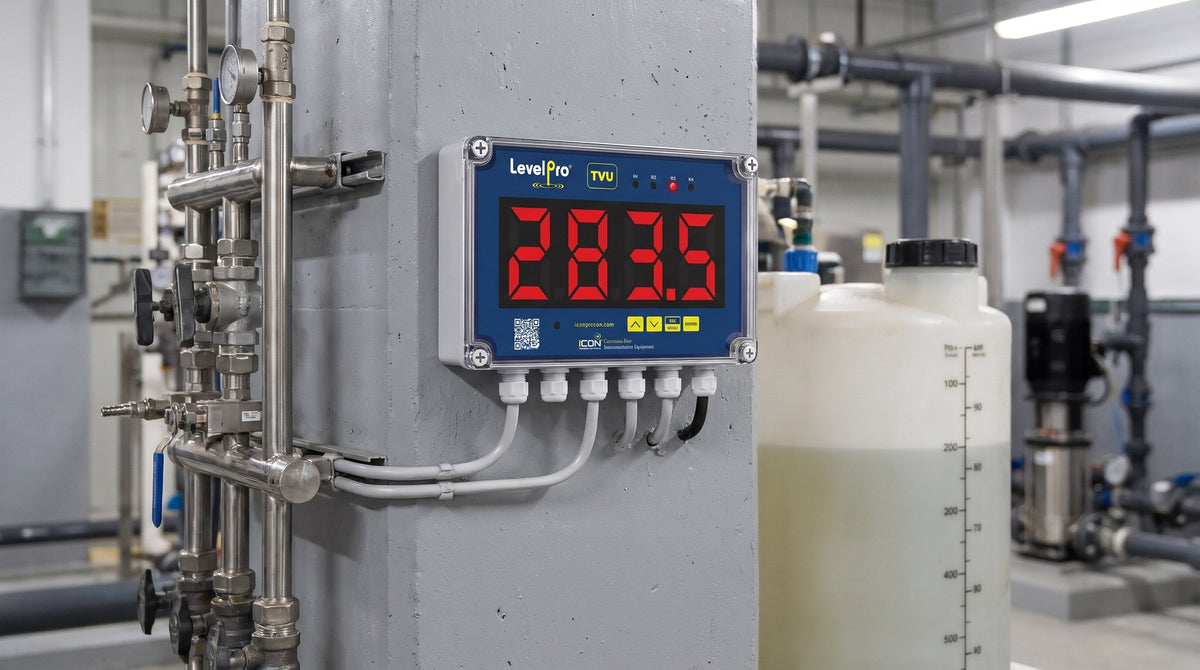
A digital panel meter shows a process value, such as tank level, flow rate or pressure, on a local display. A process controller does the same and adds relays, a 4-20 mA output or a data log, so it can start a pump, close a valve or raise an alarm. The right choice depends on three things: the signal coming in, what must switch or log, and where the box will live. This guide compares the Icon Process Controls displays, controllers, alarms and data loggers ERE carries.
In this guide
- What is the difference between a panel meter and a process controller?
- Which display fits a level loop?
- What is a flow totalizer and batch controller?
- When do you need a universal-input display?
- When is a data logger and controller the better choice?
- Which alarm should you pair with the controller?
- How do you choose a panel meter or controller, step by step?
- Which displays and controllers does ERE carry?
- Frequently Asked Questions
What Is the Difference Between a Panel Meter and a Process Controller?
A panel meter only displays a measurement. A process controller displays it and acts on it through relay outputs, an analog output or a logged record. Many products sit in between, which is why the same Icon family is sold as "display" and as "all-in-one controller".
Both read the signal that a level sensor, flow meter or pressure transmitter already sends. If you are still choosing the sensor, start with our guides to level sensors, flow meters and 4-20 mA pressure transmitters, then come back for the display.
Which Display Fits a Level Loop?
For a 4-20 mA level sensor, the simplest display is loop-powered: it sits in series with the loop and needs no separate supply. Icon offers two compact options and two controllers.
| Model | Power | Output | Notes from the product record |
|---|---|---|---|
| ITC-250L | Universal 4-20 mA loop powered | Display only | 4-digit color-changing LCD, blue to green, for outdoor visibility; NEMA 4X high-impact polycarbonate |
| ITC-250B | LiSOCl2 lithium batteries | Display only | 4-20 mA input; latching or momentary on/off switch; NEMA 4X |
| ShoPro SP100 | 120VAC | 4-20 mA output | LED display and all-in-one controller; 4-20 mA input; 24 VDC sensor supply; NEMA 4X with cord grip |
| TVL | Not stated in the record | Two 5A relays, or 4-20 mA plus one relay | 4- or 6-digit LED; 24 VDC sensor supply; Modbus RTU RS-485; eight LED brightness levels; NEMA 4X |
Use the battery-powered ITC-250B where there is no power and no loop to share, for example a remote tank you only check on visits. Use the TVL when the level reading must also start or stop a pump through its relays.
What Is a Flow Totalizer and Batch Controller?
A flow totalizer adds up the flow rate over time to give a running volume; a batcher uses that volume to open a relay at a set quantity. They are used on chemical dosing, filling and transfer lines where the operator needs a counted volume, not only a rate.
- Icon TVF: flow rate display, totalizer and batcher in a NEMA 4X enclosure; 4-20 mA or pulse input; two relays, or 4-20 mA plus one relay; 24 VDC sensor supply; Modbus RTU RS-485.
- Icon TVF 450: industrial batching controller with a large 6-digit LED display; 4-20 mA or NPN frequency pulse input; two or four relay outputs; wall mount.
Check what your flow meter outputs before you buy. Paddle wheel and turbine meters usually give a pulse; magnetic and ultrasonic meters usually give 4-20 mA or pulse. Both TVF models accept either.
When Do You Need a Universal-Input Display?
Choose a universal-input display when the same unit has to work with current, pulse and voltage signals, or when you want four relays in one case. The Icon TVU accepts current, pulse and voltage, provides four 5A relay outputs and a 24 VDC sensor supply, and adds a 4-20 mA output and Modbus RTU RS-485. It has four LED color options and eight brightness levels, so a reading can change color at a setpoint.
When Is a Data Logger and Controller the Better Choice?
Move up to a data logger and controller when you have several measurements to watch, need a time-stamped record, or must log temperature, pH, pressure and flow in one place. Icon lists the following models as measuring temperature, flow, humidity, pressure, pH, redox, level and current.
| Model | Inputs | Notes from the product record |
|---|---|---|
| ITC-650 | Up to 8 universal | Two electronic relay outputs; 24 VDC sensor supply; RS-485 Modbus RTU; password protected |
| ITC-7200 | Up to 48 universal | Color graphic TFT display; modular inputs and outputs; RS-485 Modbus RTU |
| ITC-8000 | Modular | Color graphic TFT display; power supply, communication and input and output modules chosen per order |
| ITC-4000 | Modular | Color graphic TFT display; data logging; modules chosen per order |
The modular units are configured per order, so send us the input list (signal type and count), the relay and output needs, and the communication protocol. The product records do not give a sampling rate or memory size; we will pull the manufacturer data sheet for you.
Which Alarm Should You Pair With the Controller?
Pair the controller's relay with an alarm that matches how the area is staffed: a light for a noisy plant, a horn for an unattended pad, an explosion-proof unit where the area demands it. The relay on the controller or leak detection module switches the alarm.
- ProAlert 2: high-intensity red light and a 108 dB horn with a silence function (light stays on); 10A relay output to a remote alarm or PLC; NEMA 4X.
- ProAlert 5000: alarm and display in one; 4-20 mA or voltage input; relay and 4-20 mA outputs; single or dual display versions.
- ProAlert LTE: corrosion-resistant red light, pre-wired, optional 80 dB audible alarm; connects to LevelPro float sensors and LeakPro leak sensors.
- ProAlert XPA: explosion-proof audible alarm in an aluminum alloy body, 120 dB; 24 VDC or 115 VAC input.
Horn output is a workplace noise question as well as an alarm question: the CCOHS noise basics page explains why noise is a workplace hazard and how A-weighted decibels are used, and its noise measurement page covers how levels are measured. Confirm the alarm is audible over background noise without adding to a hearing-protection problem.
How Do You Choose a Panel Meter or Controller, Step by Step?
- Identify the input. Note whether the sensor gives 4-20 mA, pulse or voltage.
- Decide display only or control. If a pump, valve or alarm must switch, you need relays.
- Count relays and outputs. Two relays cover high and low; four cover high-high and low-low.
- Check sensor power. Several units supply 24 VDC to the sensor; loop-powered units do not.
- Pick the power source. Loop, battery or 120VAC.
- Confirm communication. Match Modbus RTU RS-485 to your PLC or SCADA.
- Choose the enclosure and area rating. NEMA 4X for washdown and outdoor; explosion-proof where classified.
- Add logging only if you need records. Move to an ITC data logger and controller.
Which Displays and Controllers Does ERE Carry?
ERE carries the Icon Process Controls display, controller, alarm and leak detection range in the Leak Detection & Alarms collection, alongside sensors for the same loops. For the sensors that feed these displays, see the process pH and conductivity sensor guide and the float switch guide. ERE has supplied Canadian industrial and environmental customers since 1994, so send us the signal and the job and we will match the unit.
Need help picking a display or controller?
Tell us the sensor signal, the relays and outputs you need, the power available and the area rating. We will match the model.
→ Request a Quote | 1-888-287-EREC | Browse Displays & Alarms | sales@ereinc.com
Frequently Asked Questions
What is a digital panel meter used for?
It displays a process value, such as level, flow, pressure or temperature, from a sensor's 4-20 mA, pulse or voltage signal, so an operator can read it at the equipment.
What is a process controller?
A device that reads a process signal and acts on it, using relay outputs, a 4-20 mA output or logging, for example to start a pump or sound an alarm at a setpoint.
Do I need a power supply for a loop-powered display?
No separate supply. A loop-powered display such as the Icon ITC-250L takes its power from the 4-20 mA loop it reads.
What is the difference between a totalizer and a batcher?
A totalizer adds up flow to a running volume. A batcher uses that volume to switch a relay when a set quantity has passed.
Can one controller handle several sensors?
Yes, a data logger and controller can. The Icon ITC-650 takes up to 8 universal inputs and the ITC-7200 up to 48.
Related articles
- Ultrasonic Level Sensor Guide: Ultrasonic vs Radar vs Submersible
- Flow Meter Guide: Ultrasonic, Magnetic, Paddle Wheel or Turbine
- 4-20mA Pressure Transmitter Buyer's Guide for Canada
- Float Switch Guide: Choose by Float Type, Wetted Material and Contact
Lire en français : Afficheurs numériques et contrôleurs de procédé : guide de choix pour le Canada