
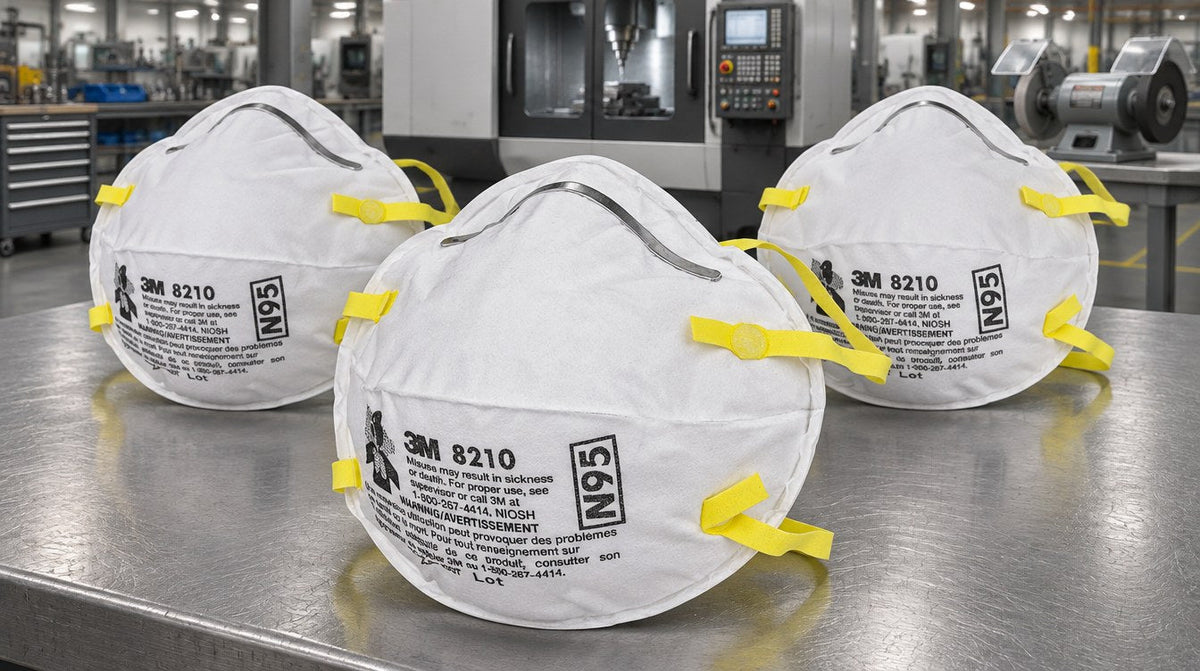
An N95 is a disposable, tight-fitting respirator that filters at least 95% of airborne particles that do not contain oil. The right model depends on the work: grinding and sanding dust, welding fume, infection control or a mixed dust-and-nuisance-odour job each point to a different mask. This guide compares the NIOSH-certified N95 respirators ERE Inc. supplies from 3M and Moldex, and explains when an N95 is the wrong tool.
In this guide
- What does N95 mean, and how is it different from R95, P95 and P100?
- Which N95 fits general industrial work?
- Should you choose a valved or unvalved N95?
- Which N95 works for welding and nuisance odours?
- Is a healthcare N95 different from an industrial one?
- Do you need a fit test for an N95?
- How do you choose an N95, step by step?
- Frequently Asked Questions
What Does N95 Mean, and How Is It Different From R95, P95 and P100?
N95 means the respirator is NIOSH-certified to filter at least 95% of particles and is not resistant to oil. The letter sets oil resistance (N, R or P) and the number sets the minimum efficiency (95, 99 or 100 percent).
| Class | Oil in the air? | Examples in the ERE catalogue |
|---|---|---|
| N95 / N99 | No oil-based aerosols | 3M 8210, Moldex 2200, Moldex 2310 (N99) |
| R95 | Oil-resistant, with a limited wear time set by the manufacturer | 3M 8246, 3M 8247, Moldex 2740 |
| P95 / P100 | Oil-proof | 3M 8271 (P95), 3M 8293 (P100), Moldex 4400 (P100) |
The Moldex 4400 record states a filter efficiency of 99.9% against oil and non-oil based particulates. If the hazard is more toxic than nuisance dust, or the filter has to be replaceable, step up to a reusable half-mask; see our half-mask respirator guide. Review CCOHS guidance on respirator selection before settling on a class.
Which N95 Fits General Industrial Work?
For grinding, sanding, sweeping and similar dust, pick by fit and comfort: the 3M 8210 family for a classic cup, the 3M Aura flat-fold for people who wear eyewear, and the Moldex 2200 to 2700 series for a collapse-resistant shell. All of those below are listed as NIOSH-certified N95.
| Model | Style | What the product record says |
|---|---|---|
| 3M 8210 (box of 20) | Cup, unvalved | Two-strap design with welded dual-point attachment; adjustable nose clip with nose foam; compatible with a variety of protective eyewear and hearing protection |
| 3M 8110S (box of 20) | Cup, small | Designed for small-sized adult facial profiles; not approved for children |
| 3M 9210+ Aura (box of 20) | Flat-fold, three panel | Braided headbands; low-profile design for more room for eyewear; suggested for grinding, sanding, sweeping and barring |
| 3M Aura 9211+ (box of 10) | Flat-fold, individually packaged | Embossed top panel to help reduce eyewear fogging; individual packaging for storage and portability |
| Moldex 2200 (box of 20) | Cup, unvalved | Dura-Mesh shell resists collapsing; molded nose bridge, no metal nose band |
| Moldex 2600 (box of 15) | Low-profile cup | HandyStrap with buckle lets the respirator hang at the neck when not in use; cloth strap; Softspun lining |
| Moldex AirWave | Wave design, unvalved | Easy-breathing wave design; cool inside without a valve; ideal where unvalved respirators are preferred |
For site-wide programs, 3M also lists the Aura 9205+ in a case of 440 and a vending-pack case of 64 (two masks per pack) for dispenser stations. For a comparison of mask types by hazard, see the Disposable Respirators & N95 Masks collection.
Should You Choose a Valved or Unvalved N95?
Choose a valved N95 when the work is hot, humid or long-duration, because the valve lets exhaled air out and reduces heat build-up inside the respirator. Choose unvalved where your program or site rules prefer it.
- 3M valved: the 8511 and 8210V use the Cool Flow exhalation valve; the 8511 record calls it ideally suited to hot, dusty settings with long periods of wear.
- Moldex valved: the 2300 exhale valve and the 2700 Ventex valve both target hot-air build-up.
- Unvalved: the 8210, Aura and Moldex AirWave models above, and the Moldex AirWave is described as less costly than valved respirators.
A valve changes where exhaled air goes, so confirm with your safety advisor whether valved masks are acceptable in clean or infection-controlled areas.
Which N95 Works for Welding and Nuisance Odours?
For welding, choose a model built to fit under a helmet and to resist flame; for odours, choose a carbon-layer model but treat the protection as nuisance level only. The 3M 8212 and 8214 records are flame resistant per ASTM D2859-96 testing and the 8214 adds nuisance-level organic vapour protection.
- 3M 8212 and 3M 8214: fit easily under a welding helmet, cake-resistant filter media for longer life.
- 3M 8515: welding model with Cool Flow valve and M-nose clip.
- Moldex 2400 and 2800: carbon layer for nuisance levels of ozone and organic vapours (less than OSHA PEL); the Moldex 2500 does the same for acid gas irritants.
- Moldex M2600 and M2700: solid black shell that stays cleaner looking.
A carbon layer is not a cartridge. Where gases or vapours exceed nuisance levels, the answer is a half-mask or full-face respirator with the right cartridge, or a powered unit; see our PAPR guide.
Is a Healthcare N95 Different From an Industrial One?
Yes. Healthcare N95s are tested as surgical masks as well, so they add fluid resistance and bacterial filtration claims that general industrial models do not carry.
- 3M Aura 1870+: FDA cleared for use as a surgical mask, greater than 99% BFE per ASTM F2101, highest level of fluid resistance per ASTM F1862 at 160 mm Hg, not made from natural rubber latex. Also sold as a case of 440.
- 3M 1860S: meets Canadian and US CDC guidelines for Mycobacterium tuberculosis exposure control; fluid-resistant and disposable.
- 3M VFlex Healthcare: pleats flex with mouth movement while talking; flat-fold storage.
- Moldex 1500 Series: both an N95 and a surgical mask, latex free, BFE above 99.9%, 160 mm Hg fluid resistance.
Do You Need a Fit Test for an N95?
Yes, wherever an employer requires an N95 for a hazard. A tight-fitting respirator only protects if it seals, and facial hair, a wrong size or a damaged nose clip break the seal. Sizing matters: the 3M 8110S is a small, and several Moldex models come in Medium/Large and Small. See our fit-testing guide, and read CCOHS guidance on wearing respirators for user seal checks and when to discard.
How Do You Choose an N95, Step by Step?
- Identify the contaminant. Dust and non-oil particulates suit an N95; oil mist needs R or P series; gases and vapours need cartridges.
- Check the setting. Healthcare or infection control points to a surgical N95; welding to a flame-resistant model.
- Pick valved or unvalved based on heat, duration and site rules.
- Choose the style. Cup for general use, flat-fold for portability and eyewear, wave or low-profile for comfort.
- Size and fit test. Order the sizes your fit-test results require.
- Set the quantity. Boxes of 10 to 50 for teams, cases or vending packs for programs.
Browse the full range in the Disposable Respirators & N95 Masks collection or the broader Respiratory Protection collection.
Need help choosing an N95 or planning a respirator program?
ERE Inc. has been Canada's environmental equipment specialist for 30+ years. Tell us the hazard, the headcount and the setting and we will recommend the model, sizes and pack quantity.
→ Request a Quote | 1-888-287-EREC | Browse Disposable Respirators | sales@ereinc.com
Frequently Asked Questions
Is the 3M 8210 a NIOSH-certified N95?
Yes. The 3M 8210 is listed as a NIOSH-certified N95 particulate respirator, sold in a box of 20. It is rated for at least 95% filtration efficiency against certain non-oil based particles.
What is the difference between the 3M 8210 and the 3M 9210+ Aura?
The 8210 is a cup-style respirator with a two-strap design. The 9210+ Aura is a flat-fold, low-profile model with braided headbands that leaves more room for eyewear.
Can an N95 be used for welding fumes?
Welding-specific N95s such as the 3M 8212, 8214 and 8515 are built to fit under a welding helmet, and the 8212 and 8214 are flame resistant per ASTM D2859-96 testing. Check the metal and fume hazard with your safety advisor.
Is a KN95 the same as an N95?
No. KN95 is a different standard. The respirators in this guide are NIOSH-certified N95, N99, R95, P95 and P100 models, so they are certified under the NIOSH system.
Do N95 respirators protect against gases or vapours?
No. An N95 filters particles. Some models add a carbon layer for nuisance levels of ozone, organic vapours or acid gas, but that is not a substitute for a cartridge respirator when exposure is above nuisance levels.
Related articles
Lire en français : Respirateurs N95 : guide de choix 3M et Moldex pour les chantiers au Canada