
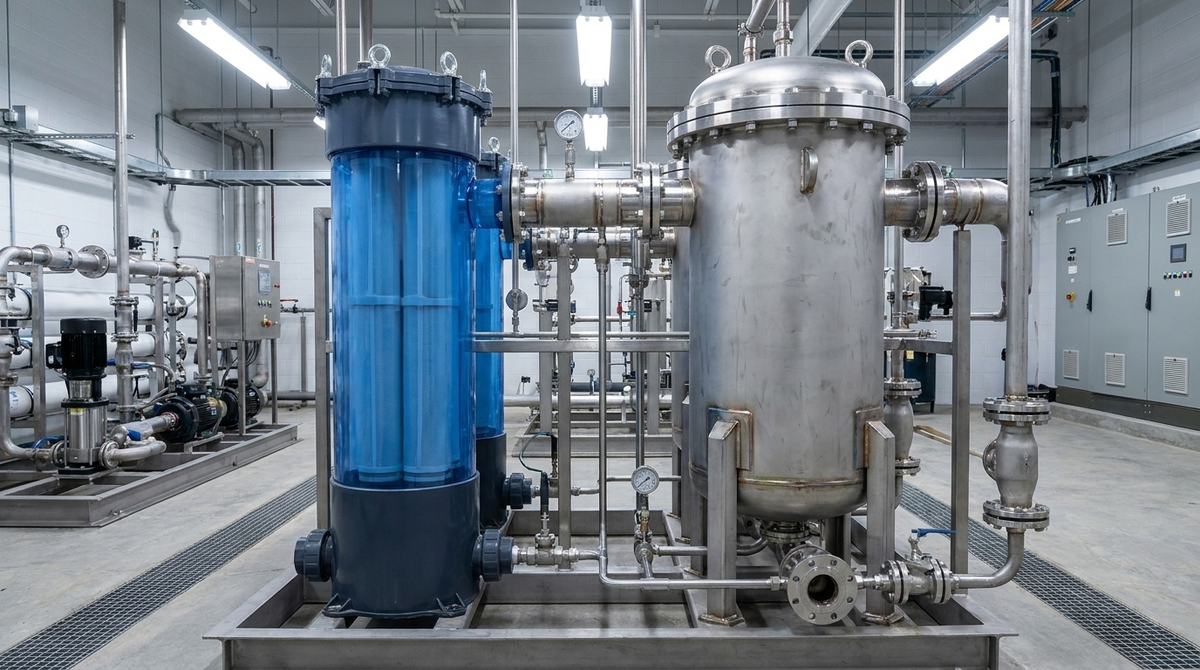
For most industrial process water applications, uPVC filter housings cost 40–60% less than stainless steel equivalents and outlast them in corrosive service — but specify the wrong material and you face cracking from solvent attack, pitting in chloride environments, or heat-related failure within months. The decision between uPVC, 304 stainless, 316L stainless, and polypropylene comes down to three variables: operating temperature, chemical compatibility, and regulatory requirements for your application.
Why housing material selection matters
The filter housing holds the bag or cartridge media under operating pressure, and its material directly determines service life, safety, and total cost in your application. Two failure modes dominate in the field:
- Chemical attack. Many industrial process streams attack specific polymers or metals. Chlorinated solvents dissolve uPVC and polypropylene; high chloride concentrations pit 304 stainless; concentrated oxidizing acids attack most metals. Selecting a housing rated for water service and then running a solvent-bearing stream through it causes cracking, embrittlement, or rapid metal loss — and potential contamination of the filtered product stream.
- Thermal failure. uPVC begins to lose its pressure rating above 55°C and softens significantly above 65°C. Running 80°C wash water or steam through a uPVC housing causes deformation and eventual catastrophic failure under load.
A fluid compatibility check before ordering housings — especially for anything beyond ambient-temperature water service — is standard practice for industrial engineers. ERE’s technical team can review your process conditions and confirm the right housing specification.
uPVC filter housings: properties, limits, and best applications
Unplasticized polyvinyl chloride (uPVC) is the most widely specified filter housing material for general industrial water filtration. It is rigid, non-metallic, electrostatically neutral, and resistant to the broadest range of aqueous process streams at a fraction of the cost of stainless alternatives.
Chemical resistance profile
uPVC resists most dilute inorganic acids (hydrochloric, sulfuric, phosphoric, nitric up to approximately 30% concentration), dilute alkalis (sodium hydroxide, sodium carbonate), chlorine and chloramine up to ~100 ppm Cl₂, most salts, alcohols, and aqueous surfactant solutions.
What uPVC does not tolerate:
- Organic solvents. Ketones (acetone, MEK), esters (ethyl acetate), aromatic hydrocarbons (toluene, xylene, BTEX), and chlorinated solvents (TCE, PCE, DCE, 1,1,1-TCA) attack uPVC, causing swelling, softening, and cracking within hours to days of exposure.
- Concentrated oxidizing acids. Fuming sulfuric acid, concentrated nitric acid above 30%, and concentrated chromic acid are incompatible.
- High-concentration sodium hypochlorite. Bleach above 5–10% NaOCl degrades uPVC at ambient temperature over time. For concentrated bleach service, specify polypropylene.
Temperature and pressure limits
Standard uPVC filter housings carry a continuous service rating of 60°C (140°F) at rated working pressure. The material begins losing mechanical strength between 55°C and 65°C, and pressure ratings must be derated above 50°C per the manufacturer’s derating curve. Maximum working pressure for most bag-size uPVC housings is 100–150 PSI (6.9–10.3 bar), depending on housing diameter and wall thickness.
Where uPVC outperforms stainless
- Capital cost. uPVC housings typically cost 40–60% less than comparable 316L stainless housings at the same flow rating.
- Corrosion immunity. Unlike stainless, uPVC does not corrode, pit, or produce iron oxides — important where metal contamination in the filtered stream is unacceptable.
- Weight. uPVC housings weigh roughly 30–50% of a comparable stainless housing — relevant on overhead skids, mobile treatment units, and trailer-mounted systems.
- Visual inspection. Transparent or translucent uPVC configurations allow visual monitoring of element condition and breakthrough without opening the housing.
Stainless steel filter housings: 304 vs 316L and when stainless is required
Stainless steel housings are specified for high-temperature, high-pressure, sanitary, and solvent-bearing applications where polymers are inadequate. Within stainless steel, the choice between 304 and 316L is critical — the two grades are not interchangeable in all environments.
304 vs 316L: what the alloy difference means in practice
| Property | 304 Stainless | 316L Stainless |
|---|---|---|
| Alloy composition | 18% Cr, 8% Ni | 16% Cr, 10% Ni, 2–3% Mo |
| Chloride pitting resistance | Pits above ~200 ppm Cl⁻ at elevated temperature | Significantly better — molybdenum raises the critical pitting temperature |
| Food/pharma certification | Acceptable (FDA), though 316L preferred | 3-A sanitary standard; the food/pharma default specification |
| Saline/coastal service | Not recommended for prolonged exposure | Standard specification for marine and coastal environments |
| Cost premium vs 304 | — | 15–25% (molybdenum alloy surcharge) |
The most common field error: specifying 304 stainless in a process involving seawater, brine, or chloride-bearing industrial effluent. Pitting initiates within months at elevated temperature. Specify 316L in any chloride-bearing service — especially above ambient temperature.
Applications where stainless is required
- Temperature above 60°C. Steam condensate, hot wash water, high-temperature process streams. Stainless handles continuous service to 175°C (347°F) with correct seal selection.
- Organic solvent filtration. Petroleum distillates, BTEX, MEK, toluene, xylene, and chlorinated solvents (TCE, PCE) are compatible with stainless. uPVC and PP must not be specified for these streams.
- Food, beverage, and pharmaceutical production. Regulatory and QA requirements mandate 316L stainless with sanitary tri-clamp or BPE connections and electropolished interior surfaces. uPVC is typically not accepted even when chemically compatible.
- High-pressure systems above 150 PSI. Heavy-duty stainless housings carry ratings to 300 PSI and beyond. Polymer pressure ratings fall off sharply with temperature.
- Outdoor installations with sustained UV exposure. uPVC and PP without UV stabilizers degrade under prolonged sunlight. Stainless is UV-immune.
Polypropylene (PP): the third option
Polypropylene filter housings fill the space between uPVC and stainless on the chemical resistance scale, at a cost similar to uPVC. PP is the right specification when:
- Concentrated sodium hypochlorite above 10% NaOCl is in the stream — PP handles bleach considerably better than uPVC over extended service.
- The process involves strong inorganic acids at concentrations that attack uPVC long-term (concentrated H₂SO₄, fuming HCl, chromic acid solutions).
- Strong oxidizing agents, metal-plating effluent, or reducing-acid service is involved.
PP limitations: maximum continuous service temperature is approximately 80°C (176°F), pressure ratings are typically lower than uPVC at comparable wall thickness, and PP shares uPVC’s incompatibility with organic solvents.
Material selection guide: which to specify when
| Application | Specify | Reason |
|---|---|---|
| Municipal/potable water dechlorination | uPVC | Chlorine-compatible, low cost, no metal leach risk |
| General industrial process water (<60°C) | uPVC | Cost, corrosion immunity, adequate pressure rating |
| Dilute acids and alkalis | uPVC or PP | Both compatible; PP for higher concentrations |
| Concentrated bleach (>10% NaOCl) | PP | Better NaOCl resistance than uPVC long-term |
| Organic solvents (BTEX, MEK, toluene, petroleum) | 316L SS | uPVC/PP are chemically attacked by these solvents |
| Chlorinated solvents (TCE, PCE, DCE) | 316L SS | Only stainless withstands extended exposure |
| High temperature (>60°C) | 304 or 316L SS | uPVC loses pressure rating above 55°C |
| Food, beverage, pharmaceutical | 316L SS | 3-A/FDA sanitary standard requires stainless |
| Chloride-bearing service, saline, coastal | 316L SS or PP | 304 SS pits in chloride service; use 316L or non-metallic |
| High pressure (>150 PSI) | SS | Polymer housings derate significantly at elevated temperature |
The Sampson filter housing lineup from ERE
ERE distributes Sampson bag filter housings and Sampson cartridge filter housings in both uPVC and stainless steel configurations — covering the full range of industrial and municipal filtration applications across Canada.
For process water, municipal pre-treatment, chemical processing, and dechlorination applications where uPVC construction is appropriate, the Sampson™ uPVC Cartridge Filter Housings are available in 40, 90, and 180 GPM configurations. The uPVC construction provides chemical resistance against most aqueous industrial streams at significantly lower capital cost than stainless alternatives.
For higher-pressure, higher-temperature, or solvent-bearing applications, Sampson™ stainless bag filter housings are available in single, multi-bag, and duplex configurations handling flows from 150 to 1,000+ GPM. ERE can specify the right housing material, flow rating, connection type, and seal compound for your exact process chemistry.
Specify the right filter housing for your process.
ERE Inc. has been Canada’s industrial and environmental filtration specialist for 30+ years. Send us your process conditions — fluid, temperature, flow rate, pressure, and regulatory requirements — and we’ll specify the right housing material, size, connection, and seal for your application.
→ Request a Quote | 1-888-287-EREC | Browse Bag Filter Housings | sales@ereinc.com
Frequently Asked Questions
Can I use a uPVC filter housing for chlorine-treated water?
Yes. uPVC is compatible with dilute chlorine solutions up to approximately 100 ppm Cl₂ at ambient temperature — covering virtually all municipal water dechlorination and pre-treatment applications. uPVC is not suitable for high-concentration sodium hypochlorite above 5–10% NaOCl or for hot chlorinated streams above 50°C. For concentrated bleach service, specify polypropylene.
What is the difference between 304 and 316 stainless steel filter housings?
316L stainless steel adds 2–3% molybdenum to the alloy, dramatically improving resistance to chloride-induced pitting corrosion. In chloride-bearing streams, brine, seawater, and coastal environments, 304 will pit over time while 316L holds up. Food, beverage, and pharmaceutical industries specify 316L as standard because it meets 3-A sanitary requirements and resists cleaning-in-place (CIP) chemicals better than 304.
What is the operating temperature limit for uPVC filter housings?
The continuous service limit is 60°C (140°F) at rated working pressure. Above this threshold, uPVC loses pressure rating significantly — at 65°C, rated pressure may be 60% of the ambient-temperature value. For processes above 60°C, specify stainless steel. For borderline applications at 50–60°C, verify the manufacturer’s derating curve before installing uPVC.
Does housing material affect filtration efficiency?
No — the housing material does not change the micron rating, particle capture efficiency, or flow characteristics of the filter element. Housing material affects service life and process safety. If a housing degrades from chemical attack, particulate contamination or cracking can introduce foreign material into the filtered product stream.
Is polypropylene better than uPVC for chemical resistance?
For most industrial chemicals, the two perform comparably, with PP having an advantage for concentrated acids and high-concentration oxidizing agents such as bleach (NaOCl). uPVC is stiffer, carries a slightly higher practical pressure rating, and holds up better at the upper end of both materials’ temperature range. Both are incompatible with organic solvents. For strong acids or concentrated sodium hypochlorite service, PP is the safer specification.
Related articles
- Bag Filter Housings: Complete Sizing and Selection Guide
- Bag vs Cartridge Filtration: Which to Use
- Filter Bag Micron Ratings: How to Choose the Right Filtration Level
- Industrial Filter Bags: Complete Selection Guide for Canada
Lire en français : Boîtiers de filtration uPVC vs acier inoxydable : guide de compatibilité chimique et de sélection