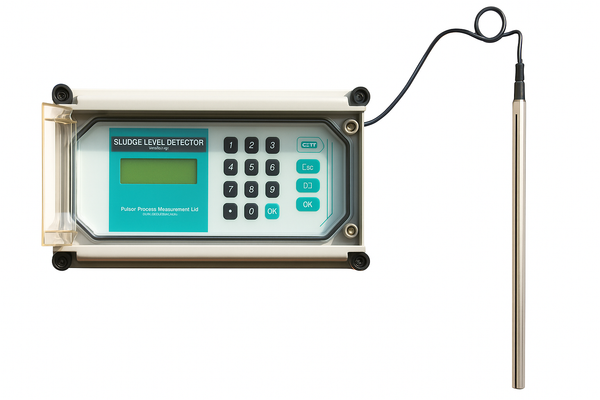
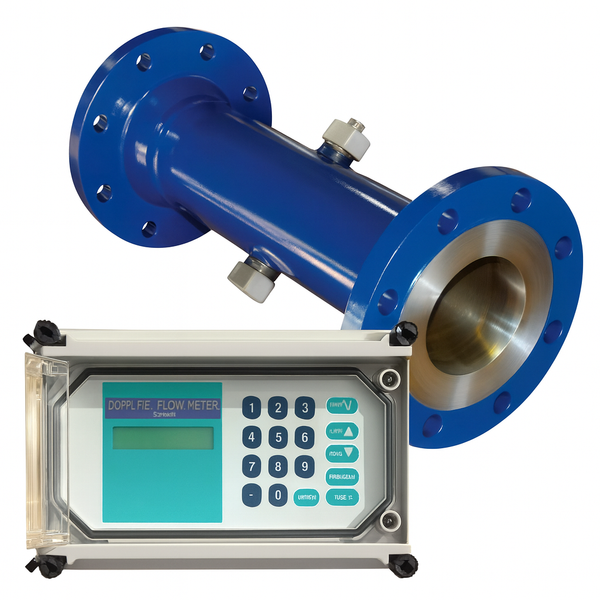
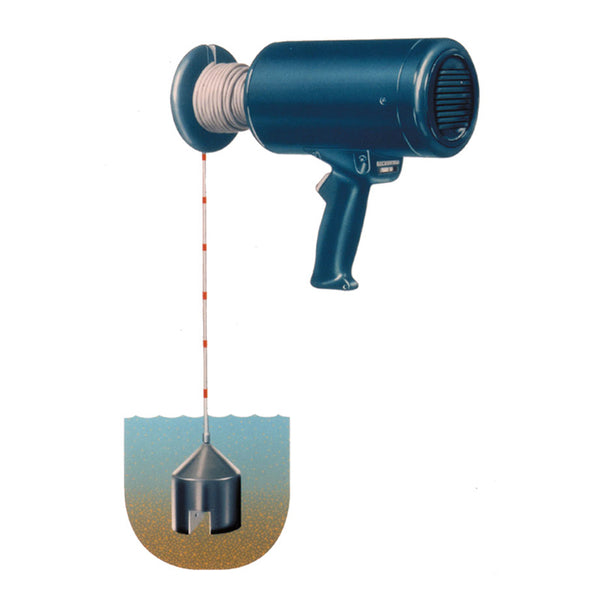
Operators track the sludge blanket so settled solids do not carry over into the effluent. Markland covers spot checks and continuous monitoring. The portable Sludge Gun lowers an infrared optical probe on a 10 m marked cable and signals the sludge interface by sound; it runs about a year on six AA batteries. The Automatic Sludge Blanket Level Detector follows the liquid-solids interface as it rises and falls, to ±2 cm, with a 4–20 mA output, and is CSA approved. The Suspended Solids Density Meter measures 0.1 to 15% suspended solids ultrasonically, without a nuclear source, in clarifiers, open tanks and pipelines, in a NEMA 4X / IP67 enclosure.
Sludge monitoring FAQ
Sludge Gun or Sludge Judge?
The Sludge Judge brings up a physical core in a clear graduated tube for a full depth profile; the Sludge Gun gives an instant reading at one point with nothing to retrieve. Many plants use both: the Judge for periodic profiles, the Gun for quick daily checks. See our comparison guide and sludge samplers.
When does continuous monitoring make sense?
When the blanket level drives sludge withdrawal or must be logged: the automatic detector and the density meter both send a 4–20 mA signal to the plant's controls. Manual checks suit smaller plants and spot surveys.
What does the density meter measure?
Suspended solids from 0.1 to 15% (1,000 to 150,000 mg/L), by ultrasound, so fluid colour and particulates do not affect the reading.