

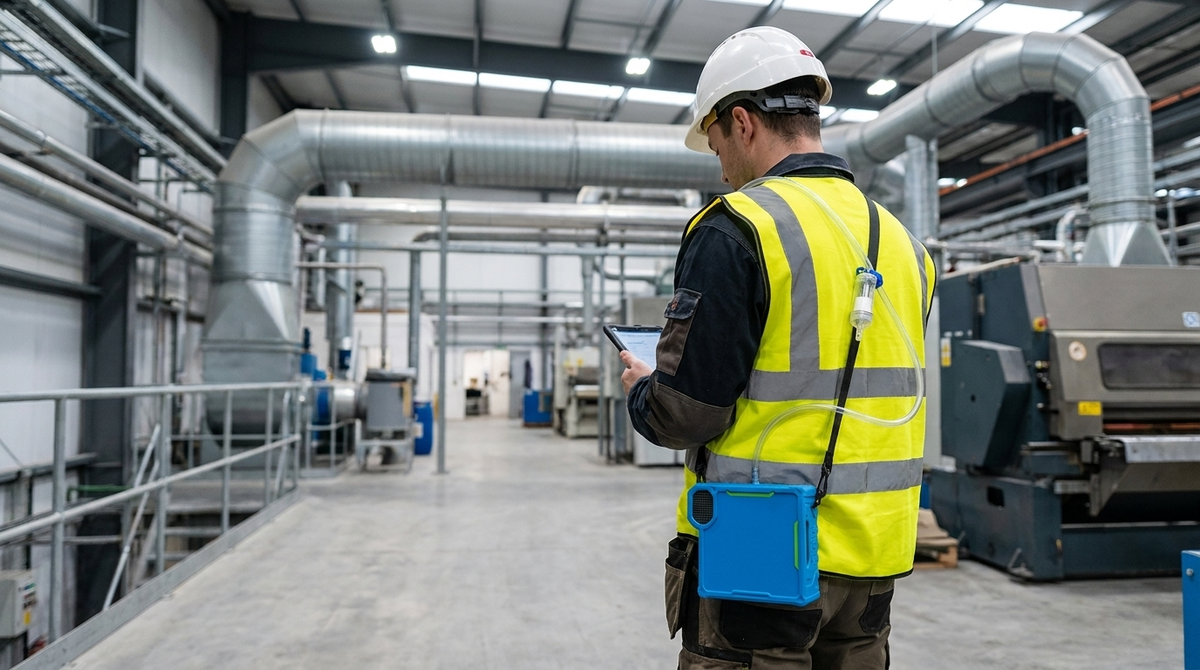
Selecting the right air sampling pump is a precision decision: the wrong flow rate or a pump that drifts during an 8-hour shift can render an exposure assessment non-defensible. This guide covers pump types, key specifications, leading brands available in Canada — Gilian, Sensidyne, Zefon, and Buck — and how to match a pump to your sampling method and regulatory requirements.
How Air Sampling Pumps Work
An air sampling pump draws ambient air through a collection medium — a sorbent tube, filter cassette, or impinger — at a precisely controlled volumetric flow rate. The volume of air collected, multiplied by the analyte concentration extracted from the medium, gives the airborne concentration. Because exposure limits (OELs) are expressed as time-weighted averages (TWAs), flow accuracy over the full sampling period is the critical variable.
Flow Control Mechanisms
Modern pumps use electronic flow controllers with feedback loops that maintain set flow within specification even as sampling media loads with analyte and resistance increases. Key features to evaluate:
- Constant-flow controller: maintains flow rate regardless of back-pressure — required for NIOSH methods
- Flow accuracy: ±5% is the NIOSH benchmark; ±2% is achievable on premium units
- Display: real-time flow readout vs. set-point confirmation only
- Data logging: some pumps log flow vs. time, supporting chain-of-custody documentation
Pumps intended for use in explosive atmospheres require intrinsic safety (IS) certification (CSA Class I, Division 1 or Zone 0/1 rating). Non-IS pumps are appropriate for most industrial hygiene and environmental assessment applications where ignition hazards are not present.
Personal Monitoring vs. High-Volume Area Sampling
The distinction between pump types follows the sampling strategy and target analyte:
Personal Monitoring Pumps (Low-Flow)
Worn by the worker in the breathing zone, personal pumps characterize actual inhalation exposure over a full shift. Flow range is typically 20–5,000 mL/min. These pumps are lightweight (200–500 g), battery-powered for 8–12 hours on a single charge, and designed for clip or belt attachment. They are the standard for occupational hygiene programs governed by ACGIH TLVs, NIOSH RELs, and provincial OELs across Canada.
High-Volume Area Sampling Pumps
Positioned at a fixed location on a stand or tripod, high-volume pumps collect bulk air samples at 1–20 L/min. Common applications include asbestos air clearance sampling (PCM method, NIOSH 7400), indoor air quality baseline characterization, and environmental Phase II ESA area monitoring where personal exposure data alone is insufficient.
Bioaerosol Sampling Pumps
Specialized pumps with multi-hole impactors (Andersen cascade, RCS centrifugal) or cyclone samplers target viable and non-viable biological aerosols — mold spores, bacteria, endotoxins. The Buck Bio-Culture™ and Bio-Slide™ pumps are purpose-designed for this application, used in mold investigation, biohazard assessment, and pharmaceutical cleanroom air monitoring.
Key Specifications to Compare
When evaluating air sampling pumps for purchase or rental, compare these parameters against your sampling method requirements:
| Specification | Typical Range (Personal Pump) | Why It Matters |
|---|---|---|
| Flow Range | 20–5,000 mL/min | Must span your NIOSH method's required flow rate |
| Flow Accuracy | ±2–5% | NIOSH minimum is ±5%; ±2% preferred for regulatory defensibility |
| Battery Life | 8–30+ hours | Full-shift sampling without mid-shift battery swap |
| Weight (without sampling train) | 200–500 g | Worn 8+ hours — worker comfort directly affects program compliance |
| Intrinsic Safety | IS or non-IS model | Required in Zone 0/1/2 or Class I Div 1/2 classified areas |
| Data Logging | Optional / standard | Time-stamped flow records support QA/QC and chain of custody |
| Connector Type | Luer-lock / slip-fit / bayonet | Must match your sorbent tube or cassette inlet adapter |
Brand Comparison: Gilian, Sensidyne, Zefon, and Buck
ERE Inc. stocks and rents air sampling pumps from the leading brands used in Canadian industrial hygiene, environmental consulting, and occupational health programs. Below is a practical comparison for field selection.
Gilian — GilAir-3 and GilAir-Plus
Gilian is the dominant personal air sampling pump in North American occupational hygiene. The GilAir-3 covers 5–3,000 mL/min with a straightforward mechanical interface and exceptional battery life (30+ hours between charges). The GilAir-Plus adds a programmable timer, extended flow range (5–3,500 mL/min), and a lighter form factor — preferred where workers run consecutive extended shifts. Both models are available in intrinsically safe configurations. Gilian pumps are validated across NIOSH Methods 1500 (hydrocarbons), 1501 (aromatics), 3500 (metals on PVC filter), and the OSHA asbestos PCM method.
Sensidyne — Apex and Pocket Pump Touch
Sensidyne's Apex pump covers the widest flow range in its class (5–5,000 mL/min) with a sealed motor that resists moisture ingression — an advantage in humid Canadian summer field conditions. The Pocket Pump Touch is a compact touchscreen unit optimized for the 50–500 mL/min range, popular for detector tube applications (Draeger, Gastec) where precise low-flow control is critical. Sensidyne also manufactures the colorimetric detector tube systems that pair directly with their pumps, making them a natural choice for labs running both pump sampling and direct-reading tube methods.
Zefon — AirChek 2000 and AirChek TOUCH
Zefon is best known for its comprehensive sorbent tube line (XAD, activated carbon, specialty media) and the AirChek TOUCH pump designed to pair with them. The AirChek TOUCH covers 50–3,500 mL/min with USB data transfer for flow log export — a strong choice for labs managing multi-analyte campaigns where documentation requirements are high. The AirChek 2000 is a fixed-range economy option (1,000–2,000 mL/min) suited to standardized cassette sampling protocols. Zefon sorbent tubes and sampling accessories are available in the ERE Air Sampling collection.
Buck — Bio-Culture™ and Bio-Slide™
Buck Air Sampling (distributed by Sensidyne) specializes in bioaerosol and microbiological air sampling. The Bio-Culture™ uses a six-stage Andersen-compatible impactor at 28.3 L/min to size-fractionate viable bioaerosols by particle diameter. The Bio-Slide™ samples directly onto glass slides for microscopic count analysis. These are specialty instruments for mold investigation, biohazard assessment, and pharmaceutical cleanroom air monitoring — not general-purpose personal exposure pumps.
Sampling Media Compatibility
The pump is one part of the sampling train. Match your pump's flow range and outlet connector type to the collection medium your analyte requires:
- Sorbent tubes (Zefon, SKC, Anasorb): activated charcoal, XAD-2, Tenax, OVS — used for VOCs, solvents, aldehydes, pesticides at 50–200 mL/min typical
- Filter cassettes (37 mm, MCE, PVC, PTFE): total and respirable dust, metals, mist, fibres — typically 1,700–2,000 mL/min for gravimetric dust methods
- Impingers (SKC, Ace Glass): formaldehyde (NIOSH 3500), acid gases, reactive analytes — typically 1,000 mL/min
- SKC IOM inhalable dust sampler: inhalable fraction dust per EN 481 at 2,000 mL/min
- Andersen and SKC Biosampler impactors: viable bioaerosol counts at 28.3 L/min — requires a high-volume pump
For our full range of sampling pumps, sorbent tubes, filter cassettes, and sampling train accessories, browse the Air Sampling collection.
Canadian Regulatory Context for Air Sampling
Air sampling programs in Canada must align with both federal guidance (CCOHS) and provincial occupational health legislation. Exposure limit frameworks vary by province:
"Most Canadian provinces adopt ACGIH Threshold Limit Values (TLVs) as the basis for their OELs, though specific values and enforcement mechanisms vary. Confirm the applicable OEL with your provincial authority before designing a sampling program." — CCOHS
- Ontario (OHSA): OELs in Regulation 833 (Control of Exposure to Biological or Chemical Agents); NIOSH sampling methods adopted by reference
- British Columbia (WorkSafeBC): OELs in Occupational Health Regulation, updated annually against ACGIH TLVs
- Alberta (OHS Act): Chemical Hazards Regulation; NIOSH methods referenced for sampling methodology
- Quebec (LSST / RSST): VEMP (valeurs d'exposition moyennes pondérées) listed in Regulation S-2.1, r. 13
Pump Calibration Requirements
NIOSH specifies that sampling pump flow rate must be measured and recorded before and after each sampling period with the complete sampling train (pump + tubing + media) attached. Allowable flow drift is ±5% of the set rate. Calibration uses a primary standard — a NIST-traceable bubble meter or electronic piston calibrator. See our instrument calibration requirements guide for calibration documentation practices used in Canadian field programs.
Rental vs. Purchase: Decision Framework
For most Canadian environmental and industrial hygiene firms, the break-even point for ownership vs. rental is approximately 15–20 pump-days per year. Below that threshold, rental delivers better economics and eliminates calibration overhead.
Purchase makes sense when:
- You conduct 15+ sampling days per pump per year
- You have in-house flow calibration capability (bubble meter, NIST-traceable piston calibrator)
- You need IS-certified units for permanent hazardous area monitoring programs
Rent from ERE when:
- Running a single Phase II ESA or short-duration occupational hygiene survey
- You don't have in-house calibration — ERE provides calibrated, pre-tested equipment ready to deploy
- You need supplemental pumps for a large multi-worker campaign without capital commitment
- You want to evaluate a specific model before purchasing
ERE's instrument rental program includes air sampling pumps, multi-gas detectors, water quality meters, and particle counters — all calibrated to manufacturer specification and tested before each rental deployment. Multi-day and project-rate pricing available on request.
Need help selecting an air sampling pump for your project?
ERE Inc. has supported Canadian environmental consultants and industrial hygiene professionals for 30+ years. Whether you need to rent a calibrated pump for a one-week site assessment or specify pumps for a permanent occupational exposure monitoring program, our technical team will match the right instrument to your sampling method and regulatory requirements.
→ Request a Quote | 1-888-287-EREC | Browse Air Sampling | sales@ereinc.com
Frequently Asked Questions
What flow rate do I need for personal air sampling?
Flow rate depends on the NIOSH or provincial method for your target analyte. Most sorbent tube methods (activated charcoal, XAD, Tenax) specify 50–200 mL/min. Gravimetric dust methods using PVC or MCE filter cassettes typically run at 1,700–2,000 mL/min. Impinger methods for reactive gases are typically 1,000 mL/min. Always check the specific method (e.g., NIOSH 1500, NIOSH 0500) for the validated flow rate before configuring your pump.
How often do I need to calibrate my air sampling pump?
NIOSH requires flow measurement before and after every sampling period using the complete sampling train attached. Allowable drift is ±5%. Additionally, verify your calibrator's accuracy against a NIST-traceable primary standard at least annually. Pumps should receive manufacturer service checks every 12–18 months or per the manufacturer's published schedule.
Do I need an intrinsically safe pump for my application?
IS certification is required in locations classified as hazardous (explosive) atmospheres — petroleum storage areas, confined spaces where flammable vapours may accumulate, or any CSA Class I, Division 1 or Zone 0/1 classified area. For most industrial hygiene surveys in manufacturing facilities without flammable vapour processes and outdoor environmental monitoring sites, a non-IS pump is appropriate and significantly lighter. If uncertain, consult the site's area classification drawing or your safety officer.
Related articles
- Environmental Sampling Equipment Guide for Canada
- Portable Gas Detectors Buyer's Guide for Canada
- Gas Detector Calibration Requirements in Canada
Lire en français : Pompes d'échantillonnage d'air : Guide d'achat pour le Canada | ERE