
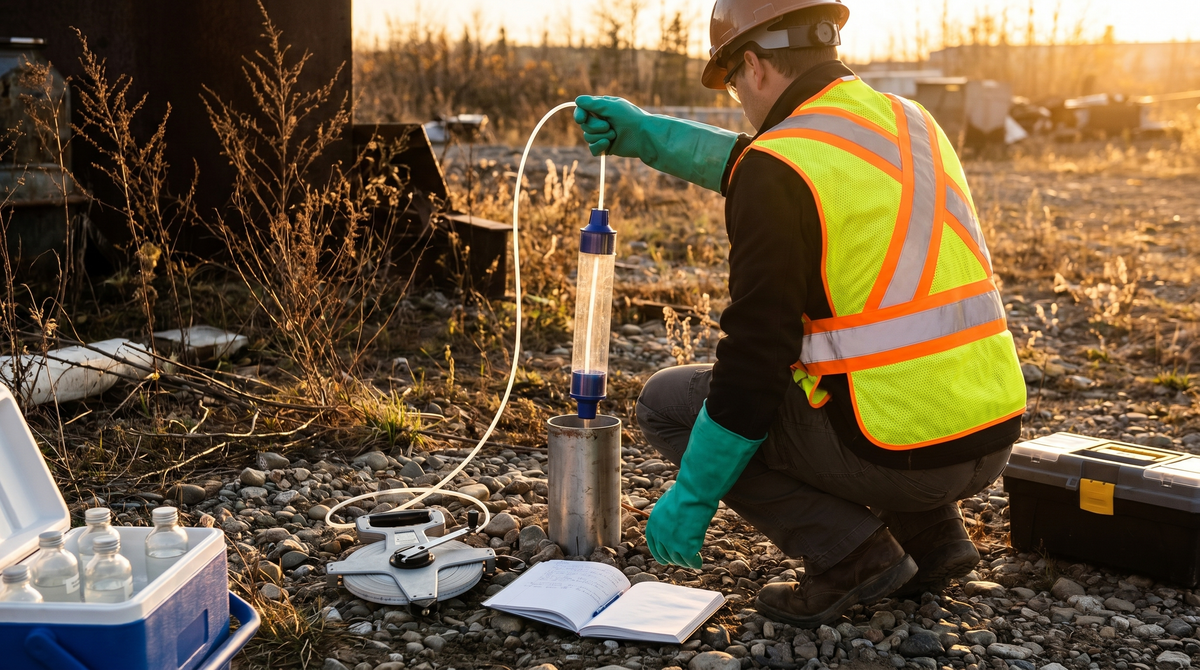
Groundwater bailers are the simplest and most reliable sampling devices used in environmental site assessments across Canada. Choosing the wrong bailer material for your target contaminants can bias your results or trigger a non-detect where contamination exists — this guide covers the key selection criteria for Phase II ESA consultants and remediation professionals.
What Is a Groundwater Bailer?
A groundwater bailer is a cylindrical sampling tube — open at one end, fitted with a check valve at the other — lowered into a monitoring well on a lowering line to collect a discrete water sample. As the bailer descends, the check valve opens and water flows in. When you raise the bailer, the valve closes, retaining the sample column. Bailers are passive, non-purge devices: you collect whatever water column is present in the well at sampling time, without removing multiple well volumes first.
They are the tool of choice for low-flow situations, discrete-depth sampling, and field teams that need a simple, protocol-compliant method without a pump. In Phase II ESA work, disposable bailers are standard for groundwater quality sampling where cross-contamination between wells must be prevented.
Top-Valve vs Double-Valve Bailers
Most disposable bailers use a bottom check valve — water enters from below and is retained by a ball valve as you retrieve the sampler. Double-valve bailers have both top and bottom valves, allowing point-source sampling at a specific depth rather than a composite of the standing water column. For stratified sites with contamination at a known depth (for example, a DNAPL zone near the bottom of the screened interval), double-valve samplers give you a discrete depth sample uncontaminated by overlying water.
Types of Groundwater Bailers: Disposable vs Reusable
Disposable Bailers
Single-use bailers are the standard for Phase II ESA groundwater sampling in Canada. They eliminate the risk of cross-contamination between monitoring wells — no decontamination procedure, no equipment blanks to run, no QA/QC exposure from shared equipment. Per well: one bailer, one lowering line, discard after use. Most provincial SOPs and ASTM D6089 recognize disposable bailers as a valid method for monitoring well sampling programs.
Disposable bailers are available in clear PVC, polyethylene (PE), and PTFE/FEP for trace-level organic sampling. Clear PVC is the most common and least expensive. The transparent material lets you inspect water quality — turbidity, sheen, colour — before transfer to sample containers.
Reusable Bailers
Reusable bailers — typically stainless steel or heavy-wall PVC — are used when long-term sampling of a single dedicated well justifies the cost of thorough decontamination between rounds. For a municipal compliance monitoring network where each well has its own dedicated equipment, reusable stainless bailers reduce consumable costs over the life of the program. They require full decontamination between sampling events: Alconox® or equivalent detergent scrub, triple DI-water rinse, air-dry, and a field blank before use on a new well.
Bailer Materials: Which to Use for Your Analytes
Material compatibility is the critical selection criterion. The wrong material causes analyte adsorption (false low results) or leaching into the sample (false positives). Use this comparison to match material to your analyte list:
| Material | Compatible Analytes | Avoid For | Notes |
|---|---|---|---|
| Clear PVC | Metals, major ions, nitrate, alkalinity, most inorganics, general chemistry | Chlorinated solvents (PCE/TCE/DCE), BTEX, trace VOCs, PFAS | Most common, lowest cost. PVC can leach plasticizers — avoid for organic solvent sites. |
| Polyethylene (PE) | General inorganics, pH, conductivity | Trace organics, VOCs | Slightly more inert than PVC. Suitable for some metals programs. |
| Stainless Steel 304/316 | Chlorinated solvents, BTEX, petroleum hydrocarbons, metals | Corrosive matrices; not suitable for PFAS | Reusable. Standard for PHC and chlorinated sites. Use 316L for aggressive chemistry. |
| PTFE / FEP | Trace VOCs, PFAS, dioxins/furans, pesticides, ultra-trace metals | Nothing — PTFE is inert to virtually all environmental contaminants | Highest cost. Required for PFAS programs under Ontario MOE and federal guidance. |
| Carbon Composite (CarboBailer™) | BTEX, LNAPL, petroleum hydrocarbon plumes (PHC F1–F2) | Metals programs, PFAS | ERE Inc. proprietary design. Disposable. Trace VOC compatible without PTFE cost. |
"For chlorinated compound sites (PCE/TCE), use stainless steel or PTFE. For PFAS investigations, use PTFE or FEP exclusively — avoid all non-fluoropolymer materials in the sampling train." — CCME Guidance on Groundwater Sampling Protocols
How to Choose the Right Bailer
Match Material to Your Target Analytes
Your analyte list drives material selection. If your project work plan includes VOCs — BTEX, chlorinated solvents, PHC F1 fractions — clear PVC is not appropriate. Use stainless steel or PTFE/FEP. For PFAS or ultra-trace pesticides, PTFE or FEP is mandatory throughout the entire sampling train, including the bailer, lowering line, and sample containers.
Well Diameter and Bailer Sizing
Match the bailer outer diameter (OD) to your well casing ID with enough clearance for smooth descent and retrieval:
- 2-inch nominal wells (actual ID ≈ 2.07–2.14"): Use 1.5" OD bailers — the standard for monitoring wells installed in 2" PVC or stainless steel casing.
- 4-inch nominal wells (actual ID ≈ 4.02–4.14"): Use 1.875"–2" OD bailers for higher sample volume per dip.
- Large-diameter or pumping wells: Wide-body 2.5"–4" OD bailers are available for wells requiring higher volume collection.
Standard bailer length is 24 inches, yielding approximately 0.5–0.7 L per dip (depending on OD). Extended bailers (36–60") are available for deeper standing water columns or higher-volume sample requirements.
Valve Configuration
For standard water-quality monitoring: bottom check valve, single-valve bailers. For depth-discrete sampling of DNAPL or stratified contamination: double-valve bailers or a coliwasa sampler for composite column sampling. Confirm your SOP — some provincial protocols specify valve type and method for specific contaminant programs.
Proper Bailer Use in the Field
The right bailer produces valid results only with correct technique:
- Use a dedicated lowering line per well. Nylon monofilament or polyethylene line (not braided rope) for disposable programs; stainless wire for deep wells. Discard the line with the bailer.
- Lower slowly. Rapid descent suspends fine sediment, biasing turbidity and metals results. Lower at 0.2–0.5 m/s.
- Check for floating phase first. Use an interface probe or OVM to check for NAPL before bailer deployment. Document LNAPL thickness in field records before sampling.
- Retrieve steadily. Smooth, even withdrawal minimizes turbulence and sediment re-suspension.
- Inspect sample before transfer. Clear PVC lets you evaluate turbidity and odour visually. Discard and re-sample if turbidity exceeds your QAPP threshold.
- Fill VOC containers first, from the bottom valve. Zero-headspace technique per EPA Method 5035 and Ontario MOE guidance applies to VOC samples.
For our full range of bailer samplers and groundwater sampling accessories, visit our groundwater bailers collection. For water sampling pumps, bladder pumps, and low-flow peristaltic systems, see our water and liquid sampling collection.
Canadian Regulatory Requirements for Groundwater Bailer Sampling
Groundwater sampling protocols in Canada are provincially mandated but reference CCME guidelines and US EPA methods. Key regulatory touchpoints:
- CCME Canada-Wide Standards for Petroleum Hydrocarbons (CWS PHC): Specifies sample containers, preservation, and holding times. Material compatibility for bailers follows CCME and provincial guidance for the specific contaminant class.
- Ontario MECP Groundwater Monitoring Guidance (O. Reg. 153/04 and supporting SOPs): References ASTM D4448 and D6089 for bailer sampling. Disposable single-use equipment required where cross-contamination risk exists.
- BC ENV CSAP Practitioners' Guidance: Documented decontamination SOPs required for reusable equipment. Disposables preferred for multi-well programs.
- Quebec MELCCFP (Caractérisation des terrains contaminés): Requires QA/QC documentation including blank samples. Disposable bailers simplify compliance.
- PFAS Programs: Health Canada and provincial PFAS guidance (Ontario MOE Protocol, CCME 2022) require PTFE or FEP throughout the sampling train. PVC and stainless steel bailers are not acceptable for PFAS sampling.
Always verify requirements with your provincial regulatory authority and reference your project-specific QAPP for final material and procedural requirements.
ERE's Groundwater Bailer Selection
ERE Inc. has supplied environmental sampling equipment to consultants, engineering firms, and remediation contractors across Canada for 30+ years. Our bailer lineup includes:
- Disposable Clear PVC Bailers — Standard single-use bailers for routine groundwater quality monitoring. Available in 1.5" OD × 24" and 2" OD × 24".
- Reusable PVC Bailers — Heavy-wall construction for dedicated monitoring well installations where reusable equipment is protocol-appropriate.
- Reusable Stainless Steel Bailers — 304 SS construction for chlorinated solvent and PHC sites where reusable equipment is used.
- ERE CarboBailer™ — ERE's proprietary disposable carbon-composite bailer for BTEX and petroleum hydrocarbon sampling. Trace-VOC compatible alternative to standard clear PVC.
Need groundwater bailers or sampling equipment?
ERE Inc. has been Canada's environmental equipment specialist for 30+ years. Talk to our technical team about matching bailer type, material, and accessories to your Phase II ESA protocol or remediation sampling program.
→ Request a Quote | 1-888-287-EREC | Browse Bailers | sales@ereinc.com
Frequently Asked Questions
What is the difference between a bailer and a peristaltic pump for groundwater sampling?
Bailers are passive, non-purge samplers — you collect the standing water column in the well without removing multiple well volumes first. Peristaltic and bladder pumps are used for low-flow purge-and-sample methods, where you stabilize field parameters (pH, DO, conductivity, turbidity) to a defined threshold before collecting the sample. Low-flow pumping is more representative for dissolved-phase contaminants in confined aquifers. Bailers are faster, require no power or generator, and are preferred for monitoring wells with limited recharge or where low-volume sampling is specified by protocol.
Can I use PVC bailers for a VOC or chlorinated solvent site?
No. Clear PVC can adsorb some non-polar organics and leach trace plasticizers, introducing positive bias to organic results. For VOCs — BTEX, chlorinated solvents, PHC F1 — use stainless steel or PTFE/FEP bailers. For PFAS sampling, PTFE or FEP is mandatory throughout the sampling train under Ontario MECP and federal guidance. Standard PVC and stainless steel are both prohibited for PFAS programs.
How do I prevent cross-contamination between monitoring wells when using bailers?
Use a dedicated disposable bailer and lowering line for each monitoring well and discard after use. For reusable equipment, follow your project QAPP decontamination SOP: Alconox or equivalent detergent wash, triple DI-water rinse, air-dry, and run a field blank before use on each new well. Document all decontamination in your field logbook. Run an equipment decontamination blank every 10 samples or at the start of each sampling event.
What size bailer do I need for a standard 2-inch monitoring well?
For 2-inch nominal PVC or stainless steel casing (actual inside diameter approximately 2.07–2.14 inches), use 1.5-inch OD bailers. This provides 5–7 mm of clearance per side — enough for smooth descent and retrieval without binding. For 4-inch nominal casing, use 2-inch OD bailers. Oversized bailers will jam in the casing and may be unrecoverable.
What is a CarboBailer and when should I use it?
The ERE CarboBailer™ is a disposable groundwater bailer made with a carbon-composite material. It is designed for petroleum hydrocarbon (PHC) and BTEX sampling where trace VOC compatibility is required but PTFE is not mandated by the project QAPP. The carbon composite is significantly more inert than clear PVC for non-polar organics, making it suitable for light-end petroleum sites (PHC F1, BTEX) without the cost of PTFE. It is not suitable for PFAS programs or ultra-trace pesticide and PCB investigations.
Related articles
- Environmental Sampling Equipment Guide for Canada
- Soil Sampling Equipment: Augers & Core Samplers for Canada
- Gas Detector Rental Canada: What to Know
Lire en français : Bailers pour eaux souterraines : types, matériaux et guide de sélection